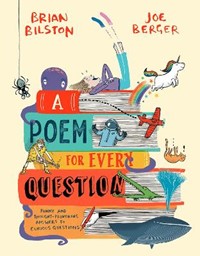
Brian Bilston brings us A Poem for Every Question

About Author
Poems to make you wonder, understand the world a little better, and laugh.... Brian Bilston introduces his new collection, A Poem for Every Question, illustrated by Joe Berger.
Brian Bilston writes poems full of humour, energy and heart. His poetry for children collections include 50 Ways to Score a Goal and Refugees.
Joe Berger is a Bristol-based illustrator, animator and cartoonist. Joe has illustrated over 40 children's books including Frank Cottrell Boyce's Chitty Chitty Bang Bang books, and is a past official illustrator for World Book Day.
Interview
October 2025
Brian Bilston brings us A Poem for Every Question (Farshore)
What is a primary colour? Could women be gladiators? and are bats the only flying mammal? are some of the intriguing, funny and awe-inspiring questions posed by poet Brian Bilston in his new collection, A Poem for Every Question. Illustrated by Joe Berger and with an accompanying non-fiction explanation, each of these 100 poems answer a vast array of questions covering a range of subjects from history to science, music to space, for curious children and intrigued adults.
ReadingZone spoke with poet Brian Bilston to find out what inspired his collection and the kinds of questions he asks. He also suggests how children can write their own 'poem with a question' in his Creative Challenge, below.
Review: "A Poem for Every Question is a thought-provoking collection of poems which answer a myriad of intriguing questions, accompanied by bright, energetic illustrations."
Q&A with Brian Bilston: A Poem for Every Question
"I think poems can create little pockets of amazement or happiness, empathy or reflection,
creativity or inspiration for children."
1. How did you become a poet? What does a day in the life of a poet look like?
I didn't really have any intention of becoming a "poet", I just liked to mess around with words in my spare time. I love how strange and inconsistent the English language is and so I would have fun by mixing up words and phrases, or creating little puns and other forms of wordplay. Somehow, these poems - or whatever they were that I was creating - became popular, and a few years later I found myself being labelled as a poet.
These days, it's a full-time job and I try to carve out time each day to sit at my desk and work on a poem. It's easy to get distracted, though - not least because being a writer requires you to do other things, too. I may have to go off to bookshops or theatres to read my poems, or tell people about what I'm up to on social media.
Regardless, I'll always try to find some time in my day to go for a walk and do some heavy thinking - either about the poem I'm working on, or the next poem I'd like to work on, or (as happens frequently) what biscuits I might buy today.
2. Can you tell us about your new collection, A Poem for Every Question. What can readers expect and what kinds of questions do you include?
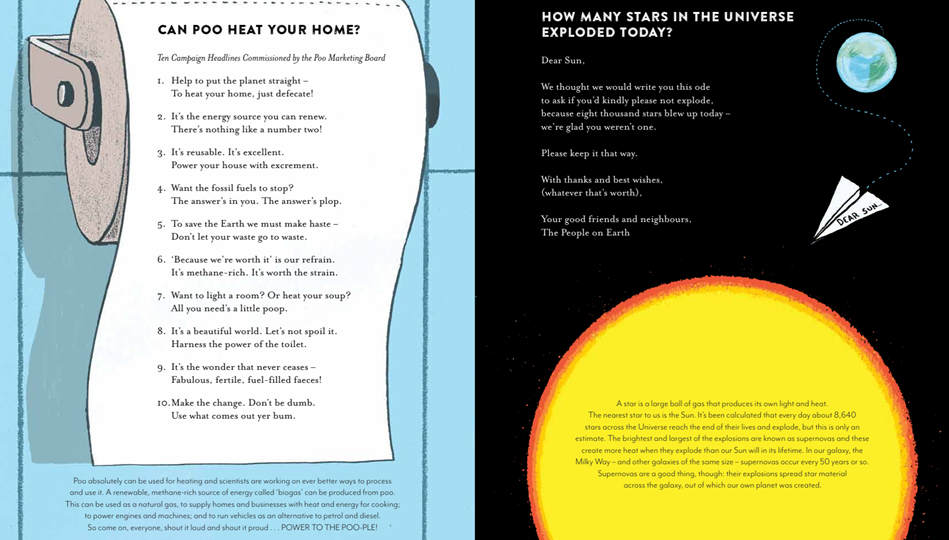
The book title is a little bit of an exaggeration - there is not a poem for every question - that would be a very big book indeed - but there is a poem for 100 interesting questions which children might ask. As well as a poem, for each question there is additional information giving more depth and context to the answer, and some brilliant - and often very funny - illustrations by Joe Berger.
Questions cover everything from space and physics to pirates and football. Some examples are: How many times a day do we laugh?; Is there a monster in Loch Ness?; How far way is Mars?; and Why do animals migrate?
3. You probably hear a lot of questions from children, but what inspired you to answer some of their questions using poetry?
It's often said that poetry is not about finding answers but asking questions, so in some ways this book is unusual! Poetry, though, can be a brilliant tool for learning. A good poem often involves using the best words in the right order to articulate whatever it is you want to say. Poems can also help us remember things, particularly when they rhyme: for example, a mnemonic such as 'Thirty days has September …'. They can also be vehicles for wordplay and humour, which can be another helpful way to make an answer memorable.
Finally, the questions themselves range so widely across subject areas, it gives me great scope as a poet to answer them in all sorts of ways. A poem can take many different forms, from shape poems to list poems, from 'voice' poems to 'imagination' poems, from 'silly' poems to more serious poems. I loved that variety.
4. What makes a 'perfect question' for a poem - and how did you find all the questions in your collection?
I think the 'perfect' question for a poem is one which I can answer without getting too bogged down in the details of the subject area; too many facts get in the way of the poetry. But the poem still needs to answer the subject in some way, even if it approaches it from an oblique angle. Sometimes this would involve a lot of creative thinking. For example, 'Are bats the only flying mammal?' was a question I kicked around for a while before settling on a poem which told the story of my dog building an aeroplane in an attempt to become the second mammal to fly.
My publisher really helped me with suggesting questions to write about - many of which I didn't know the answer to! - and giving me some fact sheets to help with the topic. If it wasn't for that, I'd still be thinking up the questions now.
5. Are your poems funny, serious or factual?
A real mixture, sometimes in the same poem. For instance, 'Are unicorns real?', which is one of my favourite poems in the collection, takes the form of a meeting of unicorns in a cave, debating about how to make people believe in them.
A suggestion is made that they have a 'Back to School' campaign to get unicorns featured on pencil cases, notebooks and schoolbags. When one of the unicorns suggests that they simply come out of their cave to make themselves known, he is reminded by the others of the fate of the dodo and the quagga and other now extinct animals. The tone of the poem is intended to be light and comic, but then ends with this reflection on what we as humans do to other creatures and so takes a different turn.
6. Can you take one of the poems and talk us through its creation?
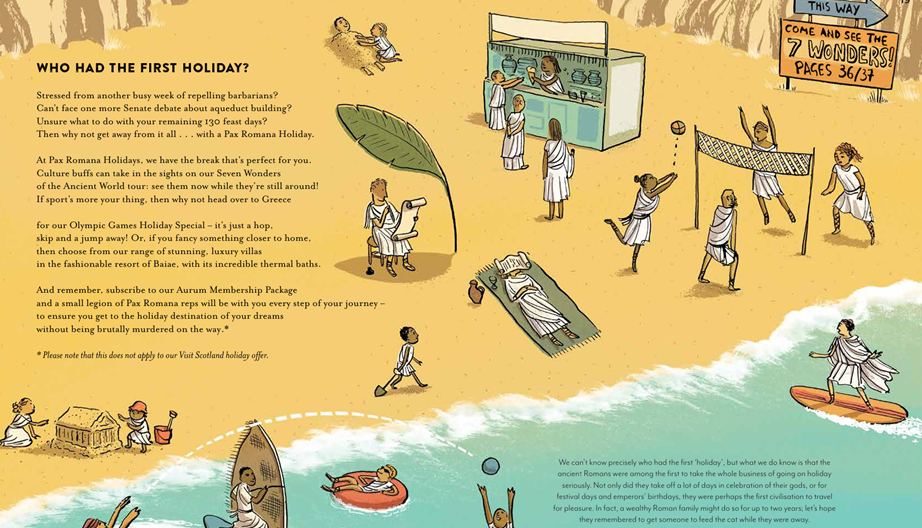
The poem 'Who had the first holiday?' was a question for which I didn't originally know the answer. I discovered that the Romans (or the wealthy ones, at any rate) were the first civilisation to have holidays as we might know them today.
My way into the poem was to write it in the form of a holiday brochure, giving it the voice of a travel agency called 'Pax Romana Holidays'. I started with some ad 'copy' to get punters interested 'Stressed from another busy week of repelling barbarians?' etc. Then I'd talk about the different kinds of holidays on offer - from 'our Seven Wonders of the Ancient World tour' to the luxury villas and thermal baths found in the 'fashionable resort of Baiae'. It was fun to write.
7. Why do you also provide a non-fiction answer to the question alongside the poem, and the glossary?
As mentioned, one challenge was not to bog down the poem with too much information. That would get in the way of the poem itself and definitely be a lot less fun.
Some questions are hard to answer precisely in poetry form. For example, the answer to 'What is a primary colour?' is really rather complex - and I'm not sure I entirely understand all the nuances to it even now! The explainer copy allowed me to put that detail to one side and apply my (appropriately metaphorical) paintbrush to some of the answer's basic theory without boring readers too much.
The glossary also helps readers, I think. Some of the answers do come with language or 'jargon' less familiar to younger readers - and sometimes older ones, too - so the glossary is there to help with that and, for some readers, points to future directions for enquiry.
8. A Poem for Every Question is a lovely collection for individual readers to dip into, but can you also suggest how the poems could be used to support teaching across the curriculum?
I'm not a teacher myself, but I'd like to think that the poems lend themselves to being a fun and interesting introduction to learning about certain topics. Science, for instance, was always a weak spot for me at school. I struggled to get my head around some scientific concepts (and often still do!) and would often feel lost before we even started learning about them.
In this collection, I've written poems about why thunder rumbles, why some things float, what rainbows are made of. I don't claim the poems themselves to be definitive answers to the questions but as a gentler, amusing way in to some complex topics.
9. What do you feel the illustrations by Joe Berger bring to the collection? Do you have any favourite spreads?
It's the first time I've had any of my books illustrated and I'm so pleased that Joe was the one to do it. Somehow, his illustrations don't just complement the poems but have become integral to them. His sense of humour is closely aligned to my own.
I laughed out loud when I saw his illustration to the classic question 'How long can you survive in a desert if you drank your own pee?' He'd drawn a supermarket in the middle of the desert. It was called 'PIDL'. I wish I had thought of that.
10. National Poetry Day takes place on the first Thursday of October each year. Do you enjoy celebrating poetry then, and what are your plans for this year? Do you also feel there is a bigger space for poetry in the classroom?
Poetry is not just for National Poetry Day, you know. It's a significant date in the calendar, of course - and it's helpful to have a date on which the profile of poetry is raised - but I don't think too much about it personally. I'll be speaking at my publisher's Book Club on this year's celebration. My very first book was published on National Poetry Day about ten years ago; I spent that day waiting in for the dishwasher repair man.
As for poetry in the classroom, I would always like to see more time devoted to it. I'm rather biased, of course. I think poems can create little pockets of amazement or happiness, empathy or reflection, creativity or inspiration for children (and for grown-ups, too, of course). There persists a kind of fear around poetry, though - and maybe a lack of confidence, too. I think we tend to pick that up later on, not when we're at primary school ourselves.
There is so much brilliant children's poetry out there, it's often an issue of where to find it. Organisations like CLPE do a lot to raise awareness and the initiatives they launch around the annual CLiPPA prize for children's poetry are fantastic. I'd encourage teachers to look at those - and for schools to participate when they can - and to find time (somehow!?) to read poetry themselves. There are lots of great anthologies for children - some poems may not do anything for you, but guaranteed there is always something to love. I think the more poetry you read, the less you fear it. That's been my experience anyway.

Creative Challenge: Write your own poem for a question! Here's how to get started:
There are a few poems in the book which look at animal record breakers. For example, 'Which is the biggest animal?' (answer: the blue whale), and 'Who is the champion weightlifter of the animal world?' (answer: the rhinoceros beetle). Research your own animal record breakers, and then pick a favourite. You could choose the slowest animal in the world, for instance, or the one which can jump the highest: and use their superpower as your poem question.
To get started on your poem, think about putting them in an unusual situation or one in which their superpowers or special qualities will stand out. What would happen next? Would they run into problems? How would their superpower help them win the day? When I wrote my poem about the blue whale, I wondered what it might be like for one to attend a football match, which would be a silly and impractical thing for it to do. For my rhinoceros beetle, I entered him into a weightlifting contest.
Think about the form of your poem. It might rhyme, but it doesn't have to. It could be presented in an interesting shape which fits in with your creature and/or their special powers. Or you could keep it simple: my blue whale poem is simply a list of reasons why you don't see them at football matches. My rhinoceros beetle poem is written in the style of a sports commentary. Above all else, have fun!

 A Poem for every Question: Funny and Thought-Provoking Answers to Curious Questions
 Refugees
 50 Ways to Score a Goal and Other Football Poems