Meet Daishu Ma's Tiger and Mei characters


About Author
We catch up with author and illustrator Daishu Ma to find out how her Tiger and Mei picture books can be used to explore friendship, courage and empathy.
Daishu Ma was born and raised in China before moving abroad to study. As a child she spent her pocket money on 'pulp comics' and published her first short story, a sci-fi adventure, at 13 years old.
Daishu enjoys experimenting with different styles depending on the project, choosing vibrant oil pastels and coloured pencils for her picture books. She now lives in East London and finds endless inspiration in nature and travelling.
Interview
November 2026
Exploring children's first experiences and friendships with Daishu Ma's Tiger and Mei picture books
ReadingZone spoke with author and illustrator Daishu Ma to find out how her Tiger and Mei picture books, published by Postwave, can help children to discover the world around them and to understand friendships and being a good friend.
The Tiger and Mei picture books include Tiger, It's Snowing, exploring the first time that Tiger sees snow, and Tiger, Don't Worry, which helps reassure children when things go wrong and they need to find a way to say sorry.
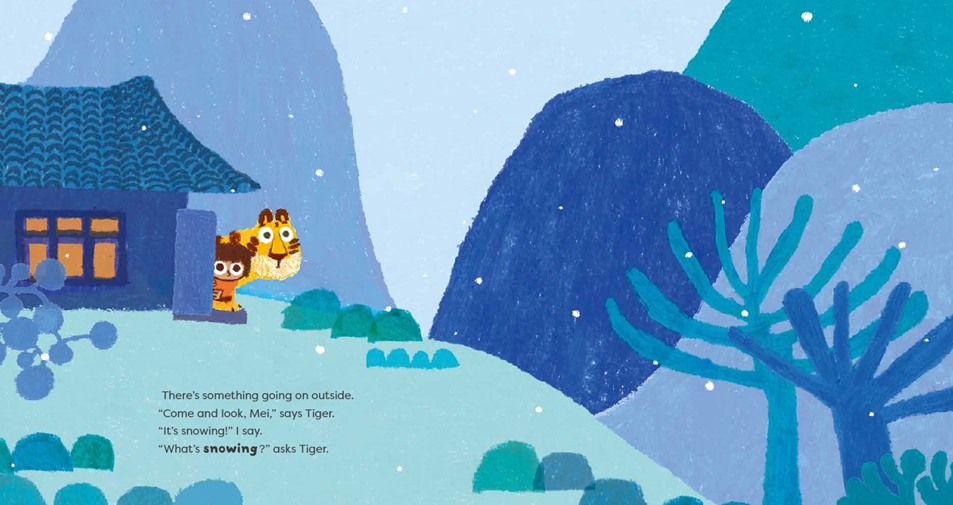
Review: "Tiger, It's Snowing bursts with the childhood joys of exploration and discovery, capturing that sense of wonder."
Q&A with Daishu Ma, introducing Tiger and Mei
"For children, everything is new, and the world is full of surprises. I wanted to create stories
that capture the curiosity and sense of wonder."
1. Hello Daishu, and thank you for joining us on ReadingZone. Can you start by telling us a little about how you became a picture book creator - where did you train, what are your influences?
Hello! I loved drawing and reading as a child. I would spend hours doodling on the margins of my notebooks, making up characters and imagining stories. When I was 13 I published my first story in a magazine. But I didn't study art in university.
After graduating business school and working in an office job for a year I decided to go back to pursuing my childhood passion and become an illustrator. I started working in editorial illustration, making book covers and illustrations for novels and non-fiction books. My very first book was a wordless graphic novel called Leaf. My early influences included folk stories, comics and graphic novels.
2. Can you tell us about your Tiger and Mei picture books, Tiger, It's Snowing and Tiger, Don't Worry?
Both stories follow the adventures of two good friends, Mei and Tiger. Tiger, It's Snowing! is a about Mei and Tiger's first adventure in the snow. They taste the snow, make footprints in the snow, run up the snowy hill and look at the village, and roll all the way down ... they even have the snowiest snowball fight! It's about slowing down, experiencing the world through our senses, and noticing what's around us.
Tiger, Don't Worry! is also about exploring something new - Mei and Tiger are helping to pick tea for the first time, but then something goes wrong and they need to make a few decisions. It's about the feelings we go through when we make a mistake, and the journey it takes to face up to it.
3. What inspired you to start exploring new experiences like these for young children, and how do you approach seeing the world through their eyes?
As adults, we sometimes forget how extraordinary everyday moments can feel. For children, everything is new, and the world is full of surprises. I wanted to create stories that capture the curiosity and sense of wonder.
When I work on a book, I spend a long time studying the characters, I pretend to be them and act out different situations, their facial expressions and body languages, I make lots and lots of sketches of them. I love that moment when the characters start to feel real—when the characters have their own voice, and their world starts to grow around them.
4. The best friends in the books, Tiger and Mei, are very different characters. Can you tell us more about them?
Yes, these two are very different. Tiger is bold and curious and maybe a bit clumsy; Mei is more cautious, thoughtful and also brave. They live in a village surrounded by tea groves and green hills, with a stream running through and a big railway bridge in the distance. Their home is based on a real place I visited in southern China. Together, Tiger and Mei have lots of fun exploring their world, and even the most mundane situation can turn into something unexpectedly fun and interesting.
5. In Tiger, Don't Worry, Tiger and Mei are scared of getting into trouble for something they have done. What do you hope little ones will take from their adventure?
I hope they come away feeling a little freer to try things without worrying about getting them wrong or getting in trouble. It's OK to make mistakes! And our friends are there to keep us steady, even when things feel a bit wobbly. And no matter what happens, at the end of the day, there's always a warm hug and a lovely cup of tea waiting for us at home.
7. What do Tiger and Mei learn from each other in these stories? What kinds of discussions do you think the friends can encourage through their adventures?
I think we all have a bit of Tiger and a bit of Mei inside us, and we often have all these conflicting ideas, with one voice telling us to go one way, and the other voice pulling us another way. But instead of avoiding these clashes, if we face them and really listen to these different voices, we'll find they can help us understand ourselves better—and lead us somewhere surprising, just like Tiger and Mei do. I hope these stories can encourage conversations about friendship, courage, empathy and how to navigate different emotions together.
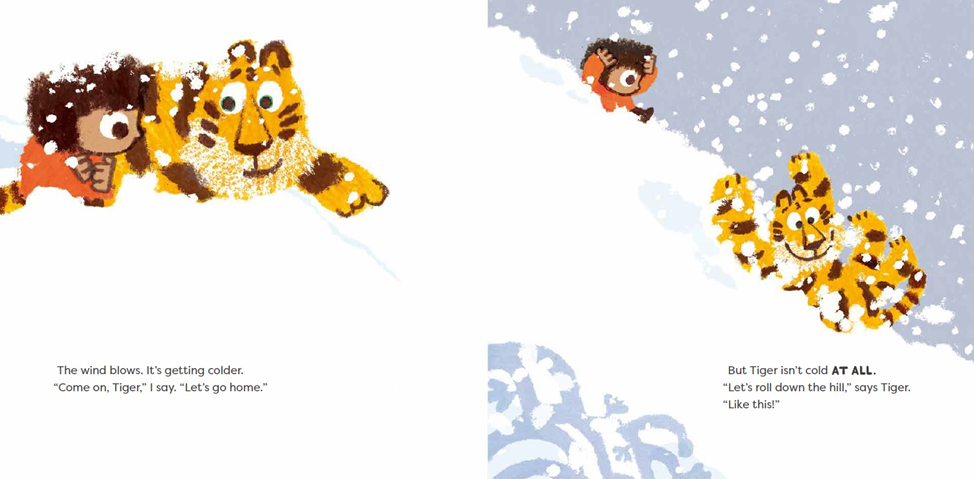
6. In Tiger, It's Snowing, we see them discover snow for the first time and you focus on their sensations through this. Why did you decide to take this approach?
I grew up in a big city, and nature has always been a source of inspiration for me. As a child, I'd seek out green spaces and spend hours watching insects in the grass. It brought a sense of calm and wonder that's stayed with me. I think children naturally connect with that kind of quiet observation. Those small moments: a cricket singing, steam rising from a teacup … can feel magical when you slow down to notice them. I think books and stories can do the same thing, helping us slow down and discover the magic within the pages.
8. So much of the story is told through the characters' visual expressions. How did you decide on the look of each of your characters, and the style to use for these stories?
I spent a long time developing the two characters. I liked imagining them in different situations: what would they say to each other? How would they react? What would their body language be? I sketch them in all kinds of moods - happy, nervous, bored, excited - and they begin to come alive on the page.
I often start with rough pencil sketches and colour tests in my sketchbook, then I draw everything layer by layer using oil pastels. Oil pastels are very chunky and soft, the colours so vibrant. They are also quite messy to use - which suit Tiger and Mei very well! For the artwork, I was especially inspired by the Russian animator Yuri Norstein and his film Seasons, with its stunning moving images of snowy scenes made using real lace.
9. Do you want to encourage young children to embrace new experiences and friendships through your stories?
Absolutely! One of the joys of friendship is that your friend doesn't have to be just like you. Tiger and Mei are very different, but they care a lot about each other and learn from one another. I hope readers see how differences can bring friends closer, and that adventures become richer when they're shared.
I also hope children feel recognised in both characters, whether they feel wild, cautious, or somewhere in between. Tiger and Mei are such a lovely pair, and I can imagine them going on lots of fun and unexpected adventures together. I'd love to see them growing up through the seasons in this beautiful place.
Right now, I'm actually working on a science book about the fascinating history of the plants, how they evolved and how they changed all of our lives.
10. What kinds of adventures do you enjoy when you're away from your studio?
I love nature and learning about the science behind it. I love visiting museums and I also enjoy spending lots of time in nature. Recently, I've become fascinated by fungi. They were among the first organisms to live on land, and they helped plants colonise the land by exchanging nutrients through a network of tiny root-like threads. We wouldn't be here without them! My favourite adventures now are long walks in the woods, looking for mushrooms. When I find them, I observe their colour, shape, smell, and texture, and try to identify them. When I return to my studio, I feel full of inspiration.
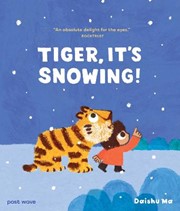 Tiger, It's Snowing!
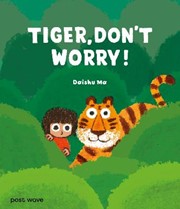 Tiger, Don't Worry! (Tiger and Mei)