Dr Sheila Kanani shares how This Book Will Make You a Scientist


About Author
Discover how to create your own experiments, based on famous discoveries from the past! Dr Sheila Kanani tells ReadingZone how This Book Will Make You a Scientist!
Dr Sheila Kanani is a planetary scientist, EDI consultant, space educator and author, with a background in astrophysics and astronomy research. She acts as a science ambassador, visiting schools and speaking at events, and is an advocate for diversity in physics and astronomy. Sheila runs her company Her Place For Space from home, and enjoys walking on her local beach with her family of boys, playing sports, gazing at the stars, reading and eating (preferably reading whilst eating!).
Interview
March 2026
Dr Sheila Kanani shares how This Book Will Make You a Scientist!
Discover 25 ground-breaking scientists from the past and present, and create experiments that will help you prove their discoveries in Dr Sheila Kanani's This Book Will Make You a Scientist
From making your own volcano and training to be an astronaut to exploring electricity, evolution and gravity, This Book Will Make You a Scientist is jam-packed with ideas for aspiring scientists everywhere! ReadingZone caught up with Dr Sheila Kanani to find out more.
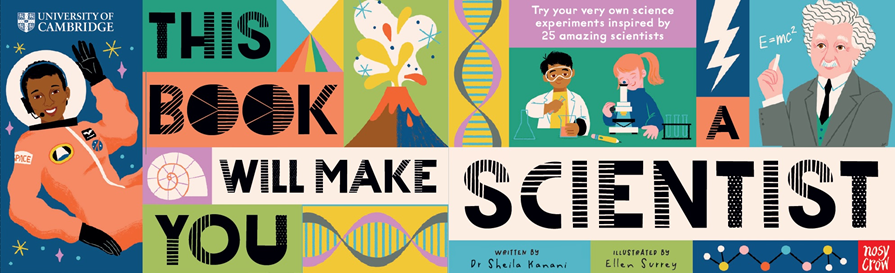
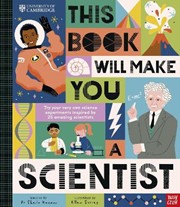
This Book Will Make You a Scientist: Measure the speed of light like Albert Einstein! Train to be an astronaut like Mae Jemison! Communicate with chimpanzees like Jane Goodall! This book will make YOU a scientist as you explore 25 different scientific ideas inspired by ground-breaking scientists through history! See also: This Book Will Make You an Artist
Review: "Perfect for igniting ideas and creating curious children, The Book Will Make You a Scientist is packed with accessible experiments."
Q&A with Dr Sheila Kanani: Helping children grow a love of Science
"If you read the book, you will learn that everyone is a scientist - from the minute we wake up to when we go to bed
we've probably encountered many different forms of science throughout our day."
1. Thank you for joining us on ReadingZone to talk about This Book Will Make You a Scientist. Can you start by telling us how your love of science began, and how you became a scientist?
I think I've loved sciences ever since I was little. I come from a very science-literate family with high science capital. My parents were pharmacists before they retired and my sister is a medical doctor, so science was always a thing in our house. We'd go to the science museums and the natural history museum and things like that.
When I was much younger, I wanted to be a vet. But I really became interested in physics and space when I was about 13 and saw the film Apollo 13 about astronauts and a mission to the Moon, and all my other life choices / study choices were made because of my love of space and astronomy. I'd love to be an astronaut even now!
2. What will readers find in This Book Will Make You a Scientist, and why did you want to write it? Would it have helped you as a child in guiding your interest in science?
In This Book Will Make You a Scientist, there's profiles of 25 scientists from 3000 years ago till the modern day, all different areas of science and alongside each of those biographies, there's an experiment that you can do related to that person, but with household materials. So extracting DNA, making perfume, measuring the speed of light, looking at rainbows, training like an astronaut, all sorts of things.
I think it's a really fun book and I really like how it relates real people to real science. And I think if I had this book as I was a child, it would have been great fun to try all the experiments at home and learn about different areas of science, not just space and physics!
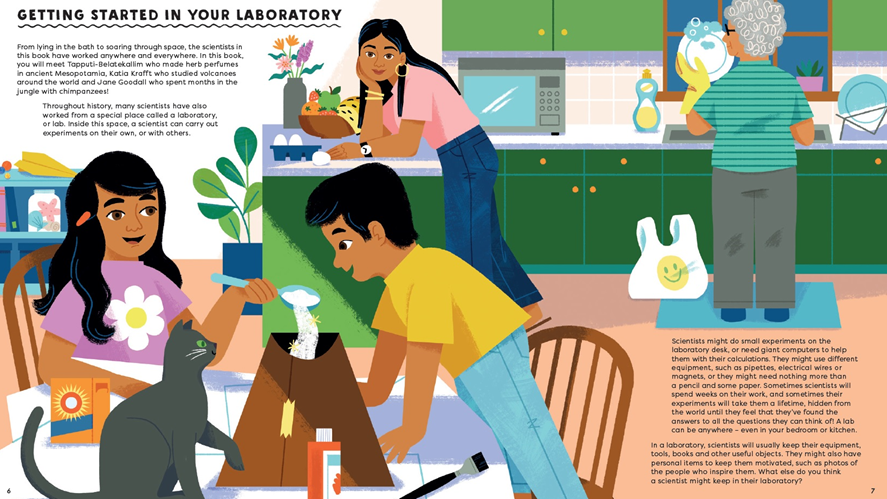
Illustrations by Ellen Surrey, from This Book Will Make You a Scientist
3. What will readers learn about becoming a scientist themselves?
If you read the book, you will learn that everyone is a scientist - from the minute we wake up to when we go to bed we've probably encountered many different forms of science throughout our day, from using our eyes to using mobile phones, satellite navigation, brushing our teeth, cooking food, all of those are scientific processes.
And so we're all scientists, but during the book, you will also learn that to be a good scientist, you will need to do teamwork, collaboration, being inquisitive, you might need some tools and materials. You should be able to ask lots of questions, explore, make predictions, and work together as a team. And also, not be worried about failing. Try, try, try again.
4. Alongside information about each of the scientists, you provide a suggested experiment for children to try. Do you feel that hands-on work is important in encouraging a love of science?
I think hands on work is so important to encourage a love of science. It's one thing reading about something, but it is a whole other feeling actually doing the science and gathering the information and recording it for yourself. Can you imagine if you could read about cakes, but you couldn't actually eat one? It's exactly the same for doing science experiments!
5. Which three of these experiments would go to the top of your 'to do' list for inspiring a love of science, and why?
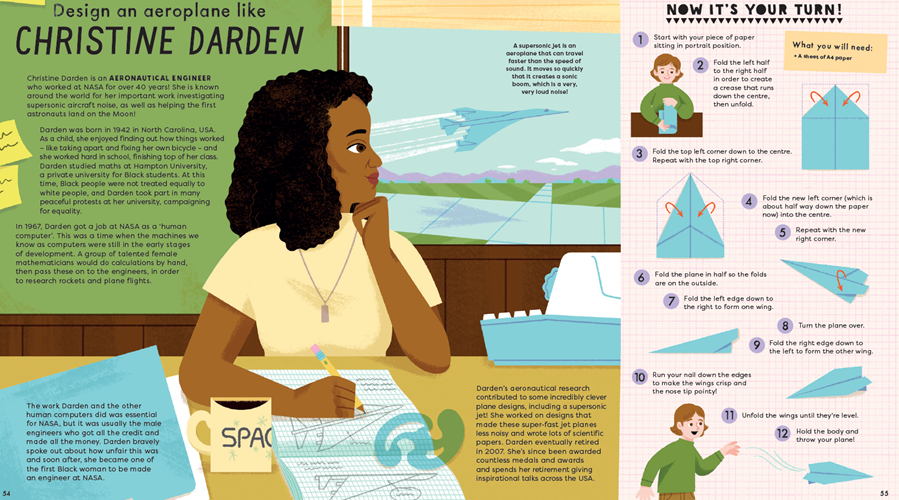
I think it's quite hard to choose a top three. I quite like some of the more simple ones like making and flying paper airplanes because you could do that anywhere. But I also like the acids and alkalis, the invisible ink, and anything to do with electricity. So static electricity and Nikola Tesla is one of my favourites, too.
6. How did you decide which scientists to feature in the book, and who to leave out?
We had long discussions about which scientists feature in the book. I think we had a long list of about 60 scientists. We wanted to cover all the different areas of science. We were looking at diversity of people. So we wanted men and women, people from all over the world. We were looking at people from different eras, so the first chemists, but also the most recent chemists. There was a lot of discussion about who should go into the books, and who to leave out and we eventually were able to shortlist to 25, which is the number that we wanted.
7. Was it difficult to achieve a balance of male and female scientists, and diversity, among the scientists you've included? Do women and minority cultures still face battles in science today?
I didn't find it that difficult to achieve a balance of men and women because I did a lot of research, but it was harder to get information about more diverse scientists because I think historically men are featured a lot more in science history, like in textbooks and things. So for example, Newton and Galileo, but actually what we've learnt from looking at past scientists is that without other people doing science, whether that meant women, ancient Greeks, ancient Indians, ancient Chinese, astronomers, et cetera, the more famous scientists wouldn't have been able to do what they did, so everyone builds up on what has been done before.
It was harder to find some of those scientists that were in the book, but we were able to do it. It just shows that they do exist. It might take a little bit of extra work, but it was definitely worth doing to make sure that the book was balanced and inclusive.
8. Which of the scientists featured particularly stand out for you, either in their achievements or discoveries?
I like a lot of the scientists in the book and all of the women, obviously. I like Caroline Herchel, she's a personal role model, but also Mae Jemison and Tapputi-Belatekallim as well. Pretty much all of them stand out for different reasons, but definitely the women more than the men. That's just because they are role models and inspiration for me - and I know that they might have had to work a little bit harder to get to where they got to.
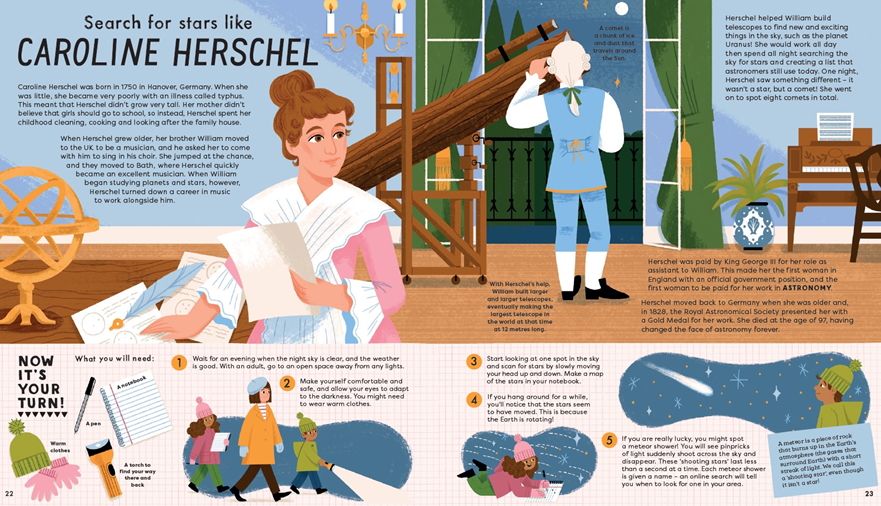
9. This Book Will Make You a Scientist is illustrated by Ellen Surrey. How do her illustrations help support the information in the book?
I love the illustrations by Ellen Surrey. I think they're stunning. They're inclusive, they're cute, they're funny. They're obviously historically accurate too. What I really like is that Ellen has thought in a diverse way as well. So the children doing the experiments in the book aren't just of one demographic and there's also intergenerational groups and there's children in wheelchairs and different colour skin and different types of hair and different ages and things like that. I think her illustrations really support the information in the book that anyone can be a scientist.
10. What inspires you most among today's scientific advances? Do you have any more science books for children planned to cover these?
Today's science is amazing, scary and inspirational. There's a lot of technology now that we have used to advance very quickly, things in space and things like AI, robots and that kind of thing. I think human beings will always be the ultimate scientists, even if we do make robots that can think like us, but ultimately we still need human beings to advance scientifically.
I have lots more science books coming along, my next big one is coming in September. It's called '10 Extraordinary Ideas That Shaped Our Universe' and it's a physics textbook, but for seven to 12-year-olds. It's illustrated by the wonderful Liz Kay and will be published by Puffin in September.
School Visits: I enjoy teaching about space and space as a context to other subjects in the curriculum - but I can cover anything, almost, and make the event bespoke to what you want. I also do teacher CPD, I teach GCSE astronomy, I can do space sensory journeys for special schools, all sorts of things. Just get in touch and we can discuss whatever event you want to plan. You can find me at herplaceforspace.com, email me via the contact form on that website and I'll get back to you!
 University of Cambridge: This Book Will Make You a Scientist