Exploring our digital footprints in Seán Farrelly's Tom Burne Has Left the Chat


About Author
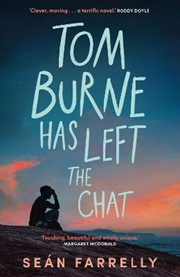
Debut author Seán Farrelly joins ReadingZone to explore the clues that our digital lives leave about us through his novel, Tom Burne Has Left the Chat.
Seán Farrelly has had four plays produced and two short stories published in the Irish Times as part of a young writers' supplement. He has worked as a writing mentor and workshop facilitator for young people since 2018. He lives in Dublin,
Interview
May 2026
Seán Farrelly explores our digital footprings in his debut, Tom Burne Has Left the Chat (Faber YA)
When micro-influencer Tom Burne takes his own life, he leaves behind his phone, its password, and the mystery of his death. 17-year-old Jamie, who finds Tom's phone, shifts through the digital fragments he has left behind to try to find out who Tom really was, and what was behind his final, fateful act.
ReadingZone caught up with Irish author Seán Farrelly to find out more about his novel, Tom Burne Has Left the Chat (Faber YA), including what inspired him to delve into our digital lives, what shapes his writing, and his challenge for writers to explore their own digital footprint.
Seán also discusses the themes he explores through the novel, including mental health, loneliness and grief, alongside insights to his writing and character development.
More about Tom Burne Has Left the Chat Read a chapter extract.

A Creative Challenge from Seán Farrelly:
A warm-up prompt I like is an activity I call Unlikely Combinations. Get a blank page. Draw a line down the middle. On the left, list approximately ten adjectives or descriptive phrases (zombified, flame-throwing, flying). On the right, list ten nouns (princess, reindeer, umbrella). Finally, connect the items that seem the least likely to exist, and write a quick scene featuring that combination in a setting you know well. What happens if a zombified princess wanders into your local shop, say, or if one day your teacher brings in a flame-throwing umbrella to school?
For something more related to digital footprints, I'd ask readers to think about what happens if a stranger took their phone after they died and somehow gained access to it. What would they find on it? What would they think about you? How would that version of yourself differ to how you see yourself in reality?

Q&A with Seán Farrelly: Exploring our digital lives in Tom Burne Has Left the Chat
"I believe everyone is a hodgepodge of multiple selves and I'm interested in the gaps between who we are
in real life versus how we present ourselves to the online world."
1. What brought you into writing for young adults, how did you learn your craft, and how much of your life is now dedicated to writing?
Ooh, fun questions. YA books were definitely the most formative kind of books for me growing up. I was a teenager when blockbusters like Hunger Games, Divergent and Twilight came onto the scene, and I certainly rode those fandom waves. I was obsessional about books like The Perks of Being a Wallflower by Stephen Chbosky, The Rest of Us Just Live Here by Patrick Ness and The Fault in Our Stars by John Green, reading them over and over to figure out how they worked.
The Skulduggery Pleasant series by Derek Landy convinced me that I could become a writer because his writing was Irish, funny and accessible (and he also lived near me - I spotted him in the shop where I used to work from time to time, in a non-creepy way!). Even the more “literary” books I gravitated towards in my twenties were either written by teenagers or concerned teenage affairs; books like The Outsiders, Frankenstein, The Colour Purple and Catcher In The Rye. Both as a reader and a writer, I enjoy big feelings, high stakes and lots of juicy, existential chats about The Point Of It All, and YA books seemed to be the place where those themes got together to hang out.
In terms of craft, writing and reading lots never hurts. I'd encourage people interested in writing to read widely. Not only outside your favourite genres, but also in different forms. I try read a poem every day on Poetry Foundation's website, and I like to read scripts and screenplays for my favourite TV shows and movies. Having a little creative community is also great, either online or in person. I watched an unhealthy amount of AuthorTube starting out, and I've been part of Fighting Words, an Irish creative writing organisation, for almost fifteen years.
FINALLY - and sorry for the long answer here - I'd say it depends on where I am in the phase of writing a book in terms of how much of my life is focused on churning out words. I kind of swing between extremes. Either I'm chilled out jotting down a few ideas here or there while working on other freelance jobs and projects, or else I'm in full hermit-mode, shut away from the world and hissing at anyone who comes too close (unless they're giving me biscuits).
Tom Burne Has Left The Chat was a particularly intense writing experience. I took about three months off from my office job and moved back in with my parents to enter hermit-mode for the first draft, and then it took another year and a half of revision to get it to a publishable standard. I was lucky enough to get a Literary Bursary Award from the Arts Council of Ireland for the latter part of the writing, which allowed me to dedicate myself to completing it full-time.
2. So what happens in Tom Burne Has Left the Chat?
The main hook of the book is: what happens to your phone after you die? The first chapter opens with the eponymous character, Tom Burne, dying of suicide off page, and the main character Jamie, discovering his phone and deciding to pocket it. Jamie and his mam are still in the wake of grief for Jamie's dad, who passed away before the book begins, and Jamie uses clues in Tom's phone to distract from his own loss and piece together who this stranger was and what could have led to his tragic end. It sounds heavy, but I was determined to keep it hopeful and warm, while also not shying away from difficult topics.
3. You touch on many coming-of-age themes in Tom Burne Has Left the Chat , but what was your starting point? Was there one discussion or idea that inspired you to write it?
I read an article on the New York Times about an older couple (a man and a woman). After the man died, his wife found WhatsApp messages, Notes app to-do lists and Spotify playlists in his phone, which acted as unexpected receptacles of memories. The phone transformed into a portal to the past that went way beyond traditional methods of using scrapbooks and old video tapes to remember someone.
The idea that we are the first generations of people in human history who will leave such an excess of information behind us when we're gone struck me as profoundly true and emotive. I write for young people (Tom Burne is the first book published but was the fourth book I wrote), so I thought what if, instead of elderly people, what if it was about two teenaged boys? And what if, instead of a married couple, they were strangers? That way, Jamie's relationship with the phone would be less about using it as a tool to remember Tom, but more of a way to get to construct a personality for him based on the digital fragments contained within it.
4. Given your work in writer development, can you give some ideas on how you get to know your characters, narrator Jamie, and Tom Burne?
For me, getting to know characters is like getting to know anybody else in your life; the more time you spend with them, the more you find out about them. I don't do character sheets or questionnaires in advance of writing (although I find activities like Character Hotseat helpful when I'm teaching). Instead, I listen out for a voice, which I know sounds a bit woo-woo, but it's the truth. Sometimes it arrives out of the blue and sometimes I have to splash around until it appears more gradually on the page. Once Jamie started complaining about the scones, I knew I had him. Then the creation of his character became a game of watching how he reacted to what was in front of him and listening to what he had to say about the world.
Coming up with Tom was a different story. Throughout the writing process, he remained a bit of a mystery to me. I think it was because the book is so rooted inside Jamie's head that I could only know Tom through Jamie's interaction with his phone, if that makes sense? It felt as if I only could see part of the full picture. Even to this day, I don't fully understand Tom or his motivations. My guesses are as good as Jamie's.
5. We learn about Tom's life and character through the digital fragments of his phone. How did you research this? How wary should readers be about getting to know someone through their 'digital footprint'? (and indeed about their own!)
I tend to do most things in life backwards. Like teaching writing for years before becoming a writer. Tom Burne Has Left The Chat was no different. Apart from ensuring that the portions of the book that deal with mental health and medical conditions were accurate, and doing things like finding out about how Gardaí ping phones in emergency cases by interviewing my cousin Garda Emer Farrelly, almost everything is made up.
I invented the app ReelLife, for example, partly because I didn't want to date the book by citing preexisting apps like Snapchat and TikTok, but also because, according to kids I work with, I give big boomer energy despite being in my twenties, and I didn't want to be like: 'Greetings, fellow youths! Let's talk about the internet!' Coming up with the Voice Memo sections or the band FunIRL were some of my favourite parts of writing the book, and there were lots of lyrics, ReelLife video transcripts and other miscellaneous phone bits that got cut (my first draft featured the entire script for the short film Zombaí that's referenced in Chapter 25, much to my editor's surprise). However, now the book is finished I'm doing a research project about devising an ethical framework for digital storytelling with young people using the book as a prompt, and it's already yielding interesting results!
Wariness in relation to digital footprints is an interesting point. I'm reluctant to give a definitive opinion. One thing I didn't want the book to be was preachy or to indict anyone for their online presence and/or social media use. Jamie at one point says parasocial relationships can be as valid as real life relationships, and I wanted the book to shore up that claim. Of course you can't get to know somebody exclusively through their online-self, but I'd argue you also can't know somebody exclusively through their school-self, or their family-self. I believe everyone is a hodgepodge of multiple selves and I'm interested in the gaps between who we are in real life versus how we present ourselves to the online world.
6. Jamie is grieving the loss of his father during his investigation of Tom's life. Why did you decide to explore bereavement in this way?
Not to sound like a broken, woo-woo record, but I never really “decided” to explore bereavement. The first thing I wrote was Jamie complaining about the scones, and once I had that, the whole endeavour became a bit of a subconscious Q&A: Q: Who is he complaining about the scones to? A: His mam. Q: Why is he complaining? A: Because they're terrible. Also because he's avoiding talking about what his mam brought him to the café to discuss. Q: What is he avoiding talking about? A: Moving country after his dad's death, which he very much does not want to do. Each answer prompts the next question, which reveals a new nugget of information.
I'm a big George Saunders fan and he often describes writing in this intuitive way. Lots of choices get made spontaneously on a scene - or even sentence - level and then it becomes the writer's job to take a step back and make sense of the things that happen seemingly by accident. For example, I had no idea Jamie's mam planned to move to Canada until Jamie likened the scones to ice-hockey pucks. Q: Why did he mention ice-hockey just now? A: Because his Mam wants him to move with her to Canada. Q: Why Canada? A: Because that's where his grandparents live. Also his mam got offered a new job there.
In retrospect, I understand my writer-brain chose to explore bereavement because, if the main drama was going to be about exploring the reasons behind Tom's death, it follows that the story should explore both sides of the grief-coin, so to speak: missing someone who you dearly loved and growing to love someone you never knew. I also suspect Jamie wouldn't have picked up and become so fixated with Tom's phone if his Dad hadn't passed away so recently. He was desperate for distraction and thought that figuring out why Tom did what he did might bring him closer to understanding why his dad died, too. Talking about story in such cold terms can sound quite clinical but, with every new draft, it becomes less about those first, logical decisions and more about the emotional realities of the characters who you've gotten to know, and maybe even love.
7. Jamie has also become very lonely, as a result of his grief. Do you hope his story will speak to other teenagers also experiencing loneliness and mental health problems? How can stories like this help support them?
I hope so! To be honest the idea of anyone, teenaged or otherwise, reading this book feels very new (and mildly terrifying) to me. I started writing books in 2016, and I began Tom Burne in 2023, so it'll be three years between coming up with the original idea and seeing it on shelves. I've grown used to these characters existing purely in my head, along with my agent, editor and a few trusted friends. I don't quite know what to do with the notion of having a “readership”.
What I do know is that it would make my life if even one teenaged reader identified with Jamie and felt less alone as a result - what a wild and wonderful thought! I struggled with my mental health between the ages of seventeen until about twenty-two/twenty-three. Reading books like Perks and TFIOS helped put a shape on complicated, unwieldy, and sometimes dark thoughts and feelings that were coursing through me during at that time. In other words: books gave me a soft place to land. The prospect that Tom Burne Has Left The Chat might be a soft place for someone else to land makes me genuinely emotional.
8. What kinds of discussions do you hope that Tom Burne Has Left the Chat will help inspire among your readers?
Now that the book is done, it's not mine anymore (something I learned from watching John Green videos on Vlogbrothers). It's totally up to readers whatever they wish to discuss. If I had to pick one thing, my hope is that the book prompts chats about the importance of connecting with other people, and that reaching out to check in on each other both in small and big ways can act as a salve for feelings of isolation. That was one of my main takeaways from writing it, anyway!
9. The setting for the novel is very specific - do you prefer to know your settings and what do you feel this brings to your writing?
The first novel I ever finished was set in a secondary world fantasy called Kueendom of Bedlam, and I remember spending days trying to figure out how the sewage system worked. Perhaps greater minds than mine could figure out a way not to get hung up on those kinds of details, but I need to have firmer imaginary ground to walk on to make any type of progress.
That said, I was conscious not to set it in Donabate, the coastal town where I grew up, so I took inspiration from Roddy Doyle's Barrytown trilogy and created Keening (also because keening is a type of ancient Irish wailing that happens during mourning, which has to do with grief… etc., etc., you get the idea).
10. Do you enjoy the writing process, or do you find it hard going? What are you writing currently and what gets you through a writing day? What do you enjoy doing in your free time to re-set?
I looooove writing. A bit too much, to be honest, where I sometimes struggle to keep up with other, non-writing tasks (like paying bills and doing the dishes).
Routine plays a huge part of my writing day, and I find it helpful to link creative time to different habits. My ideal day during hermit-mode goes something like this:
8:00 - 9:00. Wake up, scroll, breakfast, shower.
9:00 - 9:30. Walk the doggo, get coffee, put my phone in a drawer.
9:30 - 10:00. Light a candle, drink coffee, play online chess and check emails.
10:00. (strict) Close tabs, put on music, read poem
10.00 -13:30. Write, write, write.
13:30 - 14:30. Lunch
14:30 - 16:00. Pretend to write, but mostly play more online chess and think.
16:00 -17:00. Walk to the beach and stare forlornly at the horizon like a strange, sea-Captain.
I'm usually pretty pooped after the above routine and wind down by making dinner, reading and doing something non-writing-related for the evening. I hop from hobby to hobby depending on the project. For Tom Burne, I played a lot of Baldur's Gate (like, truly, an ungodly amount).

Seán Farrelly's School Visits:
I've been working in schools doing creative writing workshops since 2018 through Fighting Words, DCU and Freshly Ground Theatre. Right now I'm in the middle of devising a bespoke workshop series based on Tom Burne Has Left The Chat called The Feed, examining young people's relationships to their phones and the creativity that can be unleashed in using them for storytelling, but I also am happy to have the chats or do something a bit more informal.
Anyone interested can contact me on [email protected]. I will say I am based in Dublin and don't drive (yet), but I'd be more than happy to Zoom in!

 Tom Burne Has Left the Chat