Freddie Kölsch introduces her folk horror YA novel, Empty Heaven


About Author
Freddie Kölsch explores identity, gender and how societal norms keep the true monsters hidden in her new YA folk horror novel, Empty Heaven.
Freddie Kölsch is a connoisseur and crafter of frightful fiction (with a dash of hope) for teens and former teens. She lives in Salem, New England with her high school sweetheart-turned-wife, a handful of cats, a houseful of art and a mind's eye full of ghosts. Empty Heaven is her second novel for young adults.
Interview
October 2025
Finding the true monsters in YA folk horror Empty Heaven (Farshore)
Freddie Kölsch joins ReadingZone to explore her terrifying new YA folk horror novel, Empty Heaven, which makes for a perfect Halloween read, with much to discuss.
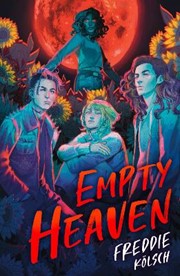
Set in the apparently idyllic town of Kesuquosh, not is all as it seems and, during a ceremony to celebrate Halloween, visitor Darian discovers that the townsfolk's worship of an apparently benevolent scarecrow creature is not just cutesy; it's terrifyingly real. But what lies behind the scarecrow, and who, or what, is the real monster in town?
Read a chapter from Empty Heaven Review: "Empty Heaven is a truly terrifying supernatural horror."
Q&A with Freddie Kölsch
Exploring folk horror traditions, gender identity and the societal power structures
that keep the real monsters hidden.
1. Thank you for joining us on ReadingZone! Can you tell us a little about yourself and how you started writing for young adults? What draws you to writing for this age range, and what kinds of themes do you enjoy exploring in your writing?
I'm so glad to be here! So I'm Freddie, I live in Salem (of the famous witch trials), Massachusetts, and my wife and I are doing the hard work of raising three very bad cats.
I started writing young adult fiction for the simple reason that my very close friend had written a YA novel and gotten a literary agent out of it. Her accomplishment made me feel that this lifelong writerly ambition I had sadly set aside as 'never going to happen' was actually possible. So I flagrantly copied her path…with her guidance and support. And of course I felt that writing a young adult book would somehow be easier, but that was a completely wrong assumption!
Writing YA brings with it a unique set of challenges, actually, which is part of why I've ended up enjoying it so much. Teenagers absolutely know when they're being condescended (or pandered) to. In some cases, adolescents seem more astute at sniffing out inauthenticity than any adult…so I think that respecting your audience's intelligence is a key part of YA.
In terms of themes - I like writing about relatively difficult things. Being queer, now and then, and the danger posed to vulnerable minorities by narrow-minded factions of society. The kind of families that queer people make for themselves when their birth families are unkind or less than present. The way that trusted authority figures can let kids down, or even damage them. Talking about heavy issues makes it really necessary to balance that with action, with humor, with genre elements, with something so that it doesn't feel too miserable. Fun and darkness in equal measure is, to me, a recipe for an enjoyable reading experience.
2. What happens in your new book, Empty Heaven, and what was the starting point for the novel?
Empty Heaven is about one traumatized girl from New York City and her three (also traumatized, but in different ways) best friends from the tiny Massachusetts village where she spends her summer vacations. Due to a series of increasingly dreadful events, this foursome of misfit teens spend Halloween of the year 2000 doing battle against: 1. An eldritchian scarecrow god named Good Arcturus, 2. their own personal demons, 3. and the supernaturally-reinforced conformity of their (seemingly) idyllic hometown. Basically in that order!
3. Why did you turn to folk horror for this novel? What do we mean by folk horror, and why does it make such a good vehicle for exploring the themes in this story including gender, difference and hidden monsters?
Folk horror is a genre that's deeply entwined with xenophobia, which would, you imagine, make it fundamentally unlikeable, potentially even capable of doing damage. However, and this is a BIG however: there exists within the category an internal conflict that goes all the way to the bone. For every 'played straight' film or story where a group of indigenous-coded villagers practice something unholy that a Fine Upstanding Member of Society discovers, there's another tale that encourages you to root for the villagers with a wink and a sly nod.
Sometimes, as with The Wicker Man, both of these things can be true at the same time. Other times, like with Jackson's 'The Lottery', there is legitimate criticism being leveled at how terribly these very homogenous communities that exist in isolation can treat minorities. The novel Harvest Home - which seems to be semi-forgotten now but was monumentally influential when it debuted in 1973 - is so tongue-in-cheek that I wasn't able to confirm whether the absurdly over-the-top lamentations about the loss of heteronormative roles within the wicked little Connecticut town were serious or not…until I learned that the late author was a gay man.
It's my belief that a majority of the writers who are attracted to folk horror are attracted to it because they want to in some way destabilize it, and that leads to something really fascinating: a genre that is more often subverted than played straight. I went in with the same plan…and applied all my favorite folk horror trappings to a story that is essentially The Ones Who Walk Away From Omelas, then let it go where it wanted.
I think that the process of being an adolescent and coming into the (unfortunate) knowledge that every adult around you is kind of an unwilling participant in the systemic exploitation of natural resources and impoverished peoples/countries is a really hard thing to go through. But it gives a lot of kids the courage and drive to fight for changes to the system as they grow up. Those are the people I most admire, and, like me, they often tend to be outsiders (queer or otherwise) due to circumstances beyond their control.
I wanted to write something to make them feel seen, understood, bolstered-up against an often cruel world. This wasn't my only intention, though! I also wanted to SCARE them, and entertain them, and keep them engaged and reading, which the slow-burn dread of folk horror seems to work really well for.
4. There is a creepy scarecrow character at the centre of the story. What inspired it, and which folk horror tropes did you most enjoy developing and turning on their head when writing Empty Heaven?
My love of creepy scarecrows goes all the way back to reading Scary Stories to Tell in the Dark as a kid. There's a story called 'Harold', which was my favorite of all, and it has a terrifying illustration along with it. Ever since, I've been on the hunt for scary scarecrows. There are tons of them out there, but few ever managed to creep me out in the specific way that 'Harold' did. A few things that come close, like The October Boy in Dark Harvest, or Pumpkinhead, the eponymous character of the film, but they're not exactly scarecrows. So I did the same thing, funnily enough. I turned my scary scarecrow, Good Arcturus, into something else entirely, and that was an enjoyable subversion to write about. Playing with the idea of one of those terrible town traditions being compulsory vs. voluntary was another fun thing to subvert.
5. Why did you make friendship - and found family - so central to the novel? Can you tell us about the four young adults at the centre of the story and how the group developed? Do you have a soft spot for any of them?
I think because my family is a found family - my clique in high school was the artsy outcasts, the queer kids, and a lot of us had familial conflicts and ended up low or no contact with them as adults. My best friend now is the same guy who was my best friend then. My wife was my girlfriend two decades ago. The loneliness of estrangement can be ameliorated by the steadfast love of a found family. I think the pain of loss can always be eased by the formation of loving and genuine human connection, and I guess that makes its way into everything I write.
The four misfit kids at the center of this book are like shipwreck survivors clutching at each other amidst the wreckage. They have all lived through extraordinarily - even supernaturally - difficult circumstances. That's their bond, that and music, even though they all have such different aesthetics and personalities.
I loved writing all of them, but especially Jasper, who has grown up being deeply ostracized and yet still takes time to be so defiantly himself, so punk, so undefeated, so mouthy. I remember kids like that, and I remember feeling that kind of anger, and I think that retaining that spark of rage at true injustice is so important, no matter how old you are.
6. What does the apparently liberal small town setting of Kesuquosh bring to the novel? Did you have a place in mind when writing it and how did you name it?
So the indigenous people from the part of Massachusetts where Kesuquosh is meant to be located are members of the Nipmuc Tribe. These were the Native Americans who sold maize to colonizers in Boston when they were starving in the winter of 1630, and the only thank you that the Nipmuc got from the Bostonians was imprisonment on Deer Island, starvation, forced conversion, or being sold into slavery.
However, the descendants of the Nipmuc have tribal land and state recognition today. They were able to survive…but so much of their culture was obliterated that efforts to reconstruct their (extinct) language are still ongoing.
What we know is that the Nipmuc spoke an Eastern Algonquian dialect called Loup A. The only sources we have on the language are derived from a field guide written by a Sulpician missionary named Jean-Claude Mathevet. And in one of the words in Mathevet's three notebooks entitled Mots Loups (literally 'wolf words') is the Loup A word for heaven…which is kesuquosh.
Mathevet was influenced by his own background as a missionary, so I find it unlikely that his definition of 'heaven' aligned exactly with what the Nipmucs meant when they said kesuquosh. But I still wanted to use a word from the people who lived in the Swift River Valley before they were driven out. Today many of their ancestral sites - places that had been in use for thousands of years - are inaccessible, buried beneath the 400 billion gallons of water that make up the Quabbin Reservoir.
Living here presents you with this weird duality. It's a liberal state, relatively safe for a queer person like myself. But the history…I mean, the name of the state is Massachusetts, as in the Algonquian for for the tribe that lived around what we now call Great Blue Hill. Native American words are a moderately significant part of our language, especially in terms of location names, and yet we learn so little about them in school. We walk around on this stolen land and we don't think about what's underneath it all.
This isn't to condemn people living out their daily lives; more to say that I believe a thorough education on the past of this place we call home would give us a deeper understanding of the world around us. And I think that my feelings on that are really reflected in the town of Kesuquosh. It's a beautiful place built on the sacrifice of unwilling people, enjoyed by citizens who are ignorant of the cruelties that came before. It's saying the right things but knowing nothing. It's something we all struggle against, all the time.
A final note: the only Loup A word that made it into common parlance is the word 'podunk', which I think is very appropriate.
7. Empty Heaven is a fantastically readable novel, with so many layers to unwrap. What kinds of discussions or questions would you like the novel to raise among your readers?
This is such a great question! I think that for adolescents any conversation where they feel comfortable discussing themselves on a deep level - their gender, their sexuality, their core beliefs, their ethics, their passions, what makes them them - is a positive conversation. Finding things to imitate and emulate in characters is also a good and natural part of coming into yourself as you move toward adulthood, so I think any teen book with characters they feel like they can really get into has some value.
Beyond that…I would love to see kids question authority. Not just defy it, which a lot of them are great at! But question why authority figures enforce certain rules, and pick that apart, and work toward a real level of discernment regarding how they as individuals actually think and feel about power, and ingrained systems, and the way that leadership is wielded, for better and worse.
8. Can you suggest any other folk horror novels that our YA readers might enjoy once they've read Empty Heaven? Why those choices?
I highly recommend Harvest Home by Thomas Tryon, which I mentioned before, because of the way it allows readers to draw their own conclusions. But some of my favorite examples of folk horror are from short stories: 'The Lottery' is folk horror, in my humble opinion, and essential reading for teenagers because of the questions it raises about tradition. 'The Summer People', also by Jackson, has a marvelously creepy feeling of building dread…and I thoroughly recommend 'Ringing the Changes' by Robert Aickman, which has one of the eeriest small towns ever committed to paper and an excellent payoff.
9. Do you have other YA novels planned? What are you writing currently? Do you have a favourite writing spot / time to write?
At the moment I'm working on the second book in a middle grade series. The first one, Spindlewood, is due out next year. The protagonist of Spindlewood is a girl named Lilac Black, who has no magic powers and cannot see ghosts, but nevertheless manages the ill-advised feat of tricking her way into a school for kids who can see ghosts with a combination of craftiness, nepotism, and pure blind luck. Then Lilac has to try and figure out how on earth to avoid getting caught and expelled.
I love writing MG, I feel like I'm standing on the shoulders of giants, trying to reach the level of craft in the stories that made me fall in love with reading as a child. And I tend to write before and after work! I work second shift, and late evening and late mornings are my most productive time. This is so boring, but I usually write in bed. I felt ridiculous about that until I visited Edith Wharton's home and they had her writing situation all set up…she wrote in bed too!
10. You live in Salem, does its history help inspire ideas for new stories? Where do you go to relax and be creative?
I love walking through the two cemeteries that abut the neighborhood I live in, and I love going to Boston for a night of dancing with my wife (Goth Night is our favorite), and I love concerts, and museums, and eating out, and driving to a random spot on the map to walk around, and geocaching, and exploring. And staying in town is good, too: we have museums and attractions galore, the ocean and the parks and little pop-up fairs and psychics and a tremendous amount of roving street performers, particularly in October.
Through all of that I'm always talking about new story ideas with Allie. She's my best friend and my creative partner in addition to being my spouse. Everything is an opportunity to imagine something, and we'd probably go on doing that even if I had never written a word. It makes life feel very exciting, no matter how routine a given day might be.
 Empty Heaven
 Now, Conjurers