Jessica Meserve explores The Home That Love Built


About Author
Jessica Meserve explores nature, community and resilience in her stunning picture book, This is the Home That Love Built.
Jessica studied illustration at Edinburgh College of Art and worked in publishing as a children's book designer before pursuing a career as a children's author and illustrator. She has lived in Canada, France and the US, but now lives with her family in England. She finds inspiration and happiness from the great outdoors, and her two dogs and her family.
Interview
January 2026
Exploring The Home that Love Built with Jessica Meserve (Little Tiger)
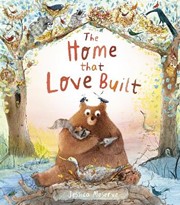
When a terrible storm destroys the homes of a small community of animals, one tiny creature gives them the determination to build a new home, stronger and better than before, which all the community can share.
ReadingZone spoke with author and illustrator Jessica Meserve about her powerful picture book, The Home That Love Built, and how to take the story further with children.
ReadingZone Review: "Using a cumulative style similar to that of 'This is the house that Jack Built', The Home that Love Built is a gorgeous book, celebrating teamwork and friendship."
Q&A with Jessica Meserve: Exploring the themes of The Home that Love Built
"While it only takes one tiny raindrop to start a storm, it also only takes one person to
inspire hope in a whole community"
1. Can you tell us a little about yourself and what brought you into writing and illustrating for children? Do you do other kinds of work?
Hello! Everyone calls me Jess. My journey into books began when I was a child, inspired by the beautiful stories my mother read to me every night including the Tales of Beatrix Potter and Grimms fairy tales. My love of picture books led me to study illustration at Edinburgh College of Art and then work as a children's book designer where I had the chance to read so many stories and see them transform from words on a computer screen into real books on shop shelves.
I soon realised I wanted to be the one doing the drawing! I took the plunge and created my first book, Small, which is all about what it's like to be a younger sister. Today, I live in the south of England with my family and two golden retrievers. I love being busy - you might find me learning Spanish, swimming in a lake, running with my dogs or making a mess with clay. Some of my favourite things are ripe cherries, big bright skies and holidays with my family in the great outdoors. My least favourite things? Dark days, mean people, and fuzzy apples!
2. What happens in your picture book, The Home that Love Built?
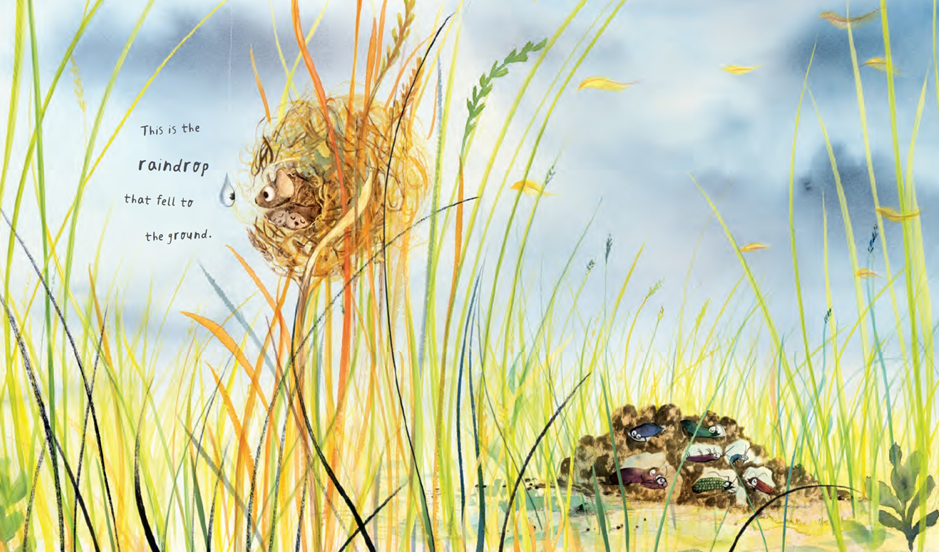
The story begins with a single raindrop which quickly turns into a terrible storm, devastating the woodland and destroying the animals' homes. While it only takes one tiny raindrop to start a storm, it also only takes one person to inspire hope in a whole community. In my story, this inspiration comes from a young beetle who demonstrates to the rest of the creatures how to begin the seemingly impossible task of rebuilding their home.
3. What inspired this story of teamwork and creation? Why did you feel drawing on the rhyme of 'This is the house that Jack built' would work well for this story?
I have to thank the team at Little Tiger for asking my to write any story of my choosing based on the title, The House That Love Built. The title was a wonderful spring board, prompting me to think deeply about what truly makes a house a home.The first image I drew was the mouse and the raindrop. It sparked an idea about how quickly life can change from good to bad, and how challenging those sudden shifts can be for young children to process.
Not every 'raindrop' turns into a disaster, but the story explores that question: if it does, what can we do? I also began to think about how magical it is when just one person inspires change and hope when everything seems lost. Once these themes were in place, I realised the stacking rhyme element of This Is the House That Jack Built would work beautifully. It creates a natural rhythm in the text while echoing the core idea of rebuilding life bit by bit, with love.
4. What kinds of things will children learn about nature through the story?
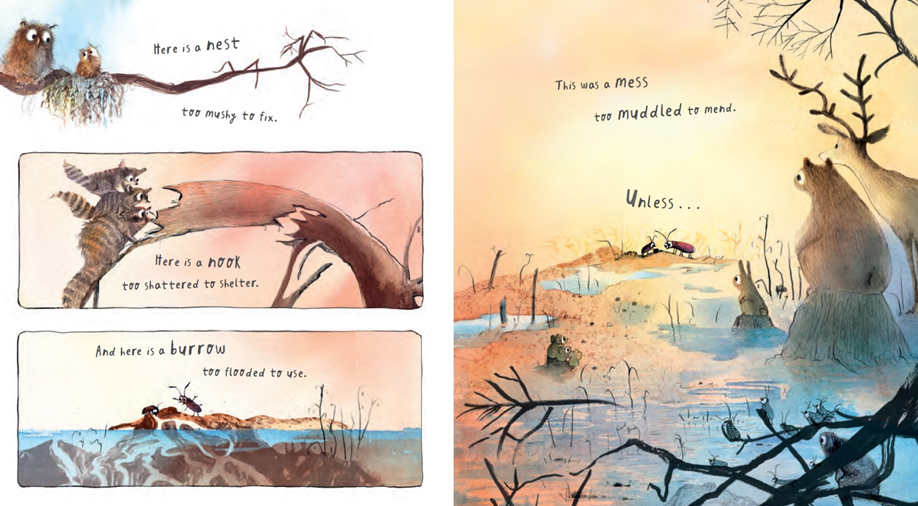
Unfortunately, natural disasters can turn a child's world upside down, taking away the places where they feel safest. Nature is both peaceful and powerful, and I wrote this story to help children understand these changes.
I want to show that nature has the power to bloom and regrow just as communities have the power to heal and rebuild. Sometimes, when everyone comes together to help, the new home can feel even more special because every person in the community truly belongs there.
5. Do you also hope it might inspire young children to take a closer look at animals in their natural habitats?
Nature is full of incredible architects, and I find the way animals build their homes truly amazing. While researching for this book, I discovered the extraordinary Sociable Weaver bird. These birds build the largest communal nests in the world - massive structures that can house generations of families for over a century! These nests even become tiny ecosystems, providing shelter for insects, reptiles, and other birds. Although my story isn't set in Africa where the weavers live, I was so inspired by their teamwork that I used the idea of communal building to design the roof of the animals' new home.
6. Do you have any suggestions for adults sharing the book with children for activities to take it further?
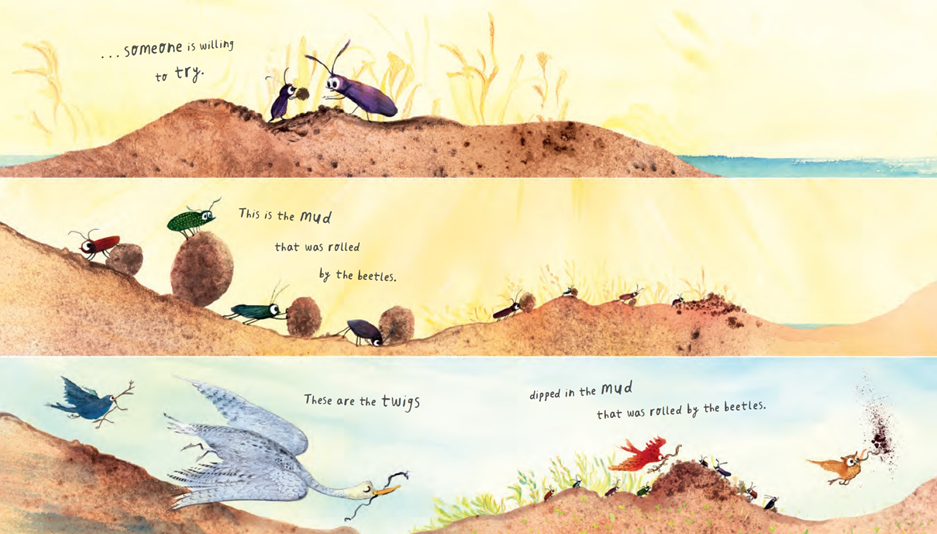
A wonderful way to bring this story to life is to challenge children to design and build their own bird's nests! This activity is packed with rich learning opportunities, combining art and design with nature and engineering. The fun starts even before the building begins - children can go on a nature walk to forage for materials like twigs, dried grass, and moss. You can even experiment with making your own 'mud glue' to hold the structures together, just like real birds do!
7. Can you tell us how you created the images for this picture book - and how do you invite your readers to look more closely at the images, what might they find if they do?
I create my images using a special mix of watercolour paint, pencil, crayon, and ink on watercolour paper. I don't paint everything in one go! Instead, I paint the sky on one sheet of paper, draw the black-and-white animals on another, and paint the grass and leaves on a third. It's a bit like making a puzzle.
Once all the pieces are finished, I scan them into my computer and use digital 'magic' to layer the separate paintings together, creating the final illustration you see in the book. Working this way means that if I make a mistake, I don't have to start the whole image over again - I just have to redo that one little bit!
I love hiding lots of additional details in my illustrations which children can find on multiple readings of the book. One of my favourite moments is while the raccoons are busy tucking moss into the nests. Keep a close eye on the river and you might spot a tiny beetle falling into the water? If you follow the next few pages, you'll see exactly what happens on its big adventure!
8. Do you have any favourite spreads or moments in the story?
My favourite spread is the one right after the storm, where all the animals are soggy and sad. I wanted to show the enormous contrast between the devastation of the storm and the vivid beauty of the sunrise. The final spread is also a favourite because it brings all the animals together at last. It took me many weeks and lots of hard work to get that image just right, but I know that the next time I am struggling with a picture this image will help remind me: if I don't give up and keep on trying, I will get there in the end!
9. Where do you prefer to create your picture books, and what are you working on currently?
I mostly work in my studio at home. I am very lucky to have a large space filled with desks and all sorts of lovely art materials. My children regularly keep me company there with their own art or craft projects! Currently, I am working on a new picture book about two very different creatures: a butterfly and a woodlouse. I chose this pairing because they are exact opposites in so many ways, and yet, wherever you find butterflies, a woodlouse is usually living somewhere nearby. In fact, they live almost everywhere - Antarctica is the only continent where you won't find them!
10. What kinds of things do you enjoy doing to escape your studio? Do you find inspiration in nature, or are you also a city person?
I'm a nature person first, but I do love cities too for all the history, museums, and fun stuff to look at! My home right now is the perfect mix: in the countryside but only half an hour from London. My dogs are great at getting me out of my studio. I love running with them - not for speed, but just to get outside and notice things! I run the same paths all the time, but nature always has new secrets to share, like glowing spider webs, little field mice dashing past, or my dogs running just for the simple joy of bounding.
 The Home That Love Built
 Our Tree