Kim Gregory introduces Marcie and Giraffe, a story about friendship and creativity


About Author
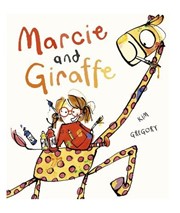
Marcie and Giraffe love being creative, and painting together, but things don't always go to plan for the friends. ReadingZone caught up with Kim Gregory to find out more about her picture book, Marcie and Giraffe.
Kim Gregory, an author and illustrator, lives with her family in the south of England. As well as writing and illustrating, she is a designer, musician and photographer.
Interview
May 2026
Kim Gregory introduces Marcie and Giraffe, a story about friendship and creativity
If you have a young perfectionist, or a child who doesn't believe in their own creativity, Kim Gregory's new picture book, Marcie and Giraffe, provides a warm and funny introduction to being creative, and also supportive friendships. ReadingZone caught up with author and illustrator Kim Gregory to find out more about Marcie and Giraffe.
More about Marcie and Giraffe: When Marcie compares her work to Giraffe's picture, she becomes angry and upset that her picture isn't as good - until she finds a way to use art to show how she feels, and it's really rather good.
Review: "Marcie and Giraffe is a lovely story about making mistakes, feelings and friendships, explored through the characters' artwork."
Q&A with Kim Gregory: Using Marcie and Giraffe to encourage creativity
"If a child can utter the heartbreaking phrase, "I'm not good enough", then that is incredibly brave. If this book
helps give ideas to discuss how to process that feeling using art and friendship, then that would be amazing."
1. Hello Kim, thank you for joining us on ReadingZone. Can you tell us a little about yourself, your loves and loathings, and what brought you into creating books for children?
Hi, it's so nice to be here! I live in the south of England with my three children and two dogs, and I make picture books.
Something I love to do is watch people in the street who are unapologetically themselves, just going about their day. Life's great characters. I also love trees and wild gardens. I don't like it when people feel bad about themselves, and I don't like it when people take out trees and get rid of wild places.
I LOVED picture books as a child. The combination of illustration and words to tell a story never lost its magic for me. So now I make them!
2. Your new book, Marcie and Giraffe, explores a wonderful friendship. What happens in the story?
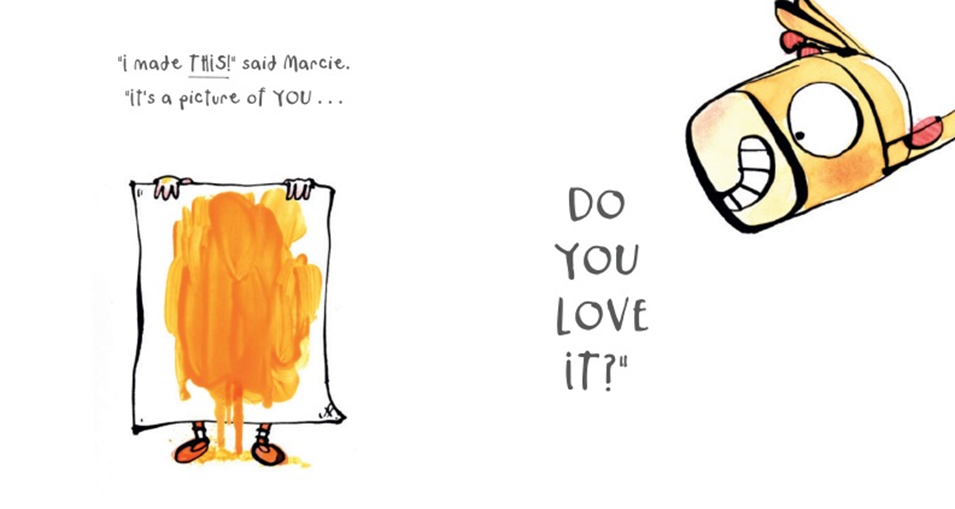
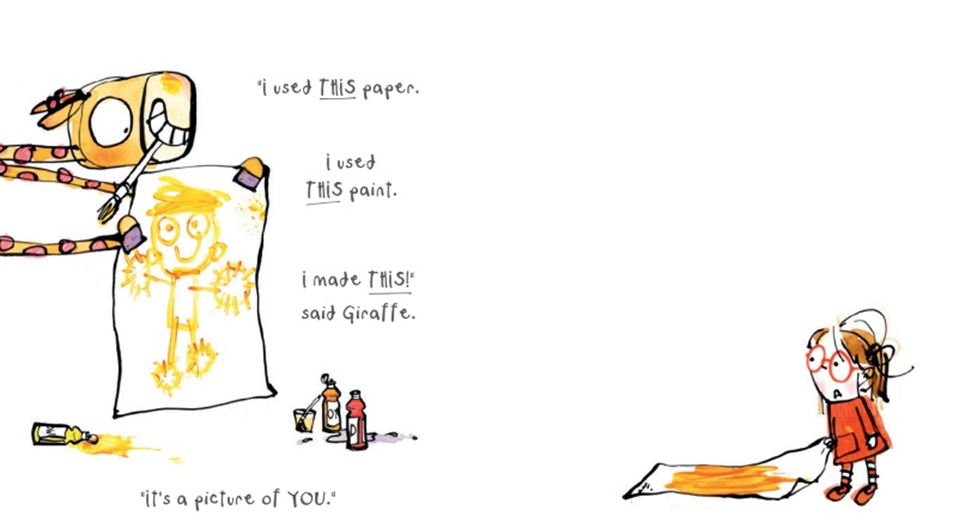
Marcie and Giraffe are two characters who have the best kind of friendship - one where they can be themselves and know they're still loved. In this story, they are creating ART. This book is about what happens when you compare yourself to others and feel like you're not good enough. We see Marcie and Giraffe go through some big emotions and find ways to get through them.
Writing children's books is a fantastically exciting and also a very complex thing to do. The way I work is by trying to tell just the right amount of story with the words and just the right amount with the artwork. My favourite challenges when writing picture books are getting it to flow well when you read it out loud and plopping humour droplets in just the right places.
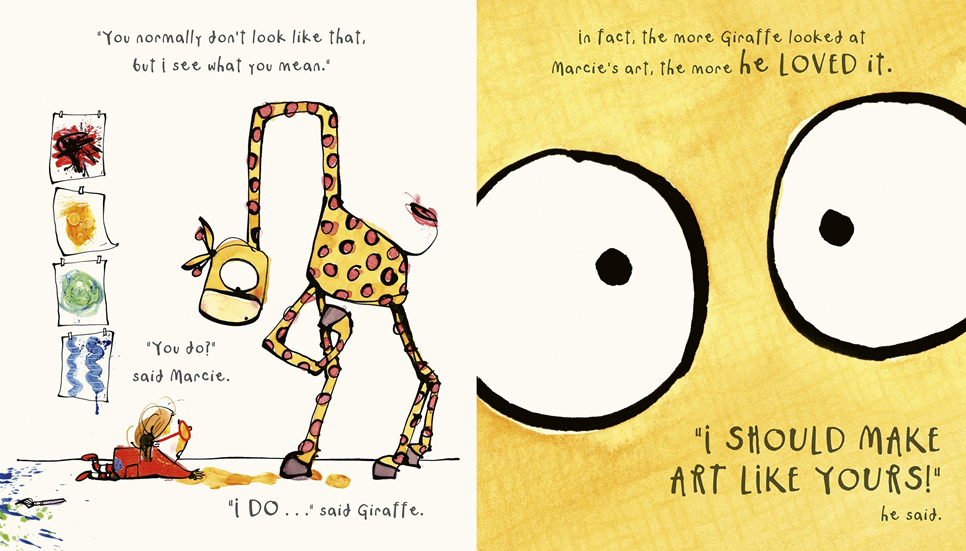
I think my favourite parts in the story are the unexpected bits. So Giraffe, who, rather than comforting Marcie, comes out with, "My picture doesn't look like you anymore, so it can't be all that good" (because Marcie looks so cross now - although I feel a bit bad finding that funny). There is also an illustration of Marcie looking up with her glasses covered in paint so she can't see (specs wearers opening ovens will relate). But the page I guess I love the most is the one where they are both being themselves and making more art alongside each other with joy.
3. Have real-life experiences helped inspire this story, perhaps your own frustrations with art?
Do you mean have I ever compared myself to others, felt terrible about it, and thought my creations were rubbish . . .? Of course not . . .
I absolutely have, yes. It's something I struggle with a lot, and this book was as much me getting that out in the open as anything else.
4. Can you tell us a bit more about your characters Marcie and Giraffe, and how you developed their characters?
When I was young, I was the tall one - rather clumsy but also a perfectionist which can be . . . a challenging brain and body to be in sometimes! I guess, like many books and characters, Marcie and Giraffe are, sort of, both a bit of me in a way. It helps to make it more real.
I made drawings of the two of them and had them interact with each other for quite a long time before the book became a book, so I found characters that bounced off each other well. Marcie can be quite a feisty little thing, and Giraffe is more a loveable, gangly friend.
I first drew Giraffe a long time ago. He always had joints where joints shouldn't be and could bend however he wanted. It's because I drew a series of pictures of a giraffe fitting into things he clearly couldn't fit into for my son. That sort of stuck. And the rest of him came from me drawing a shape with elements of a giraffe without thinking too much about what a giraffe is supposed to look like (this is probably obvious). Marcie started with her glasses and attitude and then went messily on from there.
5. Children often worry about and compare their work with other children's creations - what kind of discussions do you hope Marcie and Giraffe could start?
If a child (or adult) can utter the heartbreaking phrase, "I'm not good enough" or "Everyone is better than me", then that is incredibly brave. If this book helps give ideas to discuss how to process that feeling using art and friendship, then that would be amazing. I would also love for children who struggle to articulate what they feel through words to be given permission to use art as a tool to describe to someone how they are feeling.
6. Can you suggest any follow-up activities when adults share the book with children, especially with children who aren't confident about drawing?
There are actually many ways this book can be used in terms of follow-up activities. You can go down the line of everyone drawing a 'brain' from a picture on a screen. Everyone's will look vaguely similar (and actually, at this point, you may already find people are looking around to gauge how 'good' their one is). Then you get them all to paint THEIR brain - what's going on in their mind, how they are feeling, what they're thinking about. It's so interesting because no one has the same brain or thoughts. Make art that's YOU! It's brilliant, and the collection of art at the end is fantastic.
Another way the book has been used is to encourage people to use art as a language and show others how they feel by expressing feelings with art. Then we learn to listen to other people by looking at their art.
7. How do you create your images? Do you work digitally or more traditionally - like Marcie and Giraffe?
The biggest thing that led to Marcie and Giraffe and my art style was deciding myself what I wanted to do rather than making art like I felt I should! I spent a while finding the right dip pen-paper-ink combo for myself and then splatted ink everywhere really. It was fun. It still is.
It's also a case of trying to keep the illustrations looking fresh and alive, with real and relatable expressions. I usually draw quite a few of each picture before choosing which one to use, to make sure I keep the life in it and get the expression to tell the story.
8. What is your studio like, or where do you most enjoy working?
You know the mess at the end of the book? Yeah, that's pretty much what my studio looks like. I also have quotes from my favourite books written straight onto the walls, and lots of pictures taped to it. It's my happy place where I make art however I like. (I'm only allowed to do that now I'm an adult, though. Just in case any children are reading and thinking about writing on walls . . .)
9. What kinds of things inspire you when you're out and about to draw or write? Do you have any go-to illustrators?
Weird or funny things I see and hear, or memories of childhood, generally make me stop and jot things down.
In terms of illustrators who have inspired me, well, I'm never going to deny that the Master-of-Ink himself, Sir Quentin Blake had something to do with my inspiration. The life he captures in so few lines is something of a miracle. I also LOVE the clever and tiny differences in expression that Jon Klassen uses to tell so much of a story. He is a genius. And the childhood cosy realness of Shirley Hughes' worlds has hugely inspired me. There are so many illustrators and writers who are close to my heart and who have inspired child-me right up until this day.
10. And finally, what kinds of things do you enjoy doing in your downtime?
Sitting and looking at things with a coffee in my hand, if I'm honest. There's a lot we miss. There are a lot of incredible people and things out there just waiting to be noticed. So that's what I like to do - notice things.
 Marcie and Giraffe