Lisa Heathfield


About Author
Exploring sibling bonds, first love and the broken care system, Lisa Heathfield's This Boy I Hardly Know is a powerful coming-of-age novel for all readers.
Lisa's earlier YA novels have all won or been shortlisted for awards, including the Waterstones Children's Book Prize (twice) and the YA Book Prize.
After teaching, she ran a cafe in Brighton for seven years, before working in a school for students with mental health challenges and also a residential children's home. She now teaches teens who are unable to be in school for a variety of reasons.
Lisa lives in Brighton, UK, with her husband and three sons.
Interview
May 2026
Exploring family, first love and hope with Lisa Heathfield in This Boy I Hardly Know
Lisa Heathfield's This Boy I Hardly Know is a powerful coming-of-age novel that takes readers into the broken care system in the UK, with a story about siblings and separation, first love and found families.
When Dusty and her younger sister Poppy are separated within the care system, Dusty is lost. Then she meets Cooper, a gorgeous teenager in the same care home, and they go on the run to find Poppy.
ReadingZone caught up with Lisa to find out more about the passions that drive her writing, and why she wants to give all teenagers a voice through her novels.
Review: "This Boy I hardly know is a moving and thought-provoking read about the fractured care system and children within it."
Read the first chapters from This Boy I Hardly Know. Discussion Notes for This Boy I Hardly Know.
Q&A with Lisa Heathfield: Writing for YA readers, developing characters, and exploring the broken care system
"It's a coming-of-age story, filled with love, rage and hope. It's about the bonds of sisterhood and found families."
1. Can you tell us about your life as an author and writing for young people?
Writing books really is a dream. This will be my sixth book published and I still can't believe I'm lucky enough to be doing it! I hand write at my kitchen table, amongst busy family life. I usually write the first drafts very quickly, in just a few weeks, and then spend much longer editing.
One of the many wonderful things about being published is working with fantastic editors. For This Boy I Hardly Know, I've had the brilliant Eloise Wilson guiding and inspiring me with her passion for the book. Luckily, I love the editing process - it feels like a jigsaw puzzle, which at times seems impossible, until the last piece is fitted.
I love writing for young people, because I know that a book read when you're a teen can leave a real imprint on your life. Also, being a teenager isn't always the easiest time, so knowing that someone might read my book and escape into it, is really rewarding.
2. What have been your writing highlights to date, and what other kinds of work do you do?
Being shortlisted twice for the Waterstones Children's Book Award was really special. As was talking at the Hay Festival, when Paper Butterflies was shortlisted for the YA Book Prize. And being on the shortlist and winning regional awards has been incredible - I love travelling across the country and meeting all the wonderful teen readers (and their equally wonderful librarians!)
Alongside writing, I teach students who aren't in school for a variety of reasons, so I get to meet and work with really brilliant teens. Teaching helps balance out the more solitary writing work and stops me from becoming a complete hermit, which I naturally gravitate towards . . .
3. What happens in your new YA novel, This Boy I Hardly Know?
It's Dusty's story, following her traumatic separation from her younger sister, Poppy, in the care system. They're each other's worlds, but they're suddenly forced to live miles from each other.
Dusty is taken to a children's residential home, where the only shining light is guitar-playing, poetry-loving Cooper. Together they run away, determined for Dusty to be reunited with her sister. And though they may be resilient and stacked full with courage, they're vulnerable and have the authorities getting closer.
It's a coming-of-age story, filled with love, rage and hope. It's about the bonds of sisterhood and found families.
4. What inspired you to write this novel, about young people in the care system, and the struggles they can face?
I've worked with teens in the care system, in particular as a teacher in a children's home and I've seen first hand the often brutal realities of their lives. I've witnessed, too many times, traumatised children being restrained by adults. I've seen siblings separated and the devastation this causes.
I was so shocked to find that most of the children's homes in the UK are businesses, run for profit. The care is never going to be good enough and entirely child-centred, when the main focus is how much money the owners can make. It's a system that has to change - and I'm passionate about that.
5. How do you develop your characters? Did you know who Dusty and Cooper were before you started to write or do they come to life as their story develops?
Dusty and Cooper were there as soon as I picked up my pen. I didn't know where their story would take me, but I felt I already knew them. Part of the wonderful thing about being a writer is discovering more about the characters as you walk alongside them.
6. Why did you decide to focus their story around a journey they make?
I honestly can't remember any thought process behind this. I think my subconscious always knew it was going to be about Dusty and Poppy being forced apart from each other. And there was no way that Dusty was ever going to accept that.
The journey took Dusty and Cooper from Blackpool to Newcastle, but their relationship also took its own journey. Finally, Dusty had met someone who understood her. Luckily for her, he happened to be a gorgeous soul, too.
7. You give them each a creative talent - painting for Dusty and music and poetry for Cooper. How does that help express their characters through the story?
I think that painting for Dusty and music and poetry for Cooper are such intrinsic parts of them. Creativity is in their bones. Children in the care system have as many talents and hopes as any child and they have dreams that need to be nurtured. They're not simply numbers in a system - they're individuals, all with their own aspirations which should to be recognised.
It was Cooper who introduced me to the poet T.S. Eliot! I knew of him, but had never read his poems and so I discovered them as I wrote. And I love them! It'd be brilliant if readers discover T.S. Eliot too.
8. What kinds of discussions do you hope Dusty and Cooper's experiences will encourage among young readers - both within and outside the care system?
I hope that children within the care system will know how important they are and that they have every right to have a voice. I'd like discussions to start about the treatment of those in the care system - the separation of siblings, the restraining in children's homes (and some schools). And the shocking fact that children's homes are profit-led businesses.
9. Do you enjoy the writing process or is it challenging? What are you writing currently, and where do you prefer to write - quiet or noisy, music or silence?
I love writing. Every single time I pick up my pen and open my notebook, it feels a bit like opening a present. Our kitchen, where I write, is the centre of our home, so it can be a bit chaotic, especially as my husband and all three of our sons are musicians! I can write amidst noise, but I also love a bit of silence.
At the moment, I'm writing an adult book and at the same time have two new YA novels whirring away in my thoughts. For people who enjoy This Boy I Hardly Know, I'd say that my next book they should try would be Paper Butterflies. It seems to be a lot of people's favourite, even though it makes them cry - so perhaps have tissues close by.
10. Where do you go to seek out inspiration for new stories or characters? And what do you do to recharge when you're away from your desk?
I don't tend to seek out inspiration - I find that the characters just appear and with them, their fully-formed stories. I never plan (the editing would certainly be easier if I did!) but I just trust where the story is going. It's like I'm reading it for the first time, but the words are coming out of my pen.
To recharge, nothing beats a swim in the sea!
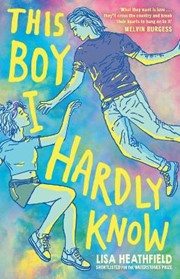 This Boy I Hardly Know
 Seed
Seed
 Paper Butterflies