Lisa Williamson Explores Consent in The Summer After the Night Before


About Author
ReadingZone caught up with award-winning author Lisa Williamson to explore consent and friendship in her YA novel The Summer After the Night Before.
Lisa was born and grew up in Nottingham. Following a degree in drama, she worked as an actor for over a decade before writing her debut novel, The Art of Being Normal, which won the Waterstones Children's Book Prize for best older fiction. Lisa is also the author of All About Mia and Paper Avalanche.
When she's not writing, Lisa loves long walks, long talks, dessert, good books and bad TV. She lives in London.
Interview
June 2026
Lisa Williamson explores consent in The Summer After the Night Before
Exploring complicated situations and the complex emotions that often go with them is what author Lisa Williamson excels at and in The Summer After the Night Before (David Fickling Books), Williamson dives deep into the question of consent and how complex this can be, and the kinds of questions that could be raised around consent.
More about The Summer After the Night Before: After one drunken night, the close friendship between Molly, Rhiannon and Ben changes during the following summer as each tries to understand and come to terms with what happened that night. Told from each of their perspectives, the reader is given a complex and emotionally real exploration of consent, truth and changing friendships. Read an extract
ReadingZone caught up with author Lisa Williamson to find out more about The Summer After the Night Before, why she wanted to write it, and the questions she tries to answer through the story.
Review: "Tackling the distinctly thorny issue of sexual consent, Lisa Williamson has painted a realistic picture of teenage relationships."
Q&A with Lisa Williamson
"It's taught in schools, but the guidance doesn't always translate to real-life scenarios. I wanted to explore consent
in a way that I hadn't seen represented before, and from multiple points of view."
1. Hello Lisa, thank you for joining us on ReadingZone to talk about The Summer After the Night Before. Can you start by telling us a little about yourself?
Thanks for having me! I love books (obvs), the seaside, theme parks, model villages, karaoke with friends, snow, solo cinema trips, dogs, hotels, dessert and jigsaws. I loathe any form of mint in chocolate and having to do mental arithmetic.
Contemporary fiction is my thing (to read and write). One of my favourite genres is posh people being awful to each other. I really love a juicy celebrity memoir, too. I would describe my taste in music as 'wedding disco'. I also enjoy a spot of musical theatre (once a theatre kid, always a theatre kid). My favourite way to escape is to go for a long walk in nature with a good friend, preferably with a pub garden at the end of it.
2. You worked before as an actor, so how did you become a YA writer and what draws you to writing for this age range? Do any of your YA books stand out for you in your writing career?
I enjoyed acting but I was never particularly successful at it. There were lots of gaps between jobs. When I found myself growing disillusioned with the industry, I turned to writing (my very first love as a little kid) for an alternative creative outlet. At this point, the idea of getting published one day felt very outlandish but I figured there was no harm in giving it a try.
I didn't set out to write for young adults. Indeed, the first book I wrote was for adults (it was about an out-of-work actor, so no prizes for guessing what inspired it). I sent it to a bunch of literary agents, and it was rejected by everyone.
I was a bit disappointed but luckily acting had forced me to develop a thick skin, so I dusted myself off and decided to write another book. At the time, I was working as an administrator at the Gender Identity Development Service (back then, this was the NHS clinic for young people questioning their gender identity), spending my days typing up notes from therapy sessions. It slowly dawned on me that I was very well placed to write a story from the point of view of a teenager navigating the sorts of experiences described in these sessions.
This story became my debut novel The Art of Being Normal and I've been writing for young people ever since. I feel a very strong connection with my younger self and have always found it very easy to tap into how it feels to be 11 or 14 or 17. At those ages, you're often doing things for the very first time, which is endlessly interesting to explore as a writer.
3. What is your new book, The Summer After the Night Before, about?
It's about three 16-year-olds - Molly, her best friend Rhiannon and Rhiannon's twin brother Ben. When Molly gets drunk at a party marking the end of Year 11, Ben volunteers to take her home. She wakes up the next morning half-naked in Ben's bed with no memory of how she got there. The story charts the summer that follows from the point of view of all three characters.
4. What drew you to explore consent in this novel and the kinds of questions teenagers might face? Was it a challenging novel to write?
When I was a teenager in the '90s, consent was never really talked about. As far as I can recall, it was never touched on in the few Sex Education classes we had. Although this has changed in the years since and conversations around consent are far more commonplace, it remains a complex subject.
It's taught in schools, but the guidance doesn't always translate to real-life scenarios. I wanted to explore consent in a way that I hadn't seen represented before, and from multiple points of view. In 2026, it's widely acknowledged that you shouldn't have sex with someone who is too drunk to consent. But what if you're both drunk? And what if they do consent at the time? Suddenly, the lines between wrong and right are so much more confusing.
5. Can you tell us about the three main characters, Molly, Rhiannon and Ben, who narrate the story?
Molly and Rhiannon have been best friends since Year 7. They're like chalk and cheese. Molly is outgoing and a people pleaser, while Rhiannon is guarded and can be spiky, especially when she's in a situation where she feels out of her depth. Ben is Rhiannon's twin. They share an antagonistic relationship, exacerbated by Rhiannon's suspicion that her parents favour Ben over her. Much to Rhiannon's disgust, Ben has had a crush on Molly since Year 7. Molly likes Ben as a friend but has never considered him as anything more.
6. Why did you decide to have multiple narratives for this novel, and to tell it in the first person, present tense?
My go-to is first person, present tense. I love the immediacy of it and how intense it can feel. I also love multiple POVs (both writing them and reading them). We're all unreliable narrators to a point. Having three characters present their version of the truth totally speaks to this, with Molly, Rhiannon and Ben often contradicting each other or misreading situations.
I found getting in Molly's head the easiest because, of the three, she is the freest with her emotions. Ben was the hardest because he is keeping the most from the reader.
7. Molly and Rhiannon's friendship group is at the heart of the novel. How do you make these friendships so realistic, and why did you want to embed the questions around consent within such a close-knit group?
Friendship can be complicated. As a teenager, I was a lot more insecure than I am now in my mid-40s (thank goodness!). I could be jealous, catty and judgmental. Within our friendship circle, we often gossiped about others to make ourselves feel better about our own situations.
At the same time, when things were good and we were all in tune, it felt truly magical. I really wanted to show these ebbs and flows within Molly and Rhiannon's friendship group, and how the shockwaves of the events of one night impact them all.
8. How much research did you need to do for this novel as you explore many challenging subjects, including sexual assault, trauma and the effects of alcohol? Who helped you?
I did a lot of reading on blackout sex, which was not something I knew a huge amount about, and I spoke with friends who had had experiences not dissimilar to Molly's. To help me with Ben's point of view, I listened to the About the Boys podcast on BBC Sounds, which was excellent. Mostly, though, I followed my instincts and put myself in the shoes of all three main characters.
9. The Summer After the Night Before is a powerful and gripping read, but what would you like your readers to take from Molly, Rhiannon and Ben's experiences?
The more I think about it, the more I think that Ben's biggest mistake is not being honest with Molly from the start. I don't condone his behaviour at all, but on some level, I do understand it. As a teenager, it can be hard to face up to your mistakes. The temptation is to cover them up instead. Communication is key to any successful relationship, and the pain and confusion Molly experiences is dialled up by Ben's refusal and/or inability to be truthful with her in the first instance.
10. Do you have any more novels planned for YA readers? For readers who enjoy The Summer After the Night Before, which of your other novels might they also enjoy?
I'm actually having a bit of a break from older YA and working on a brand-new series for a slightly younger teen audience (watch this space!). If you've enjoyed The Summer After the Night Before, I'd highly recommend All About Mia and First Day of My Life. They both feature complex relationship dynamics (my favourite thing to write about, it would seem!).
School Visits: Over the past decade, I've visited over 200 schools and love connecting with readers. I offer talks about my journey to becoming a writer and the inspiration behind my books, as well as creative writing workshops. Just check out the school visits page on my website and either fill in the contact form or drop me an email.
Image of Lisa Williamson by Remy Hunter
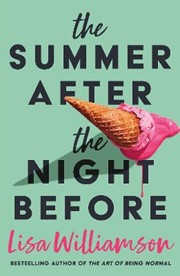 The Summer After the Night Before - from Waterstones Prize-winning author, Lisa Williamson
 Paper Avalanche
 All About Mia
 The Art of Being Normal