Maudie Powell-Tuck and Duncan Beedie introduce Hank, the grumpy goose


About Author
Meet Hank the goose, who isn't always on his best behaviour . . . Maudie Powell-Tuck and Duncan Beedie introduce their new picture book, Hank Meets Frank.
Maudie Powell-Tuck worked in publishing before becoming an author and freelance editor and mentor. When not writing, Maudie loves window-shopping for things she cannot afford, and dreaming about owning a pug called Stanley.
Duncan Beedie is a bestselling children's author and illustrator from Bristol. When not drawing badgers, bears and bush babies, Duncan likes to get out in the woods or sit in a comfy chair to read ghost stories.
Interview
August 2025
Exploring laughter, behaviour and expectations in picture book Hank Meets Frank (Little Tiger)
Hank the goose, created by author Maudie Powell-Tuck and illustrator Duncan Beedie, is the perfect picture book character for exploring how bad behaviour can affect those around you. Hank's antics will also have young children doubled up with laughter - and begging for more Hank stories!
Hank struggles with being good and in his first picture book outing, Hank Goes Honk by Maudie Powell-Tuck and illustrator Duncan Beedie, we discover just how hard it is for Hank to behave well. In fact, he is often 'obnoxious' - but he does, eventually, try his best to do the right thing.
In his latest picture book, Hank Meets Frank, Hank needs to be on his best behaviour; his cousin Frank is visiting - and everyone knows that Frank is the sweetest, cutest creature around. Or is he...? And will Hank get swept up in making the wrong choices, once again?
Review: "A laugh-out-loud tale of mischief, mayhem, and messy cousin rivalry - perfect for sparking conversations around emotions, behaviour, and making things right again."
Q&A with Maudie Powell-Tucker and Duncan Beedie
Author Maudie Powell-Tuck and illustrator Duncan Beedie tell ReadingZone what inspired Hank's adventures, why we need "objectionable" characters in children's books - as well as books that make us "snort-laugh", and how Hank's stories can encourage discussions about how our behaviour affects those around us.
1. Hello Maudie and Duncan, thank you for joining us on ReadingZone! Can you tell us a little about yourselves and the kinds of stories you enjoy creating?
Maudie: Hello ReadingZone, thanks for having us! I'm Maudie, a picture book writer and editor. My favourite thing in the world is to lie down (it has to be lie as I'm permanently exhausted) with my kids and read picture books - especially ones that make us all snort-laugh together. That's really all I want to write: funny stories that create moments of connection.
Duncan: Hello. I am very lucky to be in a position where I get to illustrate the stories of some seriously talented writers (Maudie being a prominent example). I find it much easier to draw by way of telling a story. My life would be far simpler (and more enjoyable) if I could carry this idea through to other more mundane facets of adult life - like filling out tax returns, etc.
2. Do you have a 'Hank' in your lives? Who or what inspired your creation of Hank the goose?
Maudie: Oh yes, I come from a whole family of 'Hanks'. . . The stories I could tell you . . . JOKING! No, he's not based on anyone in particular, but I do think we all have a bit of Hank in us. A little voice that tells us to scoff all the biscuits, do the thing we ABSOLUTELY SHOULD NOT DO, press that very tempting red button labelled "DANGER". . .
Hank came about as I wanted to write a story about an anti-hero character wreaking absolute havoc in a picture book - so who better than a very loud honking goose?
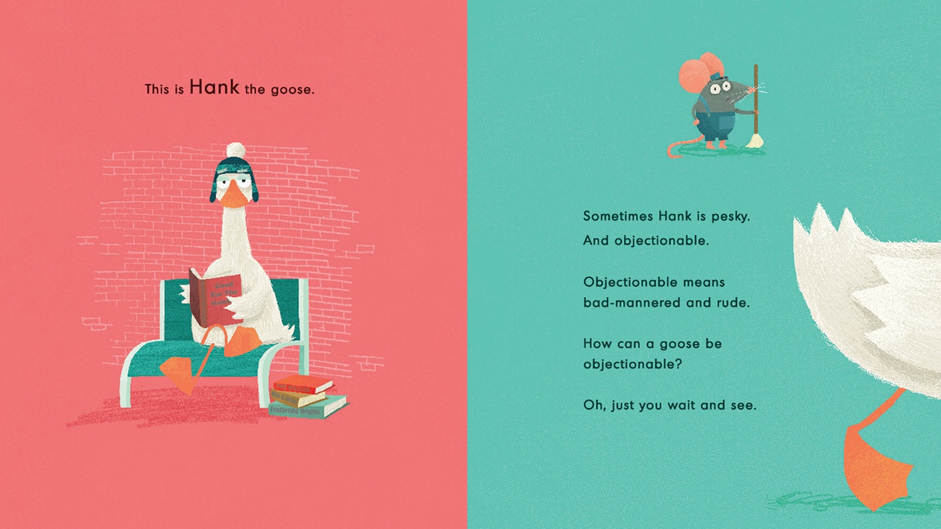
3. What happens in each of his picture books, Hank Goes Honk and Hank Meets Frank? Why did you decide to make the narrator so present?
Maudie: Hank Goes Honk is all about dastardly Hank trying to be a more considerate goose (spoiler alert: it's like teaching a cat to bark). In Hank Meets Frank, Hank's cutie pie cousin, Frank, is coming to stay and Hank must try to behave (spoiler alert: he doesn't!).
And I have absolutely no idea why I made the narrator so present. I was cycling and suddenly the narrator's voice popped into my head. I had to screech to a halt, dive into a cafe and quickly write it down before I forgot it. I didn't want Hank to talk, only HONK!, so I guess the story always needed a strong narrator. You could say it's a light parody of parent/teacher voice and I think children love seeing a little of their own lives in the interplay between Hank and the narrator.
4. Duncan, what appealed to you about illustrating Hank's stories and how did you want to portray him?
Duncan: As Maudie alluded before, I too am drawn to the fact that Hank is somewhat of a git. There are far too many righteous and worthy characters in children's books (unlike in life), so I think it's healthy for children to be introduced to gittish behaviour via an obnoxious honking goose. We all experience gits throughout life and act like them ourselves at times. I'm not saying it's a behavioural trait that should be nurtured or celebrated, but to ignore it would be folly.
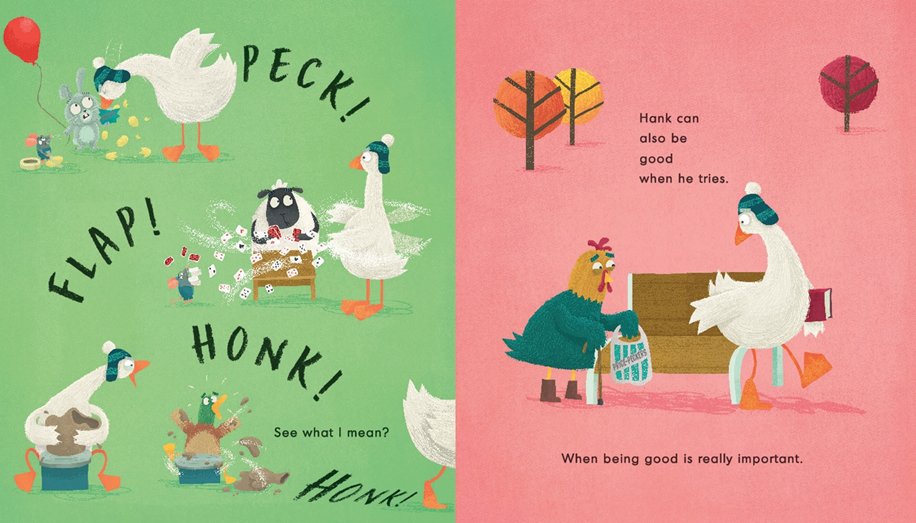
5. What are the challenges in creating a story with a grumpy main character? How do you get your readers to care about him?
Maudie: It was really important to make Hank funny, not mean or malicious. He makes daft choices all the time (HONKING loudly at the library, playing pranks on his cousin Frank. . .) but he also tries to change for the better - even if it doesn't always go to plan. It's this trying (and failing) to change that makes him so likeable and human.
How Hank is illustrated is so important too. Duncan has done such an incredible job - Hank's expressions are so real and relatable. Also, who can't resist Hank's woolly hat with earflaps?
Duncan: Literally no challenge for me here. Hank is one of the most relatable characters I've ever had the pleasure to work with. Maybe that doesn't paint an overall ideal picture of my character, but what can I say in my defence other than "H-O-O-O-O-O-O-O-O-N-N-N-N-N-N-N-K!"
6. We love the words you introduce to describe Hank, including "objectionable" in this story. Why did you decide to include those and how do you explain their meanings to young children?
Maudie: It started with the first Hank book - I was trying to think about a word to describe Hank's behaviour that wasn't too loaded, judgemental or heavy. I chose obnoxious as it's just such a fun word to say and it's a bit daft to describe a goose as obnoxious.
I adore picture books that challenge children (and adults!) with the odd fancy word. And children love playing with language - making up silly words and sentences - so why not throw in a couple of verbal curveballs? In the Hank books, we only introduce one or two big words, and always follow them up with a simple explanation so it's easy for the adults to help the children understand what they mean.
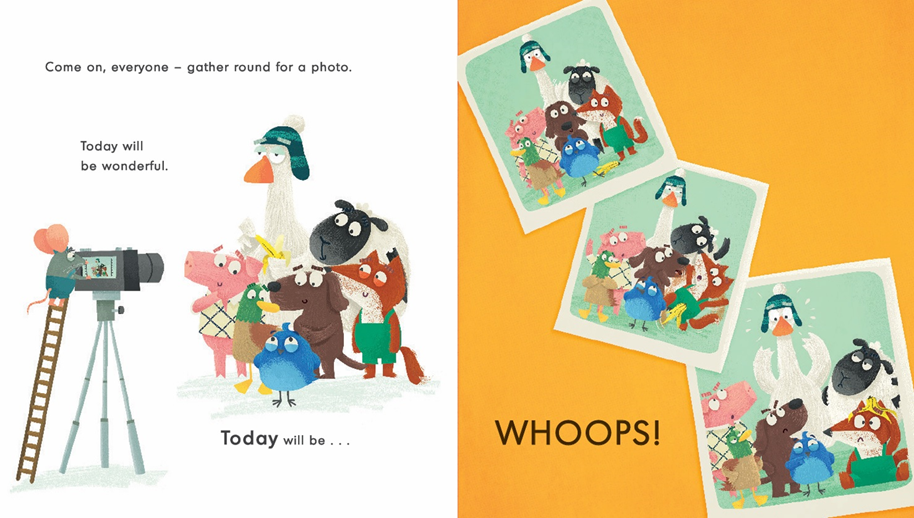
7. What kinds of discussions would you like Hank Goes Honk and Hank Meets Frank to encourage?
Maudie: None of us, adults and children, behave perfectly all the time, we all have our foibles, our trigger points - we all make questionable choices every now and then. Case in point, I spent an hour doomscrolling on my phone this morning even though I know it's TERRIBLE for me. I love that Hank in Hank Goes Honk tries to change, makes mistakes, and repairs. Changing behaviours or habits is never easy, there are always bumps in the road - whether you're 5 years old or 35 years old. Another big theme in Hank Goes Honk is being considerate - realising how our actions affect others - which is such a huge thing for children to learn.
Hank Meets Frank is all about one-upmanship and being drawn into a cycle of bad choices. It's also about how we can be labelled and blamed for things that aren't our fault, and how difficult it is not to be drawn in by the behaviour of someone else. That all sounds very fancy pants, but really, above all, we just want children and adults to have bags of fun reading the books.
8. When you're creating these books, do you discuss the images and how to support the text? How do you interpret Maudie's text, as so much of the story is told through the images?
Duncan: It is a known fact that authors and illustrators are not allowed to interact in any way throughout the story creation process. If they were to do so, it would undo the very fabric of the universe - like crossing the streams in Ghostbusters or prodding open the Lament Configuration in Hellraiser. Seas would boil, the heavens collapse, royalties would arrive in a timely fashion. Unbridled chaos, I tell you!
Thankfully, we are kept safe by the gatekeepers of the astral plains known as art directors and editors. They provide a stable link between writer and illustrator whilst ensuring our worlds don't dissolve into anti-matter. We do get to meet up at social events though, so that's nice. Thankfully, Maudie's text conveys the humour of the characters so well that it makes my job of translating the story into images a much easier assignment. And I do enjoy adding little Easter eggs and visual gags where I can.
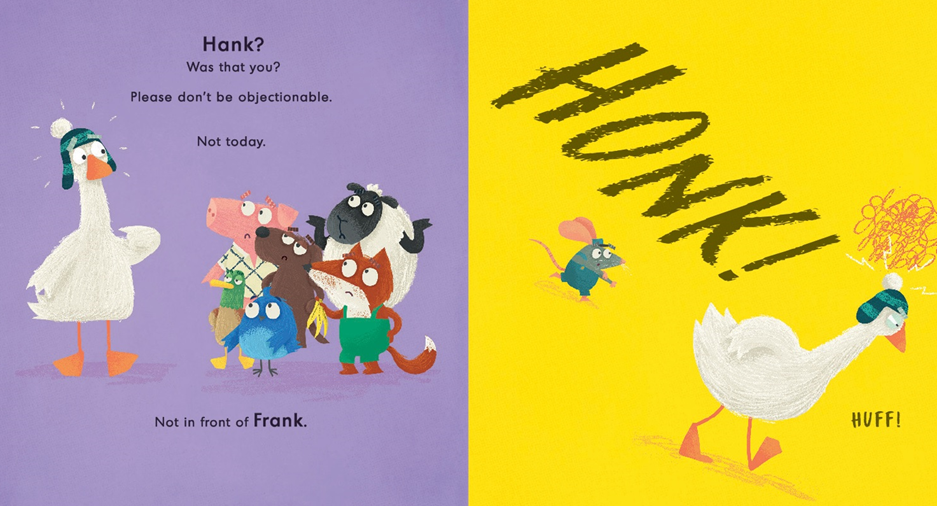
9. Speaking of the 'Easter eggs' hidden in these pages, we love the (busy!) mouse character - what's his role and why did you decide to introduce him?
Duncan: When I was first brainstorming the visual style of the book with Rebecca (my art director at Little Tiger) we wanted Hank to break the 4th wall, as it were, with his chaotic antics. We wanted it to look as though he were destroying the book from the inside out - lettering flying everywhere, pages becoming distressed, etc. So there needed to be a character to pick up the pieces. And that's how the hapless mouse janitor was conceived.
10. What kinds of things do you enjoy doing when you're away from your laptop or studio? What helps to inspire new stories?
Duncan: Summer seems to be my busiest time, so it's quite hard to drag myself away from the studio - made all the more frustrating by the glorious weather we've had the last few months. I do enjoy getting away from the city (Bristol for me) and out into the countryside. Nature has always been an inspirational source for me, but weirdly a lot of my best ideas have been spawned when I've been staring blankly at a wall. I can't explain that one.
Maudie: I spend a fair bit of time lying horizontal (I have a chronic illness, so rest is ridiculously important). Otherwise, I can't resist a good rummage around a charity shop or just generally loafing around with kids. When I'm thinking up new stories, I walk laps and laps of my local park. Duncan's right, time in nature is great for creativity, even the litter strewn, urban sort.
 Hank Meets Frank
 Hank Goes Honk