Miranda Reason introduces her post-apocalyptic thriller, Day Of Now


About Author
ReadingZone caught up with debut author Miranda Reason to explore her powerful YA thriller, Day Of Now, set in a post-apocalyptic world.
Miranda Reason grew up in an Anglo-German household, spending part of her childhood living in Hastings on the coast of Southern England and part in a small village in Bavaria.
Alongside writing and reading, Miranda is passionate about films and film history. She works as a film restorer of classic German movies. Although now living in Germany, she still prefers English for writing and storytelling, thanks to all the English children's books her dad read to her as a child. Day of Now is her debut novel.
Interview
March 2026
ReadingZone caught up with debut author Miranda Reason to explore her powerful YA thriller, Day Of Now, set in a post-apocalyptic world.
Action-packed and gripping for readers aged 14+, Day Of Now also offers much to discuss around the role of storytelling, how we remember the past and how we use those memories to shape the future, and themes of trust, power and gender.
Day Of Now: A devastating fungal pandemic has wiped out most of society. Dayna and Pax live in an isolated house in the countryside, learning to survive in the world left behind. But when their father gets sick they make a choice that changes everything: they summon help from the outside. And they’re not prepared for the betrayal that follows . . . Read the first chapters from Day Of Now
Q&A with Miranda Reason: Exploring themes of storytelling, trust and memories
"Stories were the starting point for Day of Now's world: I asked myself what I would try to save, if the world
as I knew it ended. And for me, the answer was stories."
1. This is your debut YA novel - what has your path into writing been, and why did you want to be an author? Has your 'day job' helped you develop as an author?
I've just always loved stories; reading, watching, listening to them. I didn't start writing properly until after I'd finished school, but I'd been inventing stories since childhood, and they often had their roots in other stories, mostly novels or TV series. Then I thought I'd try out writing one of my stories down, and that was it - I've been writing ever since. I get bored now when I don't have anything to work on.
A writer friend of mine read one of my early manuscripts and gave me a lot of useful feedback and encouragement, but other than that, I just wrote, reread and rewrote until I was happy with the stories. I gave them to a couple of friends and my parents to read, but mostly I just wrote (and write) because I enjoy it.
Then I wrote Day Of Now and thought this might actually be good enough for other people to be interested in. I sent a first query to about ten literary agents, and all of them rejected it except for one, Oli Munson at A.M. Heath, who was really enthusiastic about it. And he got Bloomsbury involved just a couple of months later.
All of this is still pretty mind-blowing to me. My day job is a film restorer of old German movies, and it did influence certain aspects of Day of Now, just in the way I think about the past. A big part of the book is about things the old world left behind and how they influence Dayna's idea of it; buildings, objects, pictures and especially stories. At one point, an archive (in a van) even turns up.
2. Can you tell us a bit more about Day Of Now?
Day Of Now is set in a post-apocalyptic world, about a decade after the onset of a fungal pandemic - which makes humans and animals rabid and has wiped out most of society. My protagonist Dayna and her brother Pax have grown up in this world in almost complete isolation. When their father is taken by a group, they set out on a journey to save him. They encounter other survivors along the way, and it becomes difficult to know when to trust, and when to run.
3. What was the starting point for your novel? Have any you drawn on any other books or films, such as Day of the Triffids, or real life for inspiration for the story?
I was definitely influenced by stories in various media. Especially The Girl with all the Gifts, the Last of Us and Telltale's Walking Dead series made me want to write a post-apocalyptic adventure. I also read novels and watched films for research, inspiration and entertainment, like the Day of the Triffids, the Chrysalids, the Mist, Parable of the Sower, Station Eleven, 28 Days Later and the Train to Busan. I recently discovered on rereading Northern Lights (which I've loved since I was nine) that I seem to have drawn some inspiration from there too. Good stories always influence you, whether you're aware of it or not.
Stories were also the starting point for Day of Now's world: I asked myself what I would try to save, if the world as I knew it ended. And for me, the answer was stories - which is what I had Dayna and Pax's father do: he tells, or retells, stories, and they lap them all up and half-believe them. Through their eyes, through our stories, our present seems such a wonderful, magical place, and so do people. Which will of course lead to trouble, when they encounter other survivors.
As the idea for this story first came to me in the middle of the Covid pandemic, I would say that, yes, I was partially influenced by real-life events as well, and you can see some signs of that in the book, like FFP2 masks being reused for new dangers.
4. How did the original inspiration develop into the final text for Day of Now? What were the main challenges in developing the plot, and did you know how it would end?
I had a really rough outline when I started - a beginning and a very vague end - and I just wrote and saw where it would take me (and Dayna). Which was great; it was like I was on the journey with them. They kept getting into impossible situations, and somehow, Dayna kept getting them out again - I had no idea how until she showed me.
There's a twist at the end, and I didn't know about it until I'd almost reached that point in the story. Then it was obviously the thing to do, like the story knew where it was going before I did.
5. This is a fast-paced adventure; how do you keep the momentum through the novel, what are your techniques for keeping the reader gripped?
I just wrote an adventure I'd like to read myself, and as this is set in such a perilous world, it was natural to bring on the danger from all sides. The only big adjustment I made was right at the beginning: There aren't many people left in this world, so the main obstacle for Dayna and Pax could have been infected animals - dangerous and deadly, but that doesn't give you so much variation if it's the only threat you have. I understood pretty quickly that I'd have to add some more people to the mix - humans make the best antagonists.
6. Can you tell us a little about your main characters, siblings Dayna and Pax, who travel from total isolation through the story to living with other communities? How does their vision of the 'dead' world of the past help or hinder them in their quest?
First of all, my idea of Dayna and Pax was always that of real siblings, but in a post-apocalyptic scenario. So, they can bicker, tease and irritate each other, but at the same time, they work (and fight) really well together and they get each other like no one else does, as they've grown up in almost complete isolation.
One aspect of that is that both of them have half-mythologised their father's stories - which are, basically, retellings of films, TV series and novels. These stories entertain and inspire them, they teach empathy in this seemingly empty world, but they also romanticise the past. This doesn't necessarily have to be a bad thing - because of it, this dangerous world holds so many wonders in it too; all the remnants of the past are fascinating to Dayna and Pax. The stories also inspire them to set out to save their father in the first place.
The problem is when they meet other people, who aren't always the heroes they pretend to be . . . At the beginning, Dayna trusts other survivors, reasoning that most people she 'knows' (through stories) are good. She'll learn soon enough, though.
7. Each of the communities they stumble across has found a different way to survive and to hope for the future - but as you say, they are not always what they seem. What kinds of discussions would you like these communities' views to encourage?
Many of the various survivors Dayna and Pax come across are trying to save the old world in some way; but some, like Father with his stories, are happy to preserve bits of the past and leave it at that. Others try to actively change the future, which is both admirable and horrifying, seeing as how they attempt to achieve it. The question that Dayna will also have to ask herself is: Is this justified? And if you try to stop it, are you in the right or in the wrong?
Another question is: Compared to a potential cure for the fungus, why do some people attach such an importance to seemingly unimportant things, like stories or pictures? Why do they matter?
8. The setting, London and the south of England, is contemporary although devastatingly different. Why did you choose to set the period so close to today's world, and how did you go about developing it?
I liked the idea that adults still remembered the 'dead world', but children and teenagers didn't, or if they did, they'd only have really vague, almost dream-like impressions, as it's so different to their 'now'. That a new generation was growing up in this wild world and learning how to deal with all sorts of things they wouldn't have had to before. On their journey, adults are constantly underestimating Dayna and Pax, which is how they make it as far as they do.
I also wanted the things of the past Dayna describes (so reverently) to be more or less recognisable to readers: dead phones, radios, chewing gum spots on the streets, photos, films, books – and buildings. The buildings - and I almost always tried to use real ones - were fun to pick and repurpose. I worked a lot with Google maps and images for distances, impressions or memory jogs (I also visited - or revisited - many of the main settings myself, but not until after I'd finished the first draft as I don't exactly live around the corner any more) - and all I had to do was imagine these places overgrown and neglected or, in some cases, repurposed, and describe them as Dayna would.
9. Are you planning to revisit Dayna and Pax for another adventure? Or do you plan to write different genres and for other age ranges?
I'm currently working on Day of Now's sequel, which has reached the editing stage. For a long time, I didn't think Day of Now would have a sequel; certainly not when I finished the first draft. But the characters and the world just wouldn't let me go, and I kept wondering about them. So I had to start writing again, just to see what would happen to Dayna and the others.
I've written a few novel-length stories in the past that I'd like to revisit and rewrite now - I like the ideas, but think they still need some work. Which is good, as I always have to write something anyway. I'd say these stories would all be either YA or middle grade, and they're different genres, though most of them have fantastical or supernatural touches. I'll just see where they take me, or if I decide to write something completely different.
10. Where do you go to relax and find inspiration for your next novel?
I go for walks, and I go to the cinema.
Creative Challenge: Take a favourite film or book or TV show and imagine you no longer have access to it. How would you retell the story to people who don't know it? And how might the story change when these people, in turn, tell it to others? What elements would they focus on, and what elements would get lost?
And, while we're at it, why don't you have access to it in the first place? Did the world as we know it end, or are you stranded somewhere, or did a new regime come to power and forbid all art and culture?
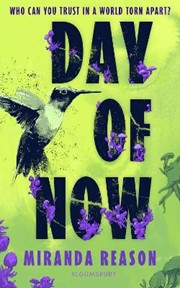 Day of Now: A powerful post-apocalyptic story about facing impossible choices