Mitch Johnson introduces his footballing adventures, Strike and Kick!


About Author
Mitch Johnson joins ReadingZone to talk about football, exploitation and standing up for what is right in his new book, Strike, a companion title to his award-winning debut, Kick.
Mitch studied Creative Writing at East Anglia university, whose notable alumni include David Almond, Ian McEwan and Kazuo Ishiguro. He now works as a bookseller at Waterstones, Norwich, and writes in his spare time.
Kick, Mitch's debut novel, won the 2018 Branford Boase Award. He loves reading and, like Kick's Budi, is a big football fan (although his chances of turning professional are considerably slimmer!)
At X @MitchAuthor
Interview
June 2026
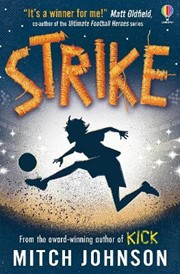
Mitch Johnson shares his passion for football in Strike, the follow-up to Kick (Usborne)
Strike - a behind-the-scenes look at the footballing world - is a perfect read for the World Cup season! Strike is a stand-alone read, but the events in the story follow on from Mitch Johnson's earlier novel, Kick, which introduces readers to the real world conditions of workers behind the glamour of football.
In Strike, Owen lives for football and is elated to earn a place at Harrowfield FC. Then a note in his new football boots alerts him to the working practices that lie behind football's expensive branding, and discovers the cost of speaking out against such practices.
ReadingZone caught up with author Mitch Johnson, to talk about his passion for football, what inspires him, and why he feels stories have a role to play in activism.
Read more about Strike and Kick, with extracts to download

A Creative Challenge from Mitch Johnson: Think about something you wish you could change about the world - something unfair that makes you angry or sad. How might someone change things for the better? Perhaps your main character could develop a special power, or maybe they discover a dangerous truth that threatens to disrupt the status quo. Who would oppose this new world, and what desperate things might they do to keep things as they are?

Mitch Johnson's School Visits: I love visiting schools! My assemblies are full of fun challenges and activities that explore the themes and research behind my books. Expect me to turn up with lots of football-related props and bundles of energy for getting kids reading. I also offer creative writing workshops for smaller groups. There's more information, and a contact form for getting in touch with me, on my website: www.mitchjohnsonauthor.com.

Q&A with Mitch Johnson: Football, passion - and putting wrongs to right!
"Footballers have so much power and influence, and I would love to see more of them
using it to change the world."
1. Thank you for joining us on ReadingZone to talk about your new book, Strike. Can you tell us three things that readers won't know about you?
The first is that I love cooking and baking (and eating). If I wasn't a writer, I would probably be working in the kitchen of a fancy vegan restaurant. The second is that I have a GCSE in Ceramics. The third is that I am very tall. So tall, in fact, that the most common question I get asked when I visit schools is: 'How tall are you?'
2. Why do you see writing as a form of activism, and what kinds of issues do you tackle in your novels? Do any of your novels have a special place in your heart?
I think books are a great form of activism because they invite you to think about things in a different way. Empathy is fundamental to creating a fairer world, and books offer readers the opportunity to walk in someone else's shoes for a while.
My first novel, Kick, tackles issues like corruption, exploitation and child labour. It's a special book to me because it was the first novel I had published after ten years of trying and failing. Its existence is a testament to perseverance.
3. What happens in your new book, Strike? How does it link to your earlier novel, Kick? Why did you decide to return to this world of football, money and ethics?
The main character in Strike is a boy called Owen. His dream is to become a professional footballer, and it looks as though that dream is coming true when he gets scouted by a top-flight academy. But Owen soon learns that the beautiful game might be hiding some ugly secrets, and he is forced to make some very difficult choices. Together with his best friend, Teddy, Owen has to decide whether he is willing to trample on the dreams of others in order to realize his own.
Strike is set ten years after the conclusion of Kick, and explores many of the same themes: friendship, resilience, hope and loss. However, whereas Kick focuses on the people who make things like football boots, Strike looks at the role consumers have to play.
I've written Strike so that it makes sense even if a reader is unfamiliar with the events of Kick. But if you have read Kick, you might meet a couple of familiar faces . . .
4. Is football a passion of yours - are you looking forward to the World Cup 2026? How do you do your research into football and how it's played?
I love football, although I don't follow a particular team. Tournament football is my absolute favourite as the stakes are so high right from the first game, so I'm looking forward to the World Cup. It's set to be a controversial tournament for many reasons - the scale, the cost, the environmental impact, the punishing conditions - but my hope is that it will provide opportunities to talk about the ways in which football could be better.
Harrowfield FC, the club in Strike, is entirely fictitious, but I still had to do lots of research. I took a tour of Wembley Stadium, and also read books that explore what goes on behind the scenes, especially relating to the economics of football. I'm very lucky that I can watch football and legitimately call it work!
5. The novel explores the exploitation behind the players and merchandise by a team's billionaire owner. What are your own feelings about the costs of supporting football?
Football is nothing without the fans, but unfortunately the costs associated with supporting a team exclude a lot of people: replica kits, football boots, TV packages and matchday tickets can all be prohibitively expensive. I recently read that it would cost a family of four over £20,000 to spend two weeks following England at the World Cup!
Football is big business, but it must never forget that it exists only because millions of ordinary people support it. I think more decisions in football should be made with these people in mind.
6. Can you tell us about the two boys at the heart of the novel, Owen and Teddy, and their strong friendship? Why was this such an important part of the novel for you?
Owen's life has plenty of ups and downs, and it's so important to have someone dependable you can share these with. Owen and Teddy are both talented footballers and when they play together, special things happen on the pitch.
Teddy is very likeable and a bit of a joker, which helps to lighten the mood when things are looking gloomy. Owen, on the other hand, is a bit quieter and less self-assured; he's battling the doubts and demons that assail anyone who's ever dared to follow their dreams. Teddy helps to make that battle winnable. They make a great team.
7. Did you enjoy bringing Budi back into the mix, too? Has he achieved everything you had hoped after the events in Kick?
It was so nice to see Budi again! I get asked by so many readers about the ending to Kick and what happens next: now people will be able to find out for themselves.
Budi has certainly come a long way, but there are still many things he is yet to achieve - on the pitch and out in the wider world. In Strike, readers will discover just how many of his big dreams became a reality.
8. Strike gives a strong voice to activism and how players can change the game. Do any footballers stand out for you for having done so? What would you like readers themselves to take from Owen and Teddy's activism?
Footballers have so much power and influence, and I would love to see more of them using it to change the world. Great examples include Marcus Rashford tackling food poverty, Megan Rapinoe championing LGBTQ+ rights, and Héctor Bellerín advocating for living sustainably. Juan Mata's challenge to fellow footballers to donate 1% of their salaries to charity has the potential to achieve so much - 1% might not sound like a lot, but in the world of football it would be a game changer!
Of course, changing the world isn't solely the responsibility of players. Footballers are themselves just small cogs in a mighty machine. That's where individuals - like Owen and Teddy, you and me - come in. We often have more power than we realise, and when we work together our impact is amplified.
9. What kinds of books do you enjoy reading when you're not writing? Are you working on another novel currently?
I enjoy all kinds of books - my next read is normally very difficult to predict! When I'm planning a new idea I will often read non-fiction to get a better understanding of the subject, but I prefer to read fiction. I recently read a book called Glowrushes, which was beautiful, and I'm very excited to read The Neverfear, the next instalment in Katherine Rundell's excellent Impossible Creatures series.
I wish there was a magical place I went to for my ideas. I think the most important thing is being curious, and open to the possibility that a new story is waiting to be told. Kick was inspired by a piece of rubbish that I found in a box of football boots, so ideas really can come from anywhere!
Currently, I'm working on an historical mystery series, which is unlike anything I've written before. I'll keep my fingers crossed that it turns out to be a good idea, but the only way to find out is to sit down and write it.
10. What fills your time when you're away from your writing desk, and what do you enjoy most? Do you have a passion for sport, like your characters?
I love sport - I honestly think it's one of the best things we have - but one of my favourite hobbies is slightly less physical, and that is board gaming. I think board games have a reputation for being boring and long-winded (I blame Monopoly), but there are so many brilliant, beautiful, well-designed games out there. Some of my favourites include Catan, Rebirth, 7 Wonders Duel and Flamme Rouge (which, as a bicycle race game, is a blend of both interests).
I love spending time with my daughters, who teach me far more than I teach them. And I love reading, of course. I could sit and read for hours . . .
 Strike
 Kick
Kick