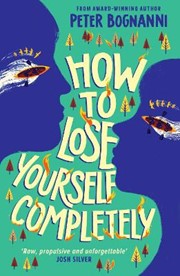
Severe anxiety inspired author Peter Bognanni's How to Lose Yourself Completely


About Author
ReadingZone caught up with author Peter Bognanni to find out more about his new novel about grief, anxiety and hope, wrapped in a deadly survival story - How to Lose Yourself Completely.
Peter Bognanni's first novel, The House of Tomorrow, won the L.A. Times Book Award for First Fiction and was adapted into a feature film starring Ellen Burstyn and Nick Offerman. His second novel, Things I'm Seeing Without You, was published in four countries and is currently in development for television.
When he's not at his desk writing, Peter teaches Creative Writing at Macalester College.
Interview
July 2026
Exploring mental health and anxiety in How to Lose Yourself Completely
Author Peter Bognanni reflects on the personal struggles that inspired his new YA novel, How to Lose Yourself Completely (Rock the Boat), a propulsive adventure about teenagers on a wilderness therapy trip who find themselves in a fight for survival.
Exploring anxiety, grief and hope, How to Lose Yourself Completely shines a light on the strength and resilience of young people who struggle with their mental health. Find out more in ReadingZone's indepth Q&A with the author, and Peter Bognanni's video introduction to the novel.
More about How to Lose Yourself Completely Review: "How to Lose Yourself Completely is a beautifully written, deeply empathetic YA novel that merges survival odds with emotional truth."
Q&A with Peter Bognanni: Exploring anxiety, grief and hope in How to Lose Yourself Completely
"It was empowering to be able to write a lot of my internal experiences into these characters
and do it without holding back."
1. Thank you for joining us at ReadingZone to talk about your new YA book, How to Lose Yourself Completely. Can you tell us what happens in your novel?
How to Lose Yourself Completely is a story about a teenager named Case who has anxiety which has gotten worse in the aftermath of his brother's death. He takes a chance and decides to go on a wilderness therapy trip that soon turns into a fight for survival. Along the way, he comes to befriend and rely on the four other anxious teens on the trip. It's a book about fighting for your life in every possible way.
2. Why did you want to write this book?
I was diagnosed with Anxiety Disorder when I was around 18 years old. At that time, when I was feeling a lot of shame and fear, it would have helped me to see a realistic depiction of a character dealing with this.
I learned about wilderness therapy from a mental health professional and the idea stuck with me. I couldn't stop wondering what it would be like to have to survive in the wilderness while also trying to tame your unwieldy thoughts. The combination seemed like it had the potential for a lot of dramatic and meaningful moments.
3. Did your struggles with anxiety make writing How to Lose Yourself Completely a challenging process?
I think it would have been more challenging ten years ago. For most of my life, anxiety has been a hard thing for me to talk about because of the internalised shame. For a long time, I thought speaking about it or writing about it would out me as someone defective or weak.
But I've done a lot of work to understand my anxiety, and this time around, I felt really energised to write about it. It was empowering to be able to write a lot of my internal experiences into these characters and do it without holding back.
4. Why did you decide to put bereavement at the heart of the story, and what other themes do you explore through the novel?
I write a lot about grief and loss. It's a subject I can't seem to stay away from. I was a little death-obsessed as a child, and as I've actually lost people in my life, it has become a more complex topic for me. I'm fascinated by the way death is so normal in one sense. It literally happens every day. Yet it's also such a rupture for someone grieving, such a hard thing to rebuild around.
In this book, I wanted to explore the fact that you're feeling pain after a loss because you loved the person so much. That's at the heart of grief and it seems like something worth examining on the page.
5. Can you tell us about the group of characters in the book? Did you have a soft spot for any of them?
My original idea was to show the reader a different kind of anxiety with each character. And how there are many different ways young people live with this. So, I had some archetypes in mind when I started. But as I developed the characters, their own little quirks and desires made them more than just stand-ins for a specific diagnosis. They became people to me. And people are much more layered and contradictory than you might think.
As far as a soft spot goes, I always kind of loved Troy. He's so earnest about his love for his dog, and I like the way he learns to find strength in his vulnerability. But Fran gets the funniest lines, so in some way she was the most fun to write.
6. The novel is told, unusually, by Case but from the second person perspective (so 'you') - why did you decide on this approach, and did it make it technically harder to write?
I started off writing this book in the first person, and something felt flat about it. Then, one fateful night, I came across a small section I had written as an experiment in the second person, and everything just kind of clicked.
The fact that it's written very similarly to a first-person book but that Case doesn't use an "I" made me think about the ways he is so disassociated from himself. He doesn't feel stable and embodied enough to call himself an "I". This felt like a unique and true way to capture anxiety.
7. How did the Choose Your Own Adventure style of novel become so core to the story - were you a childhood fan?
I was most definitely a fan. And I had an obsession with the very book that Case's older brother is obsessed with. When I settled on using the second person, I knew I wanted to reference those books, which were my first literary experience with that point of view. Then just finding a way to work them into the book led to a subplot that I came to really like.
8. Case and the group have quite an experience in the wild - how would your teenage self have copied with a wilderness adventure? Have you spent time in the wild, like your characters, to research the novel?
This is the very question I feared the most when writing the book. Because in some sense I am a total fraud when it comes to this material! I'm not really an outdoors person. Yes, I've been canoeing. Yes, I've been to summer camp and on long hikes. But most of the research I did was interviewing wilderness therapists and reading lots of first-person accounts of other people's adventures.
However, it was also helpful to be in the headspace of these characters, who are just as scared as I would have been. As far as my teenage self goes, I would have been a mess out there!
9. Are you critical of the promises of 'cures' - like outdoor adventures - for those who struggle with mental health?
It's complicated. On the one hand, yes, anything that says it's going to cure your anxiety should probably be looked at with some suspicion. In my experience, it's a lifelong process to control and accept it. Also, there are a lot of "troubled teen" experiences that are dangerous and not run by professionals.
That said, I've also met people who work with children and go walking with them in the woods while they talk about difficult things, and that can be a beautiful way to awaken the mind. There are studies that show listening to birdsong actually increases happiness. So, it's not all scam.
10. What would you like readers who struggle with their mental health to take from the novel? And those who don't?
For those readers that are dealing with similar things to the characters, I hope they feel seen and ultimately hopeful about what they're going through. I don't want to present a false sense of "everything is always going to be okay" in the book, but the truth is that of all the people I know who have mental health problems, the vast majority of them have come to live really satisfying and meaningful lives. It takes time, but they've gotten there. So, I also don't think providing some hope is falsely optimistic.
For those who don't have this struggle, I suppose my hope is that they get a brief window into the experience and leave with more empathy than they had before.
More about Peter: What kinds of things do you enjoy doing to relax when you're away from your desk?
First of all, I have three kids, and they're still pretty young, so I spend a lot of time with them. Bike rides. Basketball. Some D&D. Lots of art. But when I'm on my own, I'm a huge movie buff, and I love seeing live music. Anything that takes me out of my own head and transports me someplace else for a while is a joy in my life. Which is why I've always loved books, and eventually wanted to write them!
 How to Lose Yourself Completely