Marie Louise Fitzpatrick introduces her magical tale, The Museum of Lost Umbrellas

About Author
Marie-Louise Fitzpatrick talks to ReadingZone about the true stories and a real museum that helped inspire her new series, The Museum of Lost Umbrellas.
Marie-Louise is an Irish writer and illustrator who creates children's books across the age groups. Her award-winning titles include Izzy and Skunk, Owl Bat Bat Owl, and Hagwitch. Her YA novel On Midnight Beach was shortlisted for the Carnegie Medal and Sisters of the Moon, also YA, was shortlisted for an Irish Book Award. The Museum of Lost Umbrellas is the first in a middle grade series.
Marie-Louise lives in County Kildare and runs on coffee and chocolate.
Interview
August 2025
Magical Umbrellas, a secret island, and a quest: Marie-Louise Fitzpatrick introduces The Museum of Lost Umbrellas
Discover what inspired this story of flying umbrellas, magical houses, a strange museum and a secret island from author Marie-Louise Fitzpatrick, who introduces her new series, The Museum of Lost Umbrellas (Faber Children's), and sets a Creative Challenge; bring to life your own magical umbrella!
Read a chapter from The Museum of Lost Umbrellas
Review: "The Museum of Lost Umbrellas is one of those books which captivates readers from the outset."
Marie-Louise Fitzpatrick introduces The Museum of Lost Umbrellas
"There's an enchanted library, a talking bird, a large grey dog, picnics and high teas,
swimming, flying, secret passageways, and magic - lots of it."
1. What brought you into writing for children, and what kinds of stories do you enjoy sharing?
I left art college wanting to become an illustrator and I started writing my own stories. I've created all kinds of stories since then, books for toddlers and for teens and every age between, including wordless picturebooks, adventures, historical picturebooks and novels. There are also a few philosophical turns and plenty of myths, legends and lore woven through the mix. Overcoming fear and dealing with conflict are definitely my main concerns - common themes in all our lives!
2. Can you tell us about your new book, The Museum of Lost Umbrellas?
Dilly Kyteler, recently orphaned, comes to live on the isolated island of Ollipest with an aunt she never knew existed. On her first trip into Wurmston, the island's twisty little town, Dilly comes across The Museum of Lost Umbrellas and, before long, strange things are happening. Dilly begins to suspect that there's magic afoot and secrets to uncover. And she's right. There's an enchanted library, a talking bird, a large grey dog, picnics and high teas, swimming, flying, secret passageways, and magic - lots of it.
3. What actually sparked the initial idea for this story - was it .... a lost umbrella?!
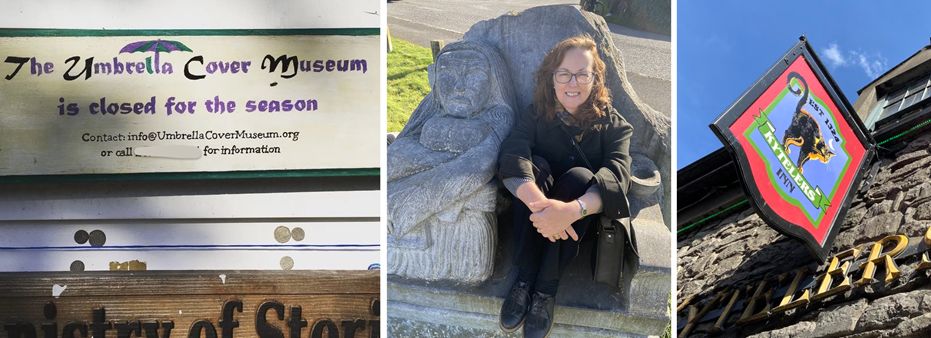
I woke up one morning in 2020 with the idea for the museum and the island in my head. Later that day I remembered being on Peak's Island several years before and seeing a sign in the window of an ordinary house. 'The Museum of Umbrella Covers is closed for the season,' it said. The idea of this tiny, obscure museum in someone's front room tickled me pink and obviously lodged in my brain like a seed!
That, and the memory of hearing about Dame Alice Kyteler (the Witch of Kilkenny, see below) for the first time when I was eight, collided to create the idea.
4. Umbrellas are often more than just umbrellas in stories, Mary Poppins being a famous example. What makes umbrellas so fascinating to writers?
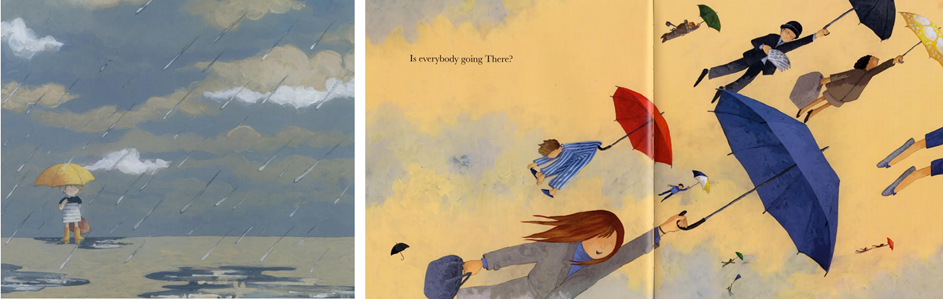
I think umbrellas are fascinating things, flimsy and functional, and often very beautiful. They can be quirky and fun, or fashioned into deadly weapons by spies. The umbrella as a means of flight is definitely lodged in our collective imagination. As well as Mary Poppins, there's Sandra Bullock and Nicole Kidman jumping off the roof in Practical Magic, a similar scene in Gilmore Girls, and plenty of flying umbrellas featured in works of art. I used flying umbrellas of one my picture books back in 2009, so I have form!
5. The magical Ollipest Island, where this story is set, hides many secrets. Why did you decide to set the book on an island, and how did you go about creating this world? Which part of it would you like to visit, if you could?
As a kid I adored books set on islands - I was a big Blyton fan, which I'm sure you can tell from some of the details in the book. Small islands are self-contained worlds and that's really useful for a writer. It sets parameters - especially handy when world-building!
The world-building was a challenge for me but I've really enjoyed it. There has to be a proper logic to the things you create, a reason why things work the way they do. My editor, Alice Swan, kept me straight! She asked question after question to push me to think things through.
Ah! Dilemma. I'd so love to walk around the narrow streets of Wurmston, but I'd also love to explore the library at Tail End, or picnic among the standing megaliths in the Field of Walking Stones.
6. When Dilly, your main character, arrives on Ollipest Island, she is an orphan and making a fresh start. How does she change on her journey through the novel, and did you have this plotted ahead of writing her story?
Dilly's journey to find a new home and family, having lost hers, became the heart of the book, but originally Dilly was a secondary character. Her mum was alive, Dilly was only six years old and she had an older sister called Rue who was the main character. The family was bequeathed Tail End by their unknown and recently deceased Aunt Florence on condition that they move to Ollipest Island immediately.
In that initial draft, Dilly was much more interesting, alive, and lovable to me than Rue, and Aunt Florence - though dead - was more vivid and present in her will than any other character in the story. Without further ado I killed off the other characters, brought Florence back from beyond the grave and aged Dilly up. In draft two Dilly and Aunt Florence took centre stage, which is clearly where they belong!
7. Which magical character or object on Ollipest Island did you have the most fun writing into the story?
The library. It really has taken on a life of its own. I'm not sure I ever intended it to be enchanted in the first place. It came alive when Dilly walked into it in that second draft, and it got more and more alive as I wrote on! I loved writing Little Green too. Bringing inanimate objects to life has been unexpectedly easy and so much fun! I grew up watching Walt Disney on TV every Sunday which probably helped.
8. The Museum of Lost Umbrellas is a fabulous adventure, but Ollipest Island also has a dark side and through the story, you explore how people's fears can be manipulated by powerful speakers. What would you like your readers to take from the novel?
That! That individuals can have charisma and an ability to proclaim and persuade, and they may use those abilities to be good leaders or to spin chaos for their own gain. We are all responsible for who we chose to follow and why. Am I following this person because I'm afraid? Am I handing over my power to someone else because I want them to fix the world for me? Am I happy with how they choose to act on my behalf? Do I care less who gets hurt, so long as it's not me?
9. What other kinds of discussions do you hope The Museum of Lost Umbrellas might inspire?
What I'd really love is for the book to be so easy and fun to read and inhabit that it inspires the reader to pick up another book. And another. And another.
10. What else do you have planned for Dilly and her new family and friends on Ollipest Island?
Book 2 is underway and I've several other ideas tacked to my wall. Some are Dilly and Callum stories, and some are from other eras on Ollipest. One idea takes place when Florence, Digdee and Mannix are twelve, another is the island origin story, set in 1324.
Creative Challenge:
Many of the families on Ollipest Island have a link to a magical umbrella. What do you think your umbrella would look like, and what kind of character would it be? How old is it? Who in your family owned it before you? What sort of handle has it? Can your umbrella make a noise or talk? Is there a pattern on its canopy or is it plain? Draw a picture of your umbrella in the centre of your page and write all the interesting details about it around your drawing.
Author Visits:
I do events, mostly festivals, shops and libraries. With the 9+ age group I speak about my work as a writer and illustrator, describe my process, where I get my ideas from. I usually do a spot of reading and quick drawing, or I set a challenge like the one above and chat to the children as they complete it. I answer loads of questions, of course! I live in Ireland so that limits my reach.
 The Museum of Lost Umbrellas