Simon Chapman explores The Speed of Light


About Author
Simon Chapman brings Einstein's theories about relativity to life in The Speed of Light, including what inspired his theories - and what would happen if we could travel at the speed of light!
Simon is an experienced Physics teacher, but he's also an author, traveller and adventurer. He has been entertaining young people with books on such diverse subjects as dinosaurs, rivers, extreme natural environments and even alien invasions for over 20 years, including in his Blue Peter award-winning Explorers Wanted series, which he also illustrated.
www.simonsjungle.co.uk / @simonsjungle
Interview
August 2025
Simon Chapman explores The Speed of Light, part of the Big Ideas series (Nosy Crow)
Einstein's theory of relativity is brought to life in Simon Chapman's new book, The Speed of Light. Find out what inspired his theories, and discover what would happen if we could travel at the speed of light!
With clear explanations supported by illustrations by Wenjia Tang, this is an invaluable guide for young and old about one of the major breakthroughs in scientific thinking this century - Einstein's theory of relativity. Published with experts from the University of Cambridge, it's the latest book in the Big Ideas series, published by Nosy Crow.
Read an extract from The Speed of Light Review: "Perfect for developing an interest in science and scientists!"
Q&A with Simon Chapman: What would happen if we could travel at the Speed of Light?
"I've always been fascinated by the idea of relative motion - that it can seem like you are stationary when
you're actually moving very quickly. What would happen if you could travel at the speed of light?"
1. Thank you for joining us on ReadingZone to talk about your new book, The Speed of Light. Can you start by telling us a little about your journey as a writer, and what got you started in writing non-fiction books?
My writing really came from the sketches and notes I make in my diaries when I go on jungle expeditions (I've taken a canoe to unexplored jungle rivers in the Amazon every couple of years for over twenty years now). I wrote cartoon guides on how to explore the rainforest, the African savannah, the Siberian wilderness etc. to answer all the questions that my school pupils would ask.
I've written lots of children books since and I suppose I'm proudest of the ones that use the watercolour paintings painted 'on location', like several of spider monkeys in Bolivia, drawn while the monkeys were swinging in the trees just above my head.
2. What's the secret to writing great non-fiction? Do you like to know about the subjects you write about, or do you enjoy researching new topics?
I think you have to know your stuff. I read loads, go to the places I write about and meet experts on the subjects - like with The Speed of Light, I have taken school pupils to the Large Hadron Collider (mentioned in the book) twice and talked with quite a few scientists both there and at Lancaster University which I live quite close to. I think getting to know a lot about the subjects lets you tell the bits which are worth knowing.
3. What is your new book, The Speed of Light, about, and how have you approached it? What will readers discover in its pages?
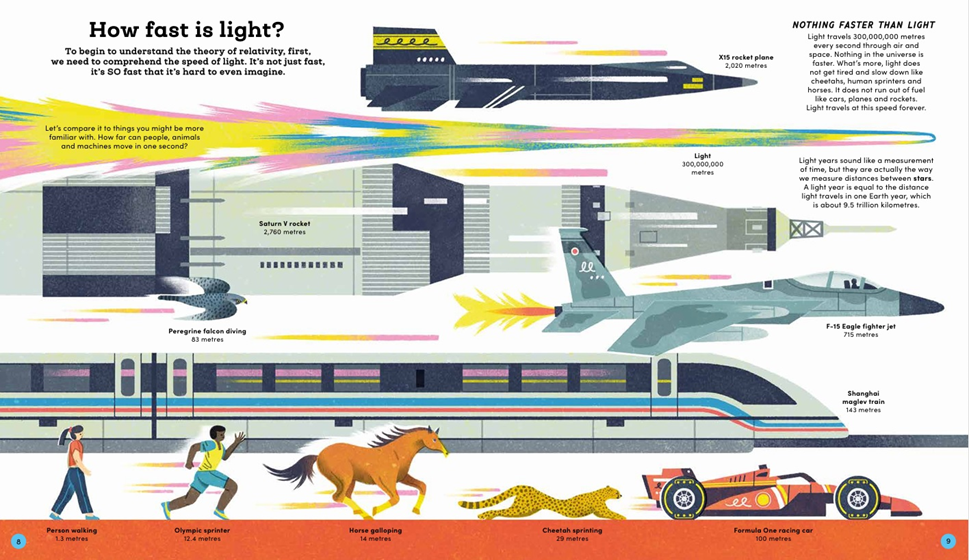
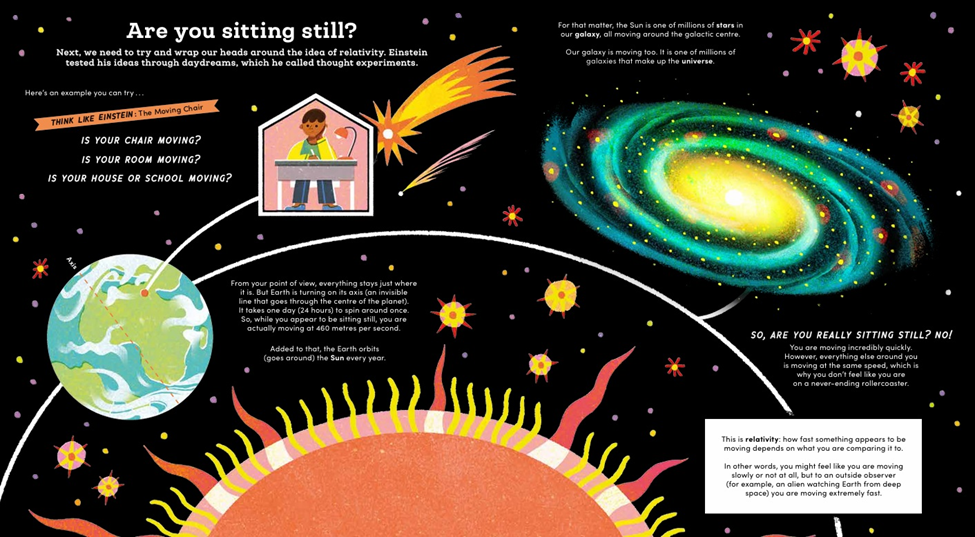
I've always been fascinated by the idea of relative motion - that it can seem like you are stationary when you're actually moving very quickly. What would happen if you could travel at the speed of light? That's what the genius scientist Einstein was thinking about. He said time and distances would warp. Basically, I wanted to get his ideas across in an understandable way.
4. How did you go about researching the subject of light in order to write about it?
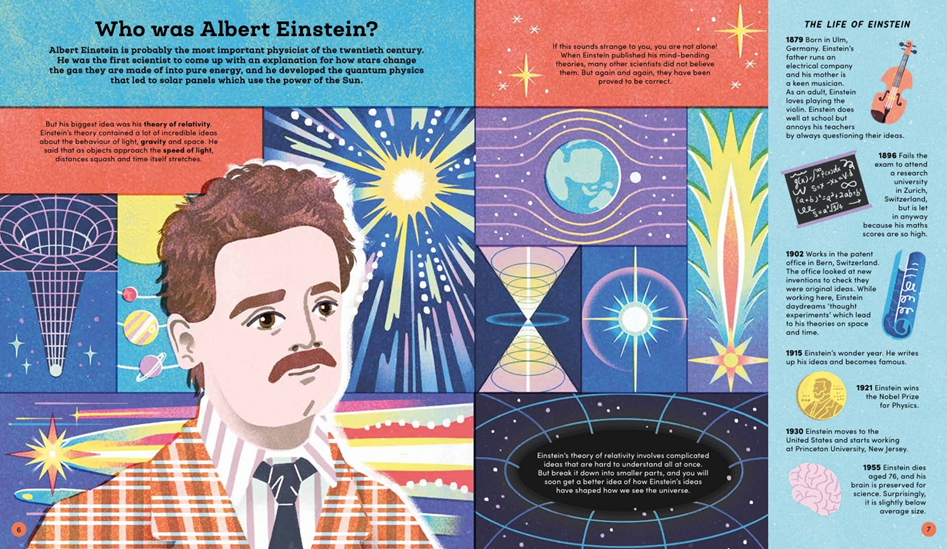
I was lucky because as a Physics teacher, I had learned some of the subject to teach at school so I had a basic idea of some of the ideas involved. I came up with the idea of how the science should follow on from page to page. I read a lot about Einstein and his ideas, wrote the page spreads then cut lots of the information down to leave just the most important bits.
Doctor Nicki Baker Campbell, a physicist from Cambridge University, checked that what I had written was correct and we had a bit of back-and-forth communication to get the science right but keep the book short enough and readable for young readers to understand.
5. Did you find out things about light and our universe that you didn't know before? What is your most mind-bending fact(s) about light?
I had come across the idea of warp drives in TV and film science fiction but I had no idea that scientists were actually working out if they could be made and how it might be possible to 'fold' space.
I can explain to myself or to others (if I had time) why astronauts on a really fast space ship experience time slower than people of Earth but I still find the idea of 'time dilation,' as it's called, really weird.
6. Why is it important that children know about the science of our world, and how challenging has it been to explore and explain Einstein's Theory of Relativity for young people?
I believe its really important for everyone to understand as much as they can about how the world - and the universe - works and not just accept 'that's how it is'. It's the only way that humankind can go about sorting huge problems like climate change and mass extinctions.
But Science is fascinating, too, and I want children to be interested by it. Understanding the theory of relativity is hard and I haven't fully grasped all the ideas - or the maths. I've left out the different types of relativity that Einstein talked about and simplified it to a format that I hope children find interesting
The illustrations by Wenjia Tang show the complex ideas well and simply. When I'm explaining science in my teaching, I always draw lots of diagrams, but Wenjia is much better at doing it than me.
7. What kinds of things do you enjoy finding out about in your day-to-day life, and where do you go to relax and discover more ideas?
All sorts of things. I've just read a book about the history of Scandinavia, which is nothing like my normal interests of jungles and science. To relax and get mind-calm, I go kayaking either on the sea or down whitewater river rapids.
9. Do you travel much for your work? Where's the most exciting place you've been to research a book?
Normally I just cycle the five miles to the school where I work! But I've written lots of books about jungles and mountains and these have led to me making expeditions to the Amazon rainforest, The Chinese Himalayas and far-eastern Siberia- amongst other places.
10. What are you researching or writing currently?
I've drafted up chapter ideas for a book about grasslands, based on my experiences with wildlife and people in Africa and South America. I've also got a book idea on how humans are looking for life in outer space. Being a keen kayaker, I would also like to write about the science of water and how it flows.

Creative Challenge: Imagine you are on a spaceship travelling at close to the speed of light. What would you see around you? When you return to earth, more time will have passed for the people at home than it will have done for you. How might things have changed?
School Visits: I'm more than happy to visit schools for talk etc., although I don't yet know my availability next term just yet. Until I update my website www.simonsjungle.co.uk, contacting me at [email protected] is best.

 University of Cambridge: Think Big: The Speed of Light
 Rivers: An incredible journey from source to sea
 Expedition Diaries: Indian Lowlands
 Expedition Diaries: Himalayan Mountains
 Expedition Diaries: Borneo Rainforest
 Expedition Diaries: Amazon Basin
 Expedition Diaries: African Savannah