Sophie Anderson reveals her sequel, The House With Chicken Legs Runs Away


About Author
Award-winning author Sophie Andersen returns to the world of The House With Chicken Legs with a sequel, The House With Chicken Legs Runs Away. She tells ReadingZone more about it.
Sophie Anderson was born in Swansea and now lives in the Lake District with her family. Her writing is often inspired by folk and fairy stories, especially the Slavic tales told by her Prussian grandmother.
Across her bestselling novels, Sophie has won the Independent Bookshop Book of the Year Award and the Wales Book of the Year Award, and been shortlisted for awards including the CILIP Carnegie Medal and the Waterstones Children's Book Prize.
Interview
April 2027
Author Sophie Anderson revisits Baba Yaga folklore in The House With Chicken Legs Runs Away
Sophie Anderson's debut novel, The House With Chicken Legs (Usborne), a story about grief and found family, Slavic folklore and Baba Yaga's house, found its feet almost immediately in schools and homes across the world. Now, readers are invited back to visit Baba Yaga's house once again in a sequel, The House With Chicken Legs Runs Away, and with a further book planned.
ReadingZone caught up with Sophie to find out why she decided to write a new story about Baba Yaga's house, what themes she explores through the novel and what other adventures are to come for the house with chicken legs.
Review: 'In The House with Chicken Legs Runs Away, readers are transported back to Marinka's world for another beautifully crafted adventure.' Sue, teacher

The House With Chicken Legs Runs Away: All Marinka's life, she has lived in her house with chicken legs. Running across the world on magical adventures, Marinka knows how her house is feeling, and it listens to her, too. But something is wrong. And before anyone can stop it, the house has pulled itself apart and run away. Read a Chapter from The House With Chicken Legs Runs Away.


Creative Challenge from Sophie Anderson: In The House with Chicken Legs Runs Away, Marinka and Benjamin fly in a sentient mortar and pestle called Valiant. There are many other interesting flying objects in folk and fairy tales - carpets, brooms, horses, ships, even stoves! What kind of object would you like to fly in or on? Can you write a scene in which you discover this object flies, and you go for a flight together? Where would you go?

Q&A with Sophie Andersen: Revisiting the world of Baba Yaga in The House With Chicken Legs Runs Away
"If I had a house with chicken legs? I'd like a cosy writing area on the front porch, so I could watch the view
as we travelled through enchanted forests to a beautiful beach."
1. Hello Sophie, thank you for joining us on ReadingZone to talk about your new book, The House With Chicken Legs Runs Away. Your debut The House With Chicken Legs is now read by children throughout the world, but what first inspired you to write about a house with chicken legs?
The House with Chicken Legs was inspired by the Baba Yaga tales my grandmother told me when I was young, and I wrote the book to comfort me through grief. These personal connections mean that the house will always hold a special place in my heart.
2. You didn't think you would return to The House With Chicken Legs, so why did you decide to revisit these characters in a new book, The House With Chicken Legs Runs Away?
The characters from The House with Chicken Legs have stayed with me - I've thought about them often and had many interesting conversations with readers about what might come next for Marinka and her house. These conversations, and my own evolving journey with grief, led me back to this world.
3. What happens in The House With Chicken Legs Runs Away - and can readers who haven't read The House With Chicken Legs still enjoy it?
The House with Chicken Legs Runs Away can be enjoyed as a standalone. At the start of the story, we meet Marinka and her house, and learn they are a family and that they care about each other deeply. When the house begins struggling, then runs away, Marinka and her friends chase after it, and a magical quest follows to try to save the beloved house.
4. What kinds of themes did you want to explore through this story and how do they link back to the first novel? Did you know what the ending would be before you started to write it?
I wanted to explore how grief changes over time, and how it can entwine with other feelings, such as guilt. There are also themes of how to help a loved one in trouble, and how we might not be able to help. And there are themes of growing independence too. I did know the ending before I started to write the book.
5. Were there also questions left from the first book that you still wanted to explore, for example, the origins of Baba Yaga's house?
It was wonderful to include the house's origin story, and to deepen and widen the Yaga world and Yaga lore introduced in the first book.
6. What else do we learn about the main characters, Marinka and the house, through their journey?
We learn the house's life story when it shares memories with Marinka. We also see Marinka grow a great deal in this book, as she learns to accept and manage some complex emotions. I love how she is becoming a kind, brave and independent young person.
7. Do you have a favourite moment or two in their story?
There are some exciting action scenes, like Marinka and Benjamin flying in a giant mortar and pestle called Valiant!
8. If you had a house with chicken legs, how would it be set up for writing and where would it take you?
If I had a house with chicken legs, I'd like a cosy writing area on the front porch, so I could watch the view as we travelled through enchanted forests to a beautiful beach.
9. There is an opening at the end of the book to explore Marinka's further adventures, do you plan to do so? What are you writing currently?
There will be one more adventure, so Marinka's story will become a trilogy. I'm currently proofreading A Year Of Fairy Tales, which publishes this September, and I'm hugely excited about it!
10. Every writer needs time out - what do you love to do with yours? As so many of your stories include references to fairy and folk tales, are these your preferred reading materials?
I do love reading folk and fairy tales, and books inspired by them, but I also love reading a wide range of genres too - memoirs, biographies, non-fiction, nature writing, poetry, science-fiction, fantasy . . . There are so many amazing books to enjoy!
Sophie Andersen's School Visits: I offer presentation events for groups of any size, in which I talk about my writing and inspirations; folk and fairy tales, their varied interpretations and reimaginings; and give creative writing advice. I also offer creative workshop events for class-sized groups, which vary with age and ability, but might involve artistic reimaginings, map-making, poetry, or creative writing as a response to various prompts. I sometimes bring in a suitcase of enchanted and cursed magical objects to inspire stories! Schools can get in touch via my website.
Sophie Andersen Image by Seenicks Photography
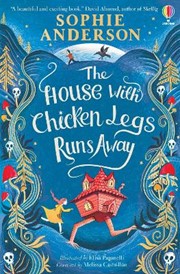 The House with Chicken Legs Runs Away
 The House with Chicken Legs