Sophie Andersen introduces The Snow Girl


About Author
Bestselling author Sophie Anderson introduces her novel The Snow Girl and gives ReadingZone a glimpse into her follow-up to The House with Chicken Legs.
Sophie was born in Swansea and has worked as a geologist, science teacher and author. She now lives in the Lake District with her family. Her stories are often inspired by folk and fairy stories, and the Slavic tales her Prussian grandmother told her when she was young.
Sophie has won the Independent Bookshop Book of the Year Award and been shortlisted for the CILIP Carnegie Medal twice, the Waterstones Children's Book Prize and the Branford Boase Award.
Interview
November 2025
Sophie Andersen introduces The Snow Girl, and tells ReadingZone about the folk tales that helped inspire it
A childhood rich with stories told by her Prussian grandmother instilled in Sophie Anderson a love of folk tales and mythology, and these stories now often make their way into her novels, including her hugely successful debut, The House with Chicken Legs.
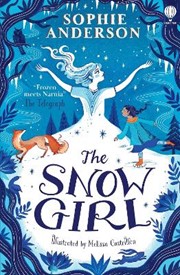
ReadingZone caught up with Sophie to find out why she returns to myths and folklore in her stories, and which tale helped inspire her latest book, The Snow Girl (Usborne), which is now available in paperback. We also have a sneak glimpse into her follow-up to The House with Chicken Legs - The House with Chicken Legs Runs Away - which will be published by Usborne in March 2026. Plus Sophie leaves young writers with a Creative Challenge, to write your own wintery poem (see below).
Read a Chapter from The Snow Girl. Review: "Sophie Anderson conjures up magic by recasting traditional folklore into absorbing stories that feel fresh and modern yet timeless."
Q&A with Sophie Andersen: Exploring the inspiration and setting in The Snow Girl
"These stories connect us, to our ancestors and to each other, and for many people, in addition to
providing entertainment, they offer a guiding light."
1. Thank you for joining us on ReadingZone to talk about The Snow Girl. Can you begin by telling us about your love of myths and folk tales? Do you have any favourite collections you like to curl up with?
My grandmother told me Slavic folk and fairy stories when I was young. She was a wonderful storyteller and would sometimes tell tales while sat at her piano, playing accompanying music! Although I now love folk and fairy stories from all over the world, Slavic ones still feel particularly special to me, as they remind me of my grandmother.
There are many collections I like to curl up with - some are very old, like Alexander Afanasyev's Russian Fairy Tales, but I love plenty of modern, child-friendly collections too, such as Jamila Gavin's Blackberry Blue, and Scholastic's Classic Folktales, Myths and Legends series that has books of South Asian, African and Caribbean, East Asian, Norse, Irish, Scottish, Welsh and Greek tales. I also love Duncan Williamson's Silver Unicorns and Golden Birds: Scottish Traveller Tales for Children, Peter Stevenson's Illustrated Welsh Folk Tales for Young and Old, Lari Don's Celtic Folk and Fairy Tales, and Chitra Soundar's Stories from India.
2. What draws you to revisiting these remembered stories in your own writing? Why do myths make such a rich source of material for writers?
I think there are good reasons why myths, legends, folk and fairy stores have survived for so long. They are wonderful tales that capture the imagination and ignite powerful emotions, and they all relate in some way to common human experiences. I find it comforting to think that for thousands of years, all over the world, people have been experiencing the same hopes, dreams and fears.
These stories connect us, to our ancestors and to each other, and for many people, in addition to providing entertainment, they offer a guiding light.
3. In your hugely popular debut, The House with Chicken Legs, you drew on myths of Baba Yaga. Why do you feel that book was such a success? Do you have plans to revisit this world and characters?
I am grateful that so many people have taken The House with Chicken Legs into their hearts. As with many books, I think different readers related to it for different reasons. Some children have told me they loved the idea of the house - a living, sentient home. Others have told me they related to Marinka's struggles to find independence and friendship.
Some readers have told me how the themes of death and grief deeply resonated with them and that the book provided comfort, often through difficult times. And some adult readers have told me they were grateful for the opportunities the book provided to open discussions about mortality and the questions and emotions surrounding this. I hope, above all else, that readers find The House with Chicken Legs to be a wonderful, magical story that whisks them away and speaks to them in ways that they need.
There has been and there is ongoing film interest, so maybe one day! I have written a sequel though that will definitely publish: The House with Chicken Legs Runs Away is scheduled for April 2026 and I hope readers love it as much as I do.
4. What is the original folk tale that you've drawn on for your new book, The Snow Girl, and what drew you to it?
The Snow Girl was inspired by the traditional Russian fairy tale, The Snow Maiden or Snegurochka (pronounced Snee-gur-ochka). There are a few different versions, but they all involve a girl, who is usually made of snow, and who is bright and cheerful in winter but leaves when spring comes.
It's a lovely story, full of beautiful imagery and I always felt it's message was one of seeking out love and happiness, and living life to the full because the time we have is fleeting.
5. How have you used it in The Snow Girl - what happens in your story and how have you adapted the original tale in your story?
As with all my stories, I centered child characters - in this case, Tasha, a young girl who has recently moved with her parents to the far north to live with her grandfather. Tasha is timid and anxious after an event the previous year, and struggles to make friends in her new home. Then snow falls in the valley and Tasha builds a snow girl and makes a wish that the snow girl will come to life, so that she won't feel so alone.
Tasha's wish comes true and a magical, wintry adventure follows in which Tasha and the snow girl explore the valley on enchanted starlit nights. But when your best friend is made of winter, what do you do when spring comes?
6. Why did this myth adapt so well to the themes you explore in the story - fear and courage, friendship and loneliness? Who is the Snow Girl in the story, and what does she bring to Tasha's life?
I felt these themes worked well with the messages in the original fairy tale, and could be beautifully adapted to create a magical adventure for a middle grade audience that was relevant and relatable. The snow girl, Alyana, becomes the first friend that Tasha makes in her new home, and as trust grows between them, Tasha is able to open up about her feelings - about what happened to her the year before that has made her timid and anxious, and about all of her feelings now. Alyana helps Tasha talk about her feelings, process them, and find ways to move forwards to live her life more fully.
7. The snowy setting in The Snow Girl is almost a character in its own right. Can you tell us how it developed, and how you researched the rich detail of what life might be like for the families and nature in this setting?
I grew up in South Wales, but for the last 18 years I have lived in The Lake District. Both regions have beautiful landscapes that have undoubtedly inspired me. I love rooting my stories in the natural world, and look to my own surroundings to help me describe my settings in an authentic way.
The Snow Girl is set in a quiet valley surrounded by mountains, that is in many ways similar to several valleys in The Lake District. The stone farmhouses, small rural community, and much of the wildlife described in the book were likewise inspired by what I see and experience in my life in The Lake District.
Most winters, we have some lovely snow here too - not quite as much as there is in The Snow Girl, but enough to help me write some snowy scenes! I also surrounded myself with wintry and snowy books, including picture books, middle grade and adult novels, and non-fiction, to inspire me.
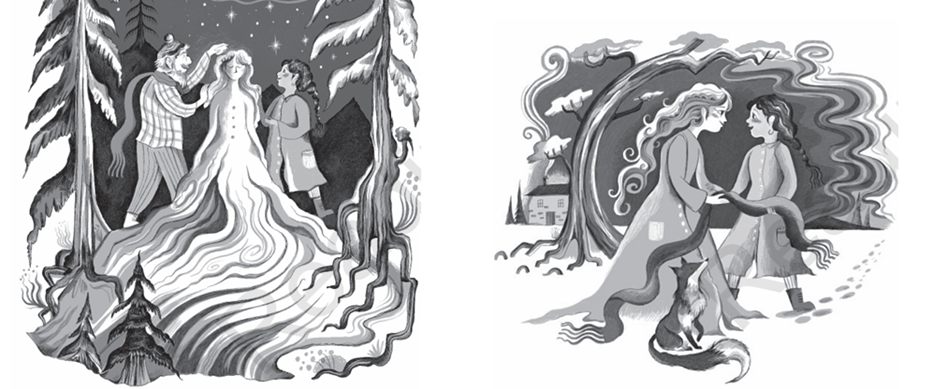
Illustrations from The Snow Girl by Melissa Castrillon
8. What do you feel the illustrations by Melissa Castrillon, who illustrated The House With Chicken Legs, bring to The Snow Girl?
They are gorgeous! Melissa is a hugely talented artist and her work is always so beautiful. Her illustrations add to the magical, wintry fairy tale atmosphere of the story perfectly and have many wonderful details for readers to pour over. I feel so grateful that she worked her magic on this story!
9. What are you currently writing? Where and when do you prefer to write? Is it hard to fit in writing time to your day?
I have just finished writing A Year of Fairy Tales, a collection of 12 re-imaginings of familiar and lesser-known fairy tales, one for each month of the year. It will be beautifully illustrated in full colour by Elisa Paganelli and published in a gorgeous gifty hardback. I'm hugely excited about this book and can't wait for it to reach readers!
10. What kinds of things do you enjoy doing in your down-time - and to help inspire new stories! Do you, like many of your characters, enjoy being in nature and the countryside?
Yes, I love the outdoors, but I find inspiration in lots of places. Folk and fairy stories are of course a huge inspiration for me, along with family and friends, the people I meet, the landscapes around me and all the places I visit, nature and wildlife, clouds and weather, towns and cities, museums and galleries, books, news stories, magazine articles, movies, documentaries, art and music. I believe inspiration can be found everywhere!

Creative Challenge from Sophie Andersen: A winter poetry challenge…
1. List around ten things you associate with winter, e.g. cold, snow, ice, frost, scarves, thick coats, warm boots, hot chocolate, winter markets.
2. Pick around three to seven of these things and write a sensory detail about each of them (how they look, feel, smell, taste or sound), e.g. the crackle of ice underfoot, the bite of frost on frozen toes, the twinkling of starlight on snow, moonlight skimming over a frozen lake, the comfort of a soft knitted scarf, the sweet scent of hot chocolate, the excitement of a winter market.
3. Put the words I am or I am not in front of some of these sentences, play with them and string them together to create a poem, for example:
I am not the crackle of ice underfoot
nor the bite of frost on cold toes
I am the twinkling of starlight on snow
moonlight skimming over a frozen lake
I am the comfort of a soft knitted scarf
and the sweet scent of hot chocolate
I am the excitement of an enchanted winter

Organising a school event with Sophie Anderson
Sophie says: I have a teaching qualification and many years' experience delivering both presentation and workshop style events in varied settings, and can tailor events to meet a wide range of needs. To discuss or book and event, contact me through my website: Contact - Sophie Anderson
Watch Sophie Andersen introduce her follow-up The House with Chicken Legs Runs Away (2026, Usborne)
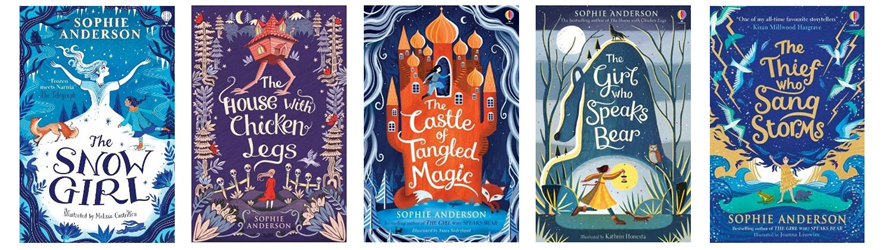
 The Snow Girl
 The Thief Who Sang Storms
 The Castle of Tangled Magic
 The Girl Who Speaks Bear
 The House with Chicken Legs