University of Cambridge: Think Big: Artificial Intelligence
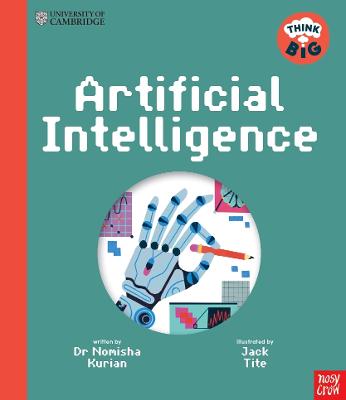
By Author / Illustrator
Dr Nomisha Kurian, Jack Tite
Genre
Non Fiction
Age range(s)
9+
Publisher
Nosy Crow
ISBN
9781805136583
Format
Paperback / softback
Published
12-02-2026
Synopsis
Who invented the first artificial intelligence? How do machines listen without ears? And can I use artificial intelligence to talk to my pets? Learn what artificial intelligence is and how it works as you explore its impact on the environment, society and even our own bodies.
Discover how artificial intelligence is used all around you, from smartphones and search engines to cars and prosthetic limbs, and how it might be used in the future!
Fun, conversational text breaks down complex ideas so they are accessible to young readers and colourful and dynamic illustrations bring abstract concepts to life. Think Big: Artificial Intelligence has been created in consultation with experts from the University of Cambridge.
For more big ideas, don't miss other titles in the series: Think Big: Secrets of Bees, Think Big: The Speed of Light
Reviews
Laura
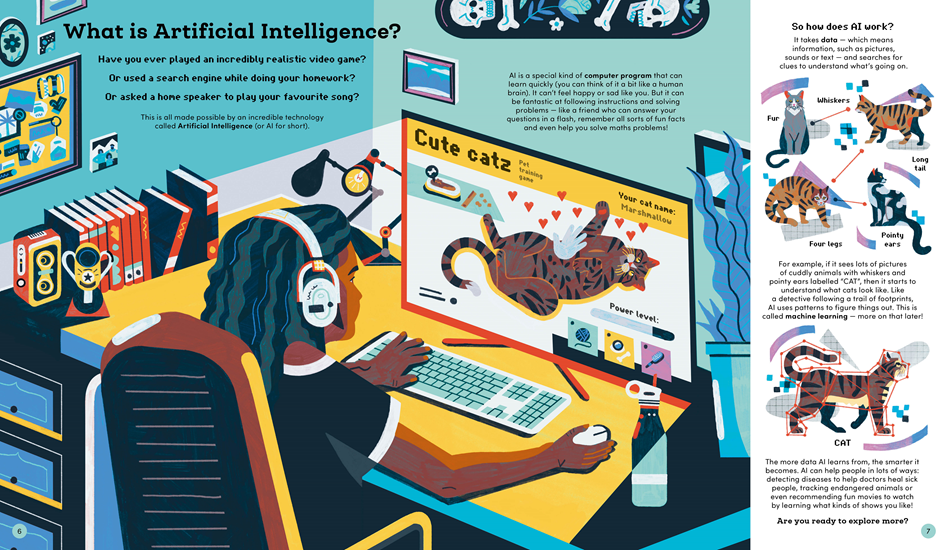
Another great addition to the Think Big series, created in consultation with experts from the University of Cambridge. First of all, we have an appealing and smart front cover which very clearly shows what the book is about, followed by a contents page at the front. The book starts by explaining how AI uses data to understand and learn. These concepts are explained well for a child with no prior knowledge of AI. We then go on to read about the history of AI, including early ideas and the first AI to win a game of strategy against a human.
Think Big: Artificial Intelligence is a great introduction to AI, simply explained and accessible. The author poses questions on each double page spread, such as 'What is Artificial Intelligence?' and 'Can Artificial Intelligence Do My Homework?'. The answers given are detailed without overwhelming the reader with too much complex information. They give the pros and cons of using AI, informing the reader of what great things can be achieved with this technology, but also making it clear that there is an impact on the environment, and moral questions to consider.
I would have liked a bit more emphasis to be put on the negatives of using generative AI, but it does allow for critical thinking and gives children a starting point. The illustrations by Jack Tite sometimes add to the explanation although mostly just make the pages bright and busy, which will appeal to many.
The book uses real-life examples of how AI might be used in daily life, without most of us even knowing it. It mentions search engines and smart speakers, which is really useful to make children aware of how different technologies work and to make a clear definition of what is and isn't AI.
Think Big: Artificial Intelligence is ideal for young children who are interested in finding out about AI, and would be perfectly placed in a school library or KS2 classroom (ages 7+). It will definitely create discussions around the potential of AI and how much we should be using it.
32 pages / Reviewed by Laura Richards, teacher
Suggested Reading Age 7+
Jane
In Think Big: Artificial Intelligence, each double page spread begins with a question; a progression which is logical and uncomplicated. We begin with the simple 'What is Artificial Intelligence?', then who invented it and whether all robots have AI, before moving onto different aspects and uses of this transformative technology. And, like all good non-fiction texts, it ends with a glossary and index, so that we can look up the definition of agentic AI, or easily refer back to a favourite section about, say, exoskeletons (the 'bionic bodies' of yore).
Many of us fear the rise of AI. This book is a step towards disarming that fear with knowledge, while cautioning that we humans do need to be careful about how we develop this technology. It is honest about some of the dangers (eg impact on the environment, and the generation of 'deepfakes') while not dwelling on these. One might smile at the editorial suggestion (pure conjecture on my part) that the answer to 'Can AI do my homework?' is an emphatic 'NO!' The text actually says 'yes, but...': explaining that it 'might give you the answers, but it can't make you understand them. Homework is a way for you to grow and learn new things.' Perhaps Dr Khan is a parent, or teacher. An author biography could have enlightened us on this and other questions, such as 'how did you come to work in this field?' and the perennial 'how old are you?'
Other positives are the stylish cut-out cover and the helpfully clear text, both in its presentation and carefully worded content. There's an apparent assumption that we readers (children primarily) are relatively new to the subject, but not unintelligent, and that most will be naturally curious and want to understand more about this futuristic field of science and its all-embracing impact. Highly recommended for home reading and for classroom discussions. A definite must for any school library.
32 pages / Reviewed by Jane Rew, school librarian
Suggested Reading Age 9+
 How to Speak and Be Heard: A Kids' Toolkit for Oracy and Confident Speaking
 Your Name Here
 World Cup Greatest Moments (Ultimate Football Heroes)
 Ultimate Football Heroes Generations: England's Heroes