Encouraging children's love of language
Posted on Tuesday, July 15, 2025
Category: Book Blog
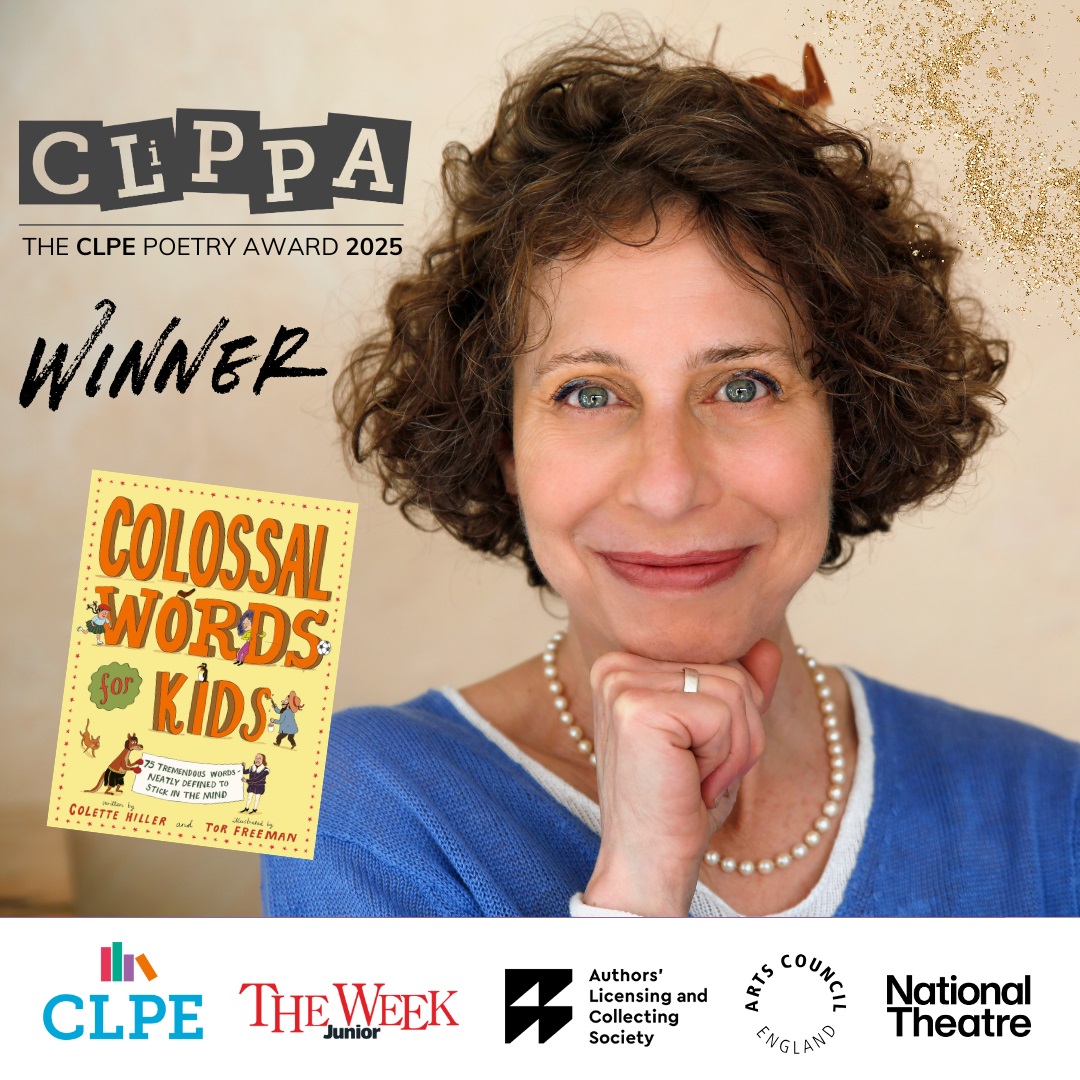
Children are natural wordsmiths, says Colette Hiller, CLiPPA winning creator of Colossal Words for Kids, and here's how can we encourage their love of language.
Colossal Words for Kids wins the 2025 CLiPPA poetry award
'My introduction to poetry came at a very young age. My mother Glynne was a writer who was hugely influenced by the French writer Colette - whom I am named after. Colette (the writer) was a liberated, free spirit - known for her appreciation of the senses.
My mother in turn, read me snippets of Colette's works. She also read me couplets of Shakespeare (This above all, to thine own self be true...) and passages of James Joyce along with A.A. Milne. The important thing was she was sharing her joy and explaining it to me through her own recitation, so it never felt foisted upon me. Instead, I was flattered she felt I could understand these things.
"It's satisfying to have the right word up your sleeve"
It's the same with all children. They enjoy knowing and using big words in precisely the same way that an adult may do. It's satisfying to have the right word up your sleeve - you feel capable.... equipped! It's a bit like having the right ingredient for a recipe. My theory is that if a child can understand the premise of a word, then they will want to use it. For example, once you know the meaning of the word 'penultimate', you won't want to say, "second to last". Once you understand the meaning of 'disingenuous' then it is empowering to identify something that is in fact, disingenuous. In having these words at your disposal, you not only speak differently - but importantly, you think more clearly. To quote Becket, “Words are the clothes thoughts wear.”
My first book, The B on your Thumb, used rhyme and poems to teach reading. In writing the poems for my follow up book, Colossal Words for Kids, I didn't set out to be "poetic". Instead, I hoped to be concise, entertaining and clear, while introducing children to new words, and to offer something more than a dictionary might do. To do this, I had to look very closely at the words I was defining. I think poetry is, in part, about looking closely at something and noticing. Interestingly, this kind of observation and deep looking is relevant to drawing. It's also important in acting - (I spent many years as an actress) for it is close observation that enables the actor to create a believable character.
Teaching useful words
I also wanted to help schools do more to teach useful words, which needn't be a difficult business, especially with the help of poetry.
By its very nature, poetry takes its time to ponder things, ideas, notions... Children also take time to ponder upon things. Small children may spend ages looking at a puddle or making a sandcastle or tucking a bear into bed. Similarly, older children may take time to ponder upon their own feelings, hopes, and thoughts. And this is precisely what poetry does.
Poetry heightens our enjoyment and appreciation of language. It doesn't just tell - it invites, evokes, and plays. Unlike prose, poetry draws attention to the sound and shape of language, turning listening and speaking it into sensory experiences.
Tips for using Colossal Words with your class
Here are tips to keep in mind if you'd like to use my book in class or with your children:
1) Spend time teaching children how to say the word itself. Take five minutes to say it in different ways and to break up the syllables.
2) Teach just one new word each week! It takes time to absorb a new word. Consider the last time when you as an adult have learned a new word. What was it in fact? By focusing on just one new word a week, the whole school (or family ) can get involved in using it. Slip it into conversations, teaching, assemblies... Everyone can try to insert the word into conversation, wherever possible! This gives the whole thing a sense of fun. When teachers (or parents) are also involved in using the word - the children will enjoy noticing - and in responding in kind.
Here is a poem that I especially like from Colossal Words for Kids because it is simple yet adds to the dictionary definition.
Judgmental
If you're judgemental
You're not open- minded
You look for fault
where you can find it
But if you're judgmental -
Then here is a fact:
You don't have good judgment
How funny is that!
Have fun sharing some colossal words with kids!
Colette Hiller won the 2025 CLiPPA, CLPE Poetry Award with Colossal Words for Kids (Frances Lincoln Books). Her new book The Elephant and the Piano, coming in August, tells the astonishing true story of what happened when a Yorkshire man in Thailand played Beethoven for a sad elephant Although written in prose, Colette says she was influenced by poetry throughout...