BBC's 500 Words writing competition is back for 2025
Posted on Tuesday, September 23, 2025
Category: Get Creative
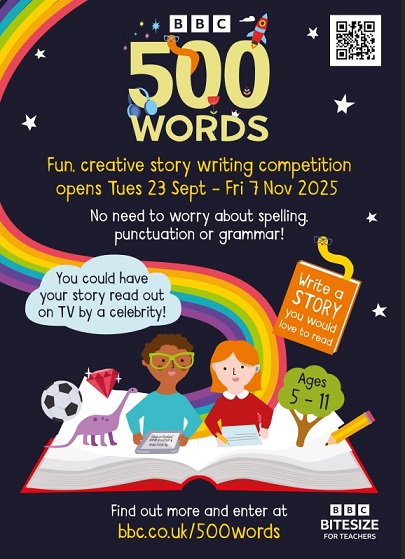
The 500 Words competition is now open, challenging children aged five to 11 years to write a short story in up to 500 words for the BBC's annual competition. Judges are looking for stories that will make them "laugh, cry or just be blown away by what we are reading".
As well as book prizes for the entrants and their schools, 50 of the finalists will be invited to a star-studded grand final at Windsor Castle in February 2026, hosted by Her Majesty The Queen. The winning stories will also be read aloud by a superstar celebrity on TV, which will be shown as part of a special 500 Words programme with The One Show in early March.
Competition details
The 500 Words competition includes two age categories: 5-7 and 8-11 year-olds. The focus for the judges is creativity; spelling, punctuation and grammar are not marked. Entries must be submitted to the BBC 500 Words website by 9pm on Friday 7 November 2025. As well as attending the final event, each winner will take home a bundle of books and the gold winners will also win 500 books for their school library. The winning stories will be illustrated by children's illustrators and published in a special 500 Words winners' book produced by Oxford University Press.
You can find further information about entering the prize, tips from the judges and a poster to download, as well as information about being a volunteer judge and the marking criteria, on the BBC 500 Words website.
Volunteer judges
The celebrity judges for the award include Sir Lenny Henry, Malorie Blackman, Francesca Simon, Charlie Higson and Frank Cottrell-Boyce. The BBC is also looking for volunteer teachers, teaching assistants, librarians and SEND staff to help read and mark the work of 5-11 year-olds. Registration is now open and each volunteer judge is entered into a random draw to attend the final.
Incentives to enter
Any schools with 50% free school meals (or higher) that submit entries will receive a £75 National Book Token. All schools need to do is submit their stories and once the competition closes on Friday 7 November, the BBC will be in touch if schools are eligible, according to the data of the Education Company.
As an added incentive for schools to enter, every story (excluding bronze, silver and gold winners) is entered into a random draw. The entrant will not only receive a ticket to the final (with a parent or guardian) and a bundle of books for themselves, but their school will also receive 500 books and a literacy wall art, to promote the love of story-telling. It only takes one submission per school to be in the draw to win a Literacy Wall Art and 500 books for your school.
Rules for entrants
There are very few rules, but they include the following: 500 Words stories must 500 words or less (the title is not included in the number); Be written by an individual and not a group; Be the child's own original idea; Be prose, not rap or poem.
Stories must not: Give any personal details of the child, including their name; Recount an historical event (but they can use a real person or historical character as a source of inspiration); Be created, written or developed by AI.
Judging criteria
All stories will be judged on characterisation, plot, originality, language and enjoyment.
Benefits of taking part in 500 Words
The 500 Words competition encourages literacy, according to 84% of teachers who submitted stories on behalf of students in 2024/25, and who felt their students were more engaged with literacy and writing as a result of taking part in the competition.
Every story entered into the competition is sent to Oxford University Press, which has now collected almost a million stories and over 500 million words since the competition began in 2011. These stories help OUP to understand the language children are using and how it's developing over time, and to find out what children are interested in: from politics to world events, celebrities to football, and it informs the creation of their dictionaries and learning resources for children. The results from this are taught in seminars and lectures around the world and help leading figures in education to improve the way English is taught in schools.