School Librarian of the Year 2025
Posted on Monday, December 1, 2025
Category: Meet A School Librarian
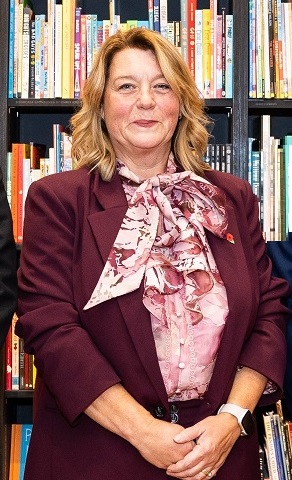
Julie Broadbent, school librarian at Northampton International Academy, has been awarded the School Librarian of the Year 2025, with judges praising her for her work in promoting reading engagement, enriching her students' experience of school, and maximising the opportunities provided by the school library.
ReadingZone spoke with Julie to find out a little more about her work across the school's primary and secondary library, what impressed the judges, and the initiatives that she feels have had the most impact on the students.
Find out more about the School Librarian of the Year Award 2025 and find out how to recommend your own school librarian for the School Librarian of the Year Award 2026 (Deadline 9am, 16th February '26).
Q&A with Julie Broadbent, introducing Northampton International Academy library
"I work really hard to foster a calm, supportive environment where students feel seen and heard."
1. Congratulations on your award! Can you start by telling us about your current library and its context, including serving specific needs in your school?
Thank you so much, I am still in shock at winning the School Library Association's Secondary School Librarian of the Year award, it truly is an honour. I am a lone librarian in an all-through school, Northampton International Academy (part of East Midlands Academy Trust). We have over 1,800 students and two libraries, which I manage and run. One library is based in our primary school and we have one library in our secondary school.
My timetable is very full, and I couldn't do it all without the support of my colleagues and my amazing team of student librarians. At social times both libraries are open and the secondary library is open before and after school. Students who use our libraries will do so for specific reasons. Whether that is for reading for pleasure, research or homework. I think it is important that students have a purpose and a focus of what they want to do or need to achieve when they come to the library. It is great that we have so many students keen to use the library everyday; it is always really busy and is a welcoming space.
In our secondary library, I help run and support all literacy lessons for all year 7 and 8 learners. I see over 600 students over a two-week timetable. I work closely with our English and literacy team and each library lesson is supported by an English teacher. Our focus for these lessons is reading for pleasure and we are committed to engaging our students with the value and importance of reading.
Whilst not all students will 'love' reading, my mission is to make them understand the value that reading gives them. Not just immediately but for their future selves. I believe that access to the library in lessons and during social times reinforces to our students the value that reading gives them.
Throughout the school day the library is also used by various classes, which include a year 11 morning tutor group, our EAL groups, small reading groups and our nurture students who all have access to the library during lessons and each group is supported in the library.
Likewise for our primary school, each morning phonics takes place in the library and we are open for students at lunchtime. Every afternoon I work in the primary library where I see all our primary learners. Years 3,4,5,6 have a session once a fortnight and EYFS, Years 1 and 2 will have a library session once a week. Here we get students to borrow books, we will read stories aloud, students can listen to audio books, read magazines and our sixth form reading leaders also support our younger readers by listening and engaging with their reading. We genuinely share our love of reading during these times. We also run 'books and breakfast' sessions before school once a week in the primary library. This is where we open the library for our parents and carers to choose books and read with their children.
When I think of the specific needs for our school, it is about giving all students access to books. For me, it is about ensuring that whoever is using the library, regardless of age or ability, they will find books that are appealing, enjoyable and engaging. I also ensure that our book collections are diverse and are representative of our school community.
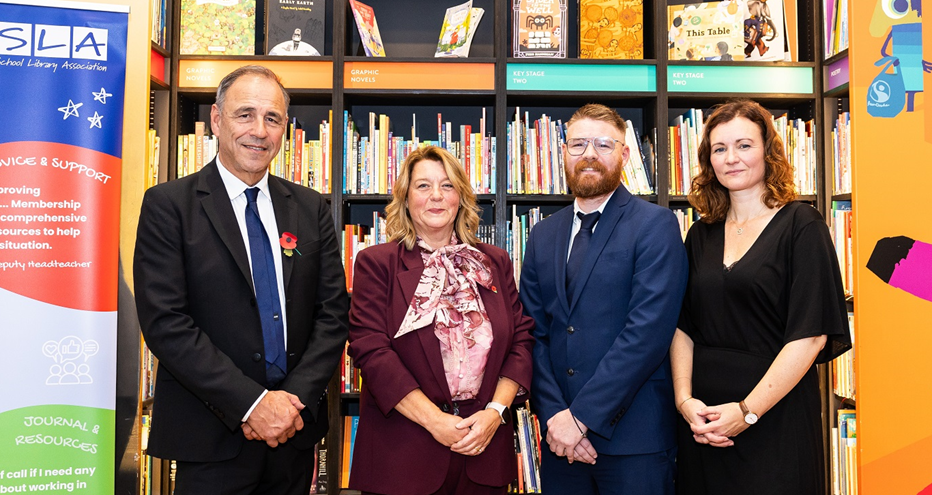
Julie Broadbent (centre left) received her award from Antony Horowitz (left), with Garry Barber (Browns Books) and Victoria Dilly (SLA)
2. How would you describe your library and your relationship with the students?
Our libraries are welcoming, modern spaces for students to read, research and explore. In primary our library is a bright, welcoming space with murals and soft furnishings. For our secondary students, the library is a working environment where students have access to laptops and desktops, as well as books, research and revision materials.
I feel that my relationship with the students is paramount to the success of our library; it is unlike that of a teacher and is quite unique within the school setting. I make it my mission to help and encourage all students to read and borrow books no matter where they are starting from and no matter what they believe about their own reading ability. I work really hard to foster a calm, supportive environment where students feel seen and heard. I think being the example that you want to set is important, too.
3. And how would you describe your approach to your role - in one sentence?
Be consistent, be persistent and be enthusiastic.
4. What are your school's priorities for the library?
Our vision at Northampton International Academy is to ensure that the library continues to be at the heart of the school where reading and learning are celebrated. We want our diverse community to have a rich reading experience, from Early Years, right through to Post-16. We want to encourage staff to also role model this behaviour by promoting a life long love of literature.
Our library continues to be a welcoming, inclusive learning environment for all students who use it, in which learners thrive. Our priority is to ensure that students have access to books and literature and feel supported on their reading journey, whilst ensuring our book collections reflect our diverse and inclusive school community. We also collaborate with local organisations that support our vision, as well as inspiring creativity through exposure to successful author and illustrator events.
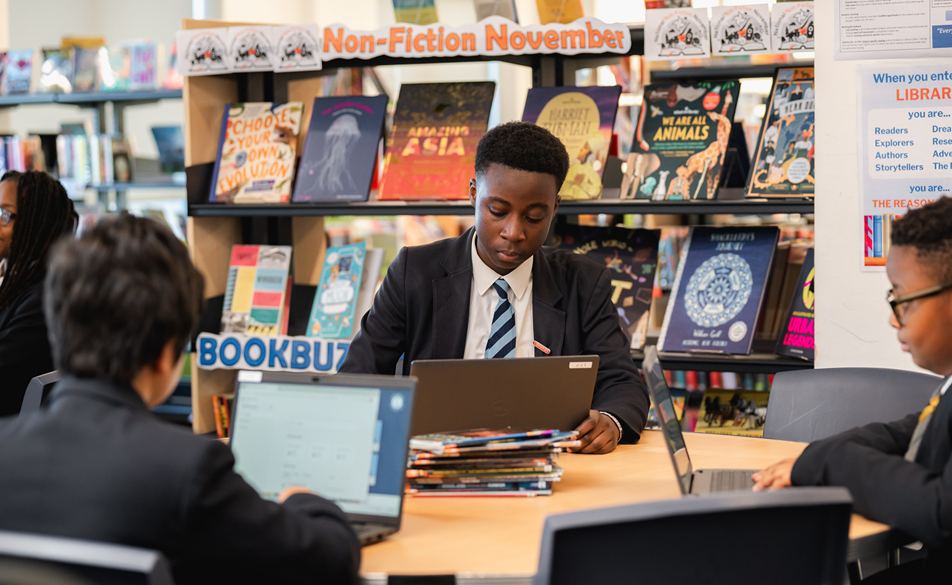
5. The SLA award flags the 'culture of positivity' you've created in your school around reading. Can you tell us what initiatives you've brought in to support this, and which have been most successful?
Previous to my appointment, a school librarian had not been in post for over a year. So when I arrived at Northampton International Academy there was quite a bit of work to do to get both school libraries up and running. Firstly, we created a timetable in both schools where timetabled library lessons were on the curriculum. Giving our students dedicated library access was paramount to creating a positive reading culture. Having a dedicated school librarian with an English teacher, giving advice and supporting students with their reading experience.
We use the Accelerated Reader programme in years 7 and 8, again reinforcing positive reading habits at home and in school. Some of our students may not have access to books at home so as a school we ensure that they are given books. We use the Bookbuzz programme and give all year 6 transition students books to read over the summer holidays.
We also have big book giveaways, book swaps and book fairs. We reward our students for reading whether that is through praise postcards, house points, shout-outs, to book giveaways and days out. We also hold competitions centred around reading and writing throughout the year, and I go into year group assemblies and give out rewards for reading.
For me, working collaboratively with local community groups has also helped raise the profile of reading throughout the school. We work with the local public library who have delivered assemblies about the Summer Reading Challenge and who have spoken to parents at our 'booknics' to encourage book borrowing from the local library. They have also helped deliver Manga and Anime sessions for our learners. All of these connections create a positive experience for our students with books and reading.
We work with the Northamptonshire Children's Book Group, part of the Federation of Children's book groups, as a testing school and this means that our readers have access to the latest books and get to have a say in the Children's Book Awards, which they do feel invested in. The NCBG have also hosted author events for us and book swaps.
All of these events and the input from our local community helps to create a positive culture of reading. Having live, in-person author and illustrator events has also proven to be so successful for our students in creating a positive culture of reading. We have welcomed some amazing authors who have included Onjali Rauf and Nathaneal Lessore. Having access to author events here at Northampton International Academy has really created a positive culture around books and reading. Listening, meeting and interacting with acclaimed and award-winning authors has raised the aspirations of our readers. These events really do inspire a love of reading and writing and have such a positive impact on our students well after the event has finished.
6. How do you support teachers and teaching across the curriculum?
All staff and teachers have access to both libraries, whether that be for whole classes or small group work. I think that working relationships with colleagues are so important. As a lone librarian, collaboration with everyone is key because together we can create a positive environment where our students feel supported and for them to learn and appreciate the library space. Staff and students also shape the space. I am open to ideas to help support all.
With regards to the curriculum, staff will send me recommendations to support the learning in classrooms and direct students to the library to borrow these resources. We also have a reading wall for the teens' section, along with revision materials, reinforcing the curriculum and signposting students to relevant information.
7. The judges also mention the diverse collection in the library. Why has this been a focus area for the library and how have you developed and funded the library collections?
Having the support of my line manager and SLT has been paramount in contributing to the development of both library collections. I have worked closely with my line managers for their support in funding our books stock. We believe as a school that it is so important that our books are chosen with representation in mind. We are a diverse school community and I believe our book stock reflects this. Our readers must see themselves within the books that we have and again this really helps promote reading across the school community. Listening to what students are engaged in and what they want to read also really helps develop our collections, too.
8. What other initiatives have you developed to support your students, and what do you have planned next for your library's development - and for the National Year of Reading next year?
The latest initiative is that I am trialling the use of audio book players in our secondary library. We have been using audio book players in our primary library and I am working with these now in secondary to see how we can use these to help with reading development and reading for pleasure, especially working with our EAL and SEN students. It gives students another option to help them appreciate and develop their love of stories, along with helping to develop their listening and reading skills.
For the National Year of Reading, we are planning more author and illustrator events, book fairs and book swaps. We will continue to work with our local public library and will be involved in voting in the Children's Book Awards and shadowing the Carnegies. We also have teams entering the National Reading Champions quiz. In March, around World Book Day week, our Reading Pioneers committee will deliver assemblies to our students and they also go into our local trust schools and deliver assemblies on the importance of reading. They will also be doing a massive book giveaway during these assemblies. In the summer, we will host a 'Booknic' where our families enjoy an afternoon of sharing books with their children. They bring blankets and a picnic and relax and read together in our outdoor space. This year I have been involved in some amazing projects and have worked with the most enthusiastic team of staff and students. Collectively and collaboratively, we all work hard to raise the profile of reading and this will continue well into 2026 and beyond.
9. Can you share three simple things you have tried out that you'd recommend to other librarians?
Greet every child at the entrance to the library when they enter. Do not get stuck behind your desk. It really is powerful at establishing a good routine. At social times I am present to welcome students, I have a really quick conversation; what would you like to do today? What is your purpose today? It is so simple but really does work and helps engage with every student who enters the library. These really quick conversations also help to direct students to try new books, too.
Run a book group. This really does focus on reading for pleasure and engages with your most enthusiastic readers. It is where you can have the best conversations about books and reading in a more relaxed way. I also love these groups as you can get so many ideas from the students.
Look to your local community - what is happening in your area. How can you get involved with your local public library or local book shop. We have done and continue to work closely with our local public library. We also work with the Northamptonshire Children's book group; do you have a Federation of Children's book group in your area? We also work with the University of Northampton, who have helped to bring in study skills sessions and train our reading leaders, and we work with local charity groups. There can be so much for young people to do in the local community, sometimes you do not need to go to far afield to improve your students' cultural capital and wider experiences.
10. What's the one thing you do that has the most impact, and how do you know?
This is really difficult to quantify as there are so many elements to what happens in both libraries. However, I would say our Reading Pioneers committee has been the most successful initiative that I have ever done in any school. This afterschool group started three years ago and began with myself, my line manager and three students. We were all just enthusiastic and excited about reading. It has now grown and flourished beyond anything that I could have ever imagined. We now have around 40 members and are recognised by our whole school body, SLT and our school trust as being one of the most successful school committees, spreading the joy of books and reading.
We have been involved in some fantastic projects in school, in the community and across the country. We have attended the Lit in Colour conference, attended author and illustrator workshops, delivered assemblies at our school and at our trust schools about the importance of reading. We have reviewed books for various publishers, shadow the Carnegies and vote in the Children's Book Awards, and hosted our big book giveaways and book swaps.
We have also been working on a very special project with a local charity, The McCarthy Dixon Foundation. We worked with them last year on the Poetry Together project and this year we were approached to be part of their Intergenerational Stories Programme. The aim of this is to bring generations together through the power of storytelling, creating meaningful connections between young people and older adults in our community. Our Reading Pioneers were paired with older adults and have interviewed, recorded and documented their life stories. After working together over a number of sessions, the project will culminate in a curated exhibition in December and each story will be archived to create a lasting digital legacy. It really has given our young people the chance to develop empathy and confidence while giving older adults the opportunity to have their voices heard. This has been storytelling at its most powerful. It really has been inspirational and I feel privileged to have been involved.
To measure impact for our primary school learners we recently did a reading for pleasure survey and the headlines that came out were:
91% of pupils like and love reading
78% of pupils think they are good readers
86% of pupils like reading at home or at school
97% of pupils think their teacher loves reading