Celebrate overlooked females in Catherine Blackledge's The Animal Queendom


About Author
Discover what makes the females of the animal world stand out from the males in Catherine Blackledge's eye-opening book, The Animal Queendom!
Catherine Blackledge PhD is a non-fiction author and a former science journalist and communications specialist.
Catherine lives in northwest England with her husband and daughter. When she isn’t writing, she marries people. You can find Catherine on Instagram @catherine.blackledge.
Interview
September 2026
Celebrate overlooked females in Catherine Blackledge's The Animal Queendom
ReadingZone caught up with science writer Catherine Blackledge to find out more about the female animals in our world - and how many fascinating facts there are to learn about.
Did you know that the female blue whale is the biggest mammal to have lived - even bigger than dinosaurs; that only female mosquitoes bite; and that female peregrine falcons are faster than a Formula 1 car!
Find out more about The Animal Queendom (Nosy Crow) in our indepth Q&A with author Catherine Blackledge!
Q&A with Catherine Blackledge: Discover the spectacular females of the Animal Queendom
1. Can you tell us a little about yourself and how you started out as a non-fiction author?
I'm a mum, a bookworm and a cat lover who lives in the northwest of England, in Lancashire, with my husband, teenage daughter and cat. At school, I loved reading, writing and science and I combined those early passions in my career. I've been a science journalist and science communicator for most of my working life.
I entered the world of writing books directly from journalism: I'd been shortlisted for a science writing award and at the awards event a publisher approached me asking if I was interested in writing books. The rest is history! I've now published three non-fiction books; the initial two for adults and The Animal Queendom is my first for children.
2. Why did you decide to look at the animal 'queendom' and not the usual 'kingdom'? Had some fascinating females already caught your attention?
My interest in the queendom is rooted in childhood. My favourite pet was a beautiful tortoiseshell cat called Patch, who was named in honour of her bright patchwork of orange and black fur. I remember appreciating and being deeply curious about the fact that tortoiseshell (calico) colouring is a characteristic of female cats; 99% or more of all tortoiseshell cats are female.
Years later, while writing my first book, which is a cultural history of being female, I discovered many more incredible and surprising facts about female animals. Some of the fascinating female creatures in my first book have a second starring role in the pages of The Animal Queendom. Look out for the fearless female spotted hyena, she's a bone-crushing leader who never backs down in a fight!
This research also highlighted for me how much we don't know about female animals and how much there still is to learn because we've been focused for a long time mainly on the male of the species! Wouldn't it be wonderful, I thought, if there could be a book celebrating female animals and shining a spotlight on all their special powers, many of which are unique to females. That's how The Animal Queendom came about! It's thrilling and a dream come true to know children around the world will now finally get to discover all these fantastic females.
3. You mention in the book that the females of species were once very overlooked by scientists but is there more information available now? How did you go about researching this subject?
Shockingly, it's only in the last 100 years that we've begun to appreciate how extraordinary female animals are. For a long time, most wildlife experts were men who ignored female animals or came to incorrect conclusions about what they are capable of. Opinions only began to change when increasing numbers of women got the opportunity to study animals and The Animal Queendom honours them with a roll call of some of those brave, trailblazing female scientists!
This historic lack of emphasis on female animals does mean it can be trickier to research our sister species. Even now, researchers sometimes overlook what females look like or do and comment only on male characteristics! My approach is to speak directly to the experts, women like Professor Daphne Fairbairn who was the first to show that across the animal queendom female animals are usually larger than males. That's one of the facts that may surprise readers: when there's a difference in size, female animals are bigger than males a whopping 86% of the time!
Songbirds, like the superb lyrebird, are one of my favourite examples of how we've got it badly wrong about female wildlife. Until remarkably recently, no one knew how powerful female bird song was; it had been dismissed as meaningless. Speaking with female researchers in Australia opened my eyes: the female superb lyrebird is a marvellous mimic who uses song as a weapon to ward off danger and shield her chick. You'll be astonished when you discover the strange sounds she can make!
4. When you're researching digitally is it even more important to fact-check? How did you do so?
Fact-checking is vital, however you research. That is especially true digitally because, unfortunately, a lot of data that isn't factually inaccurate can be repeated multiple times online and can start to appear to be factual. I verify information by looking at the original research papers AND speaking directly with the lead researchers. It was also great having the University of Cambridge team on board to act as a sounding board and another pair of eyes.
One of the fun aspects about research is talking to the scientists who are so enthusiastic about their particular animal. It's through these conversations that you discover exciting facts which no one else has written about. For instance, vampire bats have a bad reputation because they survive by sucking blood from mammals, including humans! But female vampire bats are very sociable with long-standing female friendships and are one of the few animals on our planet who will share their meal with hungry friends (non-relatives). By talking directly to the key researchers, I discovered the cheeky way starving female vampire bats signal their hunger to their best buddies. Find out more in the book!
5. Can you give us three fascinating facts from your research? Any big surprises?
It's hard to pick only three fascinating facts - The Animal Queendom is full of them! But if I have to choose, I'll start with a world record breaker. The female blue whale is both the largest creature on our planet today, and - move over dinosaurs - she is the most massive animal to have ever lived! Female blue whales are far bigger than males, regularly reaching 30 metres in length (imagine 3 double decker buses end-to-end) and can be as heavy as 190 tonnes (about the weight of 30 elephants!).
Number 2 is another multi world record-holder. The female peregrine falcon is both the fastest bird in the world and the fastest animal on the planet! Female peregrine falcons, like most female birds of prey, including eagles and hawks, are bigger and stronger than the males and more daring hunters. In the steep dive falcons adopt to hunt prey, female peregrine falcons regularly clock up speeds of more than 320 km/h - she's faster than a Formula 1 car!
The third fascinating fact is about female critters with weapons. If you're unlucky enough to have been stung by a bee or wasp or bitten by a mosquito or horse fly, your attacker was a female. That's because only female bees, wasps, mosquitoes and horse flies are equipped with the weaponry to sting or drink blood (males don't have stingers and are harmless). In fact, the blood-sucking and disease-spreading abilities of female mosquitoes make them the deadliest animal on the planet; they kill more humans every year than any other wildlife.
One of the biggest surprises for me, literally, was discovering a unique female phenomenon where female animals are monumentally bigger than males: we're talking mega females who can be as much as a hundred times longer and up to tens of thousands and more times heavier than the mini males.
The Animal Queendom features some of these jaw-droppingly massive females, including the female Northern giant seadevil. This female deep sea angler fish holds the record for the biggest size difference in animals with a backbone (vertebrates): she's an eye-watering half a million times heavier than her miniscule mate! Another big moment was the discovery of species where there are only females - males do not exist! These very special superpowered female animals only ever have female babies and their babies only ever have female babies and so on and so on.
All-female families are rare but there are all-female frogs, lizards, ladybirds, fish, snakes, salamanders and more and some make an appearance in The Animal Queendom.
6. Do you now have a favourite in the animal queendom? Which creature would you love to see in real life - and which ones are you happy to skip, and why?
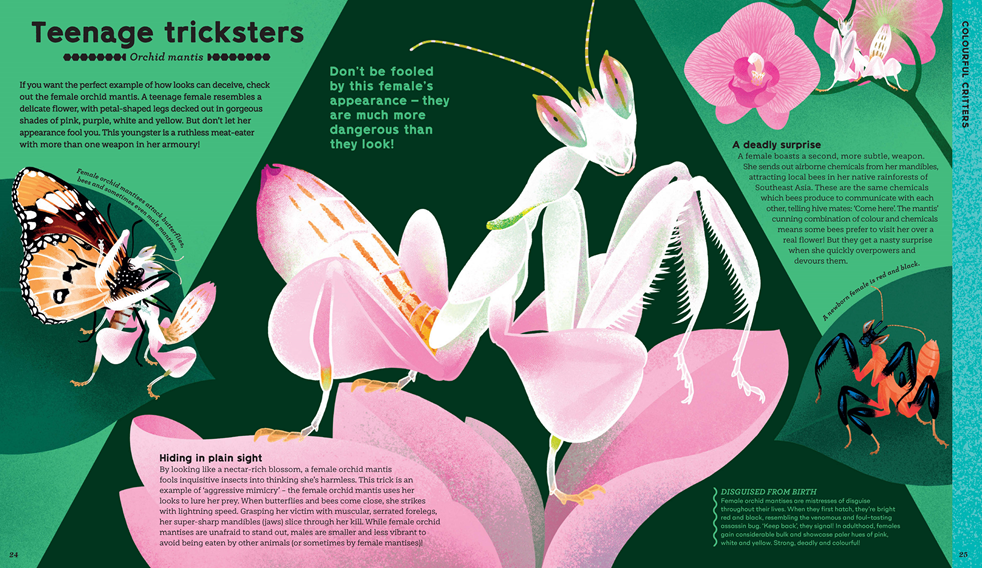
It's very hard to choose only one favourite animal. I grew to admire and appreciate all of them! The Animal Queendom's cover girl - the female orchid mantis - is one of my favourites. She is a perfect example of how looks can deceive. A teenage female orchid mantis resembles a delicate flower with petal-shaped legs decked out in shades of pink, white and yellow. But this youngster is a ruthless meat-eater who kills other insects with lightning speed, including male mantises who are smaller and less colourful. I like her because she is a great reminder to not judge individuals by their initial appearance.
There are many animals who I would love to see in real life, but my top two are both apes: bonobos and orangutans. Female bonobos have my heart because of their strong female friendships: female bonobos always look out for and support other females and it's because of this strong sisterhood that female bonobos are the leaders of bonobo groups.
Female orangutans fascinate me because of their creativity and smarts. Orangutans are thought to be the most intelligent primate after humans and mother orangutans spend at least a decade raising their children. Youngsters watch and learn as their clever mums create tools to source food, fashion leaf gloves to protect their hands from spiky fruit, make umbrellas from leafy branches and even use leaves as toilet paper to wipe off poo!
There are a few animals who I would be happy to skip meeting in real life. First up is the female great white shark. Female great whites are significantly bigger than males and typically the deadliest hunters; they're the planet's largest living carnivorous fish. I respect their strength and size but I would rather not encounter a female great white shark in the wild.
I have the same feeling about the female reticulated python. She is the world's longest snake and, like most female snakes, is far larger than the male (females can be almost double the male's length and four times their weight). Females up to 10 metres in length have been recorded in the wild (think six human adults laid head to toe on the ground). Thanks to her more massive size, and jaws that can open exceptionally wide to swallow her prey whole, even humans are on her menu!
I do not want to be next. I'm scared of spiders, so I'd like to steer clear of the female black widow spider. That's also because, if provoked, she's one of the few spiders who will bite humans and inject us with her venom (the smaller male is too weak to do this). Thankfully, human bites are not usually fatal, but I don't want to risk meeting her. However, I do admire her special female-only silk flicking skill - exactly like those spider superheroes on the silver screen!
7. The illustrations by Kasia Bogdanska are gorgeous - what do you feel they bring to your text? Is it important to be able to see - and not just read about - the comparisons of male and female of a species?
The illustrations by Kasia Bogdanska in The Animal Queendom are glorious - so vivid and colourful; they really bring my words to life, and that is exactly what you want from illustrations. They reveal a different facet to these female animals that words alone cannot quite convey. For example, I adore Kasia's portrait of the alpha female ring-tailed lemur. It made me smile with delight when I saw this queen of mean gazing out of the pages.
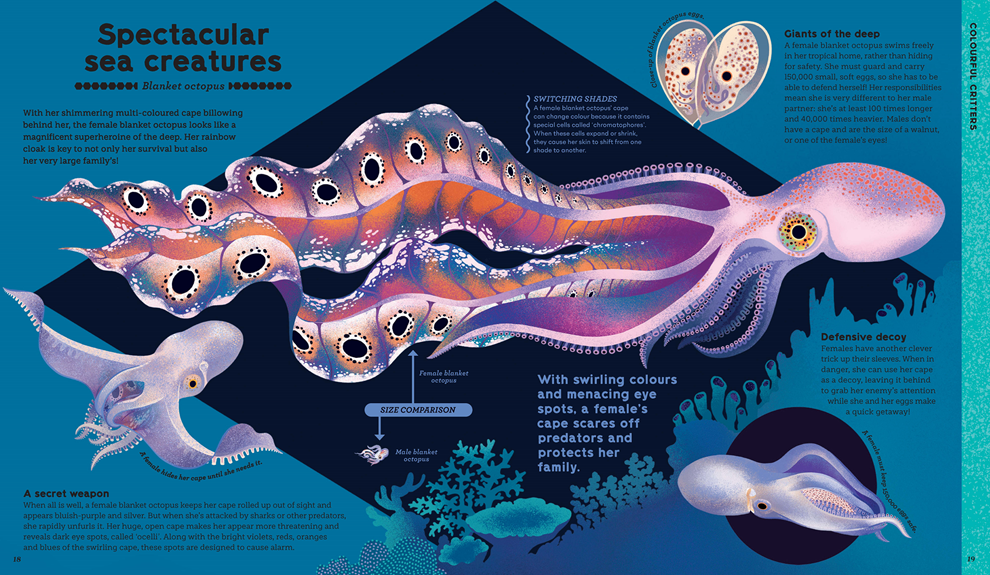
Every member of a lemur troop knows to get out of the alpha's way, give her the sunniest spot to relax in or hand her the choicest piece of fruit. The queen lemur's pose and expression communicate all of this in one very striking image. Kasia's art also illustrates in a very immediate manner the extreme size and colour differences between the female blanket octopus, with her kaleidoscopic coloured cape billowing out behind her and the very small, cape-less male. He is about the size of a walnut or, as we're able to show graphically on the page, equivalent to one of her eyes!
8. It's interesting to learn how many species are dependent on their females - can humans learn anything from animal behaviours?
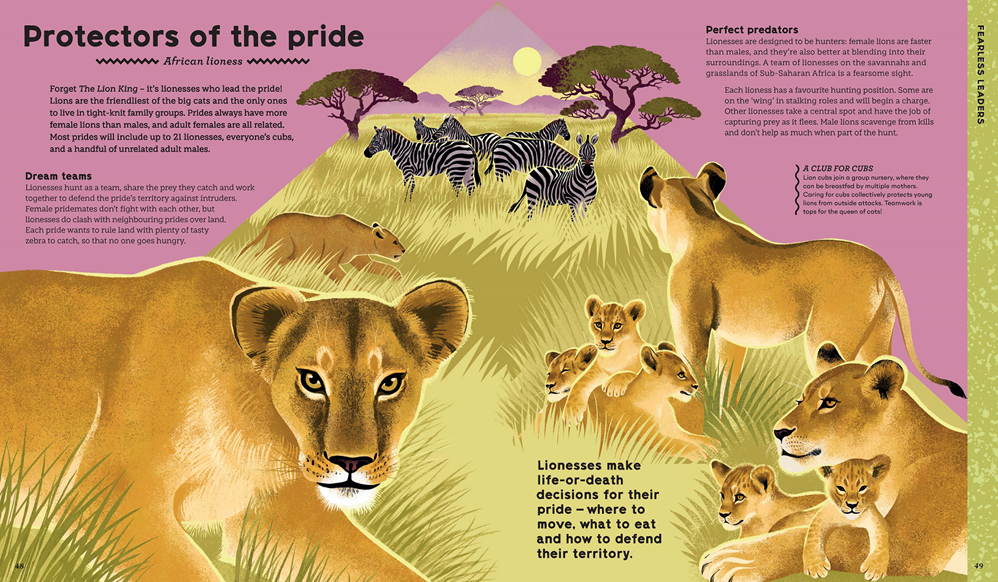
Humans can learn a lot from animal behaviour! One key factor for me is about the importance of teamwork - and female animals, who can be more sociable than male animals, show this very clearly. I've already mentioned how strong female friendships are the basis for female bonobos leading their troop and also help hungry female vampire bats survive. Another fantastic example of this, and it's one of my favourites, is how lionesses collaborate when hunting prey.
Working together as a team they are more effective and, just like England's victorious Lioness football team, lionesses in the wild all have preferred positions to play in. You can find out more about the various hunting roles and why it's lionesses, not lions, who lead the pride, in The Animal Queendom.
Animals also show us that there are different ways to lead: some female animals, like meerkats and ring-tailed lemurs have female leaders who are bossy and more aggressive than everyone else. But that's not the only way to command respect. For example, female elephants and female orcas (killer whales) are authority figures as a direct result of their intelligence, advanced age and experience. Thanks to their knowledge, accumulated over many years, wise elder female elephants and orcas keep their clans and pods alive. Grannies are great!
9. What do you hope young readers will take away from what they discover in these pages?
I hope young readers will be excited to discover the unique powers and skills which female wildlife possesses and how female behaviour is varied and complex: The Animal Queendom clearly illustrates how female animals can be mean and murderous, cunning and caring, fierce and fearless, protective and powerful and sociable and smart.
I hope children may consider that the way female animals are represented in movies, TV and videogames can be inaccurate and stereotypical. Unfortunately, there are many examples of this; they include the movie Madagascar which has a male ring-tailed lemur leader when this does not happen in real life. Likewise, the movie The Lion King ignores the fact that lionesses lead the pride, not lions.
I would also like children to take away that we really do live in an animal queendom: there are more female animals in the world than male animals, some female animals have an actual superpower which enables them to have babies all by themselves and it is female animals who are the largest, fastest and strongest on our planet. My wish is for a future where we know as much about female animals as we do about male wildlife and I hope that readers are inspired to go out there and discover more about the natural world. We need scientists and researchers from all sorts of backgrounds to contribute their ideas.
10. Do you have more books planned? What do you enjoy doing when you're away from your research and writing?
I have a few more books in the pipeline. One which I'm particularly excited about explores the world of animal dads. I think it's vital that boys and girls appreciate how important being a father is - both in the animal and human world. Awesome Animal Dads shines a spotlight on some fantastic furry, feathery and finned animal fathers who are essential to ensuring their offspring survive and thrive. I hope it will be the perfect companion to The Animal Queendom. Fingers crossed!
When I'm not researching and writing. I'm usually marrying people! It's very different to being an author but it's an incredibly joyful job and I love it. In my spare time, you'll find me running along the river near where we live, being the chauffeur to take my daughter ice skating and swimming, or going to cheer on my husband in his punk band.
Creative Challenge from Catherine Blackledge: Which animal in The Animal Queendom has surprised you the most? Perhaps it's the cute, cuddly-looking female meerkat who is thought to be the most murderous mammal on the planet (she kills and eats her grandchildren!). Or maybe it's the female cheetah - she's the fastest animal on land! Or is it the mysterious female flower crab spider who can change her entire body colour to match her background and no one really knows why yet?
Pick the animal that astonishes you the most and try to find out more about it; you can write about it, draw it or chat to your family or friends. Surprise them with your expert knowledge!
Catherine Blackledge's School visits: I offer school visits either in person or via a virtual visit. Visits can be adapted for different ages and settings including KS1-KS4, and can form part of enrichment activities, as well as the PSHE curriculum. Visits typically include a short introduction to me and the book: what it's about, why I wrote it and some fun, fascinating and shocking facts from it.
I will also do a reading from The Animal Queendom and finish with a Q & A with the children. I focus on being as interactive as possible. It's all about getting children involved. Visits can also incorporate workshops and activities with children and book signing sessions.
Suggestions for workshops and activities include:
• asking children to choose the animal which surprises them the most and explore more about it through art, writing or discussion. • asking children to select their favourite record-breaking animal and explore how and why it has this special skill or power. • considering how movies, TV and videogames can misrepresent female animals and present stereotypical views rather than the often-surprising reality. For PHSE, what impact does this have on girls' self-esteem and self-worth?
• considering how science can be subjective and the need for scientists from different backgrounds to avoid a one-sided view of the natural world. Looking at how scientific understanding has changed as female scientists entered the workforce.
• how important is positive representation in children's books? The Animal Queendom is the first children's book to celebrate the unique skills and powers of female animals, but recent research (2025) shows when talking animals are represented in popular children's books, female animal characters appear far less than male characters do. For PHSE, what impact does this have on girls' self-esteem and self-worth?
My overarching aim is to highlight how varied female behaviour, shape and size is, reveal how little many of us know about the female animals on our planet (and why that is), and encourage children to engage with the natural world because it's immensely beautiful, endlessly fascinating and there's still so much to learn! Schools interested in arranging a visit can contact me at [email protected]
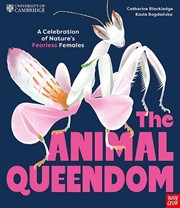 University of Cambridge: The Animal Queendom: A Celebration of Nature's Fearless Females