Emma Simpson introduces Pebble and Po, a story about asking for help


About Author
ReadingZone caught up with author and illustrator Emma Simpson to find out about Pebble and Po, a story about friendship and not being afraid to ask for help.
Before becoming a full-time author-illustrator, Emma Simpson worked in the special education sector for many years. This time still informs the work she makes today. She is also greatly inspired by nature and loves to walk in the beautiful Bavarian Alps that surround Munich, where she currently lives.
Interview
October 2026
Emma Simpson introduces Pebble and Po, a story about asking for help
At a time when many young children will find themselves in a new class with new friends, Pebble and Po show that it's good to ask for help when you need it. Each of the friends in this story find themselves needing help for different reasons, and sometimes you need to be brave and ask for help.
ReadingZone spoke with author and illustrator Emma Simpson about the power in 'quiet' stories, how she hopes Pebble and Po will encourage children to ask for help, and what the story tells us about friendship and kindness.
More about Pebble and Po: "This is a wonderful book for sharing; gift it, read it, pass it on! A very lovely story that celebrates how important it is to ask for help when you need it." - Lizi, ReadingZone
Q&A with Emma Simpson
"I wanted to make a book that highlights how asking for help when you need it is actually a sign of strength,
and an important part of becoming a resilient and independent person."
1. Hello Emma, Thank you for joining us on ReadingZone to talk about your picture book, Pebble and Po. Can you tell us a little about how you started in creating children's picture books?
Hello! Thanks for having me. I qualified as a speech and language therapist and worked in primary education for many years. I really enjoy working with children and earned my PGCert in Special Educational Needs after moving to Germany.
Growing up in a creative family, I always loved making things, including stories, but it never occurred to me that I could do it for a living. Having my own three children, however, reignited my passion for picture books and nudged me back towards my love of creating.
I attended the Picturebook Summer School in Cambridge which was a turning point. Spending a week surrounded by people with a shared love of picture books was a massive boost and I felt completely in my element. It wasn't until I found The Good Ship Illustration team (an online art community), however, that I found the confidence to start sharing my work and believing that I could do it professionally.
2. What happens in your picture book, Pebble and Po, and what inspired you to create a story about asking for help?
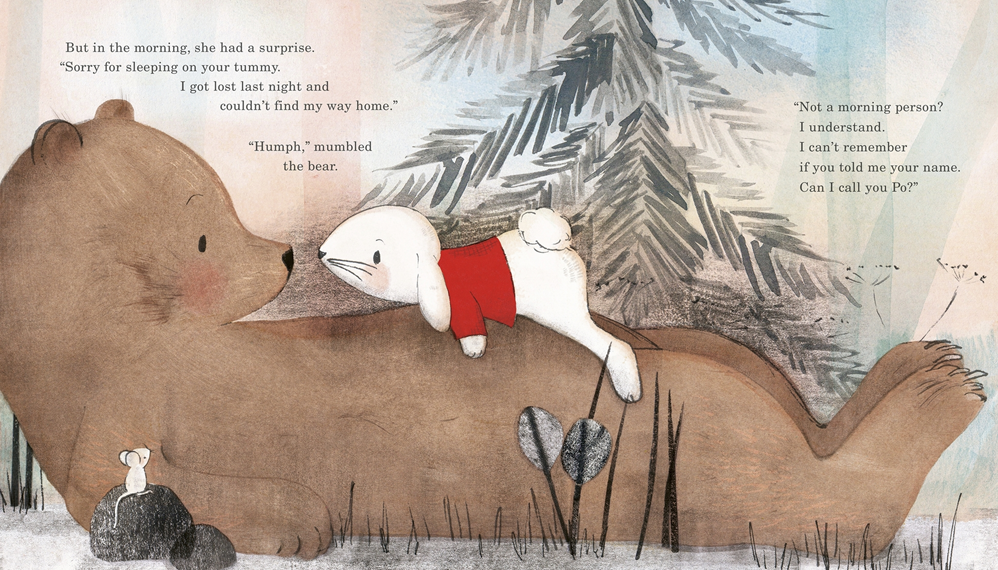
Pebble is a happy-go-lucky rabbit who gets lost one evening and settles down somewhere warm and cosy to sleep. Only in the morning does she discover that she has slept on the tummy of a big brown bear. The bear, who she calls Po, has a very rumbly tummy so she decides to help him find something to eat. Along the way they make new friends who also need a helping hand.
While Pebble loves helping others, she's not so good at asking for help but she learns that everyone needs to ask for help sometimes. Asking for help can sometimes feel difficult, even for grown-ups, because of the worry that it might be seen as a sign of weakness.
I wanted to make a book that highlights how asking for help when you need it is actually a sign of strength, and an important part of becoming a resilient and independent person. I hope this book can be a starting point to talk about times that we need help, how we can help each other and things we can do when we feel in a bit of a pickle.
3. What would you like children to take from the animals' adventures?
Hopefully readers will take away something positive from the story, whether it's celebrating kindness and friendship or recognising the strength it takes to ask for help.
I deliberately made all the animal characters as different from each other as possible and I hope that children will see that EVERYBODY, no matter how grown up or competent they may appear, needs help sometimes.
4. Why did you decide to use animal characters, a bear and a rabbit, to explore this - or were your characters the starting point for the story?
I've always wanted to make a book with animals characters as they are so relatable to young readers. I had an image of a rabbit sleeping on its tummy on a hill that caught the eye of the art director at Little Tiger. I thought the hill looked a bit like a big tummy and that became the starting point of the story.
I chose a bear as I loved the visual contrast to the small white rabbit. I also wanted to challenge the classic perception of a big bear as Po is as gentle as can be.
5. There are quite a few challenges through the story for the friends - how did you decide on these?
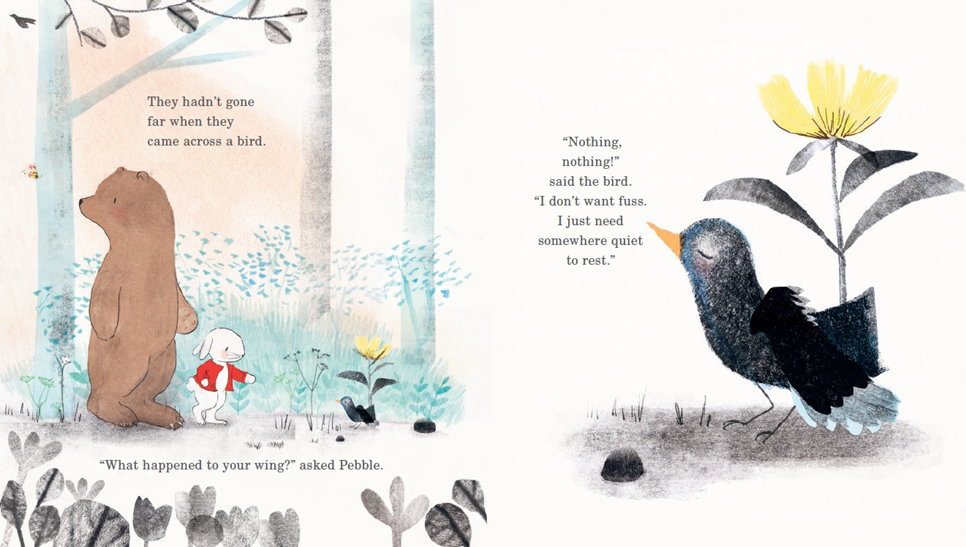
The scenarios I chose are hopefully ones that children can relate to. Being hurt, scared or lost are just a few examples of where someone might need to ask for help.
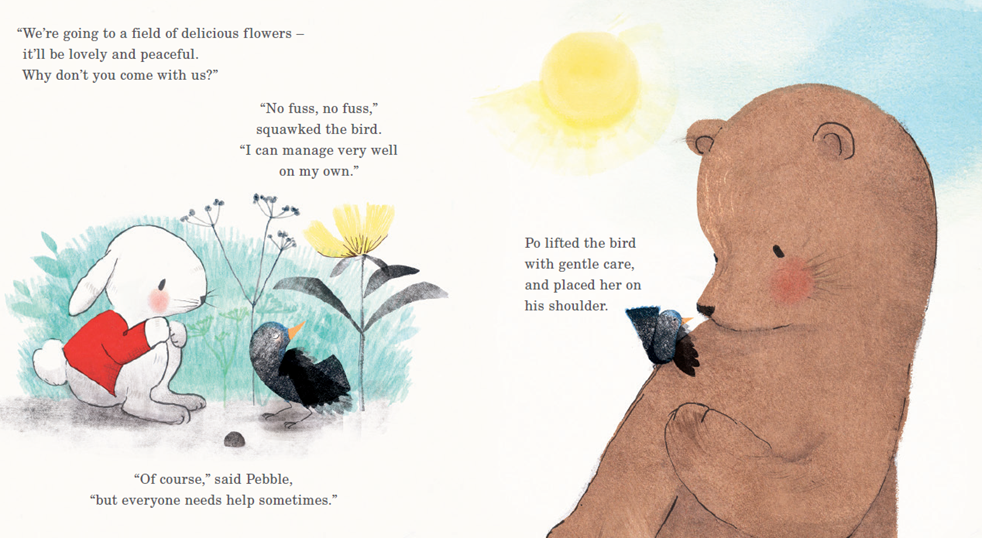
6. What is your favourite moment or spread in Pebble and Po?
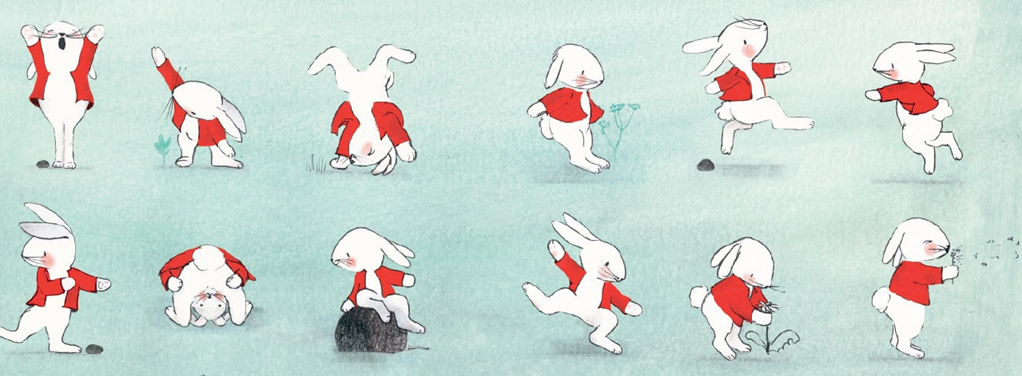
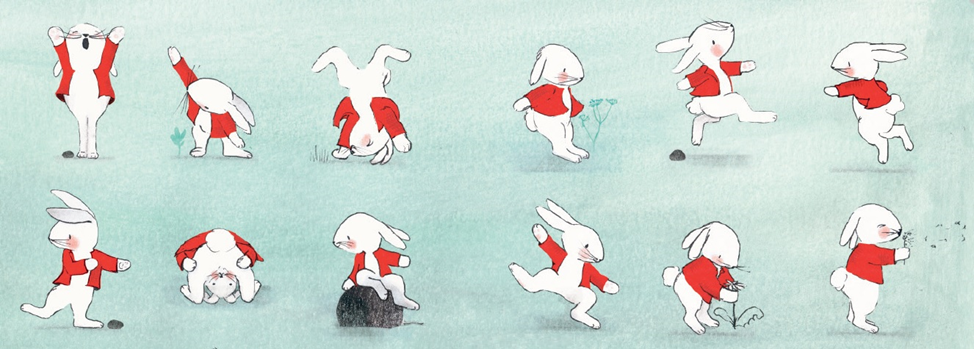
I think I'd have to say the spread when Pebble wakes up on Po's tummy, as it was the starting point for the story. Throughout the book I loved drawing Po's profile and the lovely curve of his nose. I do also love the end papers of Pebble as they communicate so much about her lively personality and were such fun to make.
7. Despite the challenges through the story, it has a very gentle tone. Do we underestimate the power of 'quiet' stories for young children?
There is room for every type of story. Providing a wide range of stories creates more opportunities for children to make meaningful connections and develop an understanding for themselves and the world.
I have never tried to write in a specific way. I write with my voice, as it comes naturally and I hope that in a world where we are often pushed to shout the loudest it can provide a space for calm reflection and the opportunity to connect and talk.
8. Can you talk us through the style of illustration and colour palette you use for this story? How do you create your illustrations?
I always start my illustrations with pencil and paper to get to know the ins and outs of the characters. Once I've found my shapes I move on to colour and a black fine liner pen to highlight important bits.
For the colour I often paint on separate papers, scan them in and layer on top digitally. This allows for flexibility and making changes, something that happens a lot when making a book, without having to redo the entire image. I like to include leaf prints and pressed flowers that I have collected over the years. I love the idea that a bit of nature can make its way into the book.
9. We love the natural setting for the story - do you spend time in nature to find settings for your stories, as well as details like these?
Spending time in nature is one of my favourite things to do. Everyday I have to get outside, even if it's just for a short walk, to see the trees, the sky and feel the fresh air on my face. I am lucky to be close to lots of forests, mountains and lakes and love feeling connected to nature.
10. What kinds of activities and adventures keep you busy when you're not in your studio?
I love walking in the mountains and swimming in the lakes. I've recently taken up running again which I'm really enjoying and I play the violin. I have three children so we have a busy household with lots of sport, art and music!
Creative Challenge from Emma Simpson:
Hopefully Pebble and Po can provide a starting point for conversations about asking for help. Children can be encouraged to remember a time they asked for help and when they have helped someone else. Who are trusted individuals children can ask for help? The conversation could extend from friends, teachers and family members to looking at who are trusted members of the community.
Organising a School Visit by Emma Simpson:
School visits are something I'm excited to do. Schools can get in touch with me via email, [email protected].
 Pebble and Po