Volcanologists Tamsin Mather and David Pyle explore The Power of Volcanoes


About Author
Discover the science behind these fiery wonders in The Power of Volcanoes by Tamsin Mather and David Pyle.
Tamsin Mather, Professor of Earth Sciences at the University of Oxford, has studied volcanoes in places like Hawaii, Ethiopia, Nicaragua, Chile and Iceland. Her research helps make predictions about eruptions and their hazards, and how volcanoes affect our planet's environment.
David Pyle, Professor of Earth Sciences in Oxford, saw his first volcano in Chile, aged seven, and went on to study geology at university. He has visited, climbed or studied mostly active volcanoes on six continents.
Interview
June 2026
Volcanologists Tamsin Mather and David Pyle explore The Power of Volcanoes
In this stunning non-fiction book about the fiery power of volcanoes, experts Tamsin Mather and David Pyle provide an insight into what we know about volcanoes - and reflect on what we have yet to learn.
From how we study volcanoes to where they are found, from famous eruptions to how volcanoes can both destroy and create, The Power of Volcanoes gives an authoritative overview of these natural wonders and encourages readers to find out more.
Review: "Readers will find glossy pages filled with interesting facts to ignite their enthusiasm for volcanoes." - Jane, ReadingZone
Q&A with Tamsin Mather and David Pyle: Exploring The Power of Volcanoes
"Volcanoes can be very destructive, but they also make new land and are one of the things that
makes our planet so beautiful and good for life."
1. Can you tell us a little about yourselves and your chosen scientific field?
Tamsin: I liked science and maths at school and exploring the great outdoors. I studied chemistry at university, which I loved, but then I found a way to combine all my passions by studying the science associated with the world's volcanoes. Volcanoes can be very dangerous but are fascinating. They can be very destructive, but they also make new land and are one of the things that makes our planet so beautiful and good for life, and give us natural resources like geothermal power and some metal deposits we need for important technologies like batteries.
David: When I was growing up, I collected rocks and fossils, and I loved the idea of mountains. At school I enjoyed all my subjects, and ended up taking science A-levels, and then went to university to study geology. My interest in volcanoes became real when we studied the 1980 eruption of Mount St Helens, and from then on I was captivated. I began my research on a volcano in Greece, where I found that I could read the minute-by-minute story of ancient eruptions just by looking at the layers of ash and pumice left behind. Since then, I have been looking for answers to the question of 'what will happen next?', by studying volcanoes and working out the effects of their past eruptions on people, and the planet.
2. What first inspired you and what continues to fascinates you about volcanoes? Do you remember learning about them as a child?
Tamsin: I started studying volcanoes when I started my doctoral work because I got really inspired by the project and the people that I would be working with. I also have very vivid memories of going to Pompeii and climbing Vesuvius when I was 10 years old, so I think that some seeds were sown from quite an early age. It is hard to say what fascinates me most about them - they are all so different and interesting in their own way but volcanism in general plays many really important roles in terms of keeping our planet habitable and governing how it has changed over deep geological time.
David: I lived in Chile for a year, when I was seven years old. Chile is one of the most volcanic countries in the world, and it was here that I first saw snow-capped mountains (the Andes) and volcanoes. A hot summer trip to a volcano called Villarica, and sitting on the deposits from an eruption that had happened just the year before, made a deep impression on me. Since then I have visited many volcanoes, in many parts of the world. One thing that fascinates me is how the rocks thrown out in eruptions can look the same the world over; so by studying one volcano, we can learn about all volcanoes.
3. How did you decide what to include in The Power of Volcanoes? Where do you suggest children go to find out more?
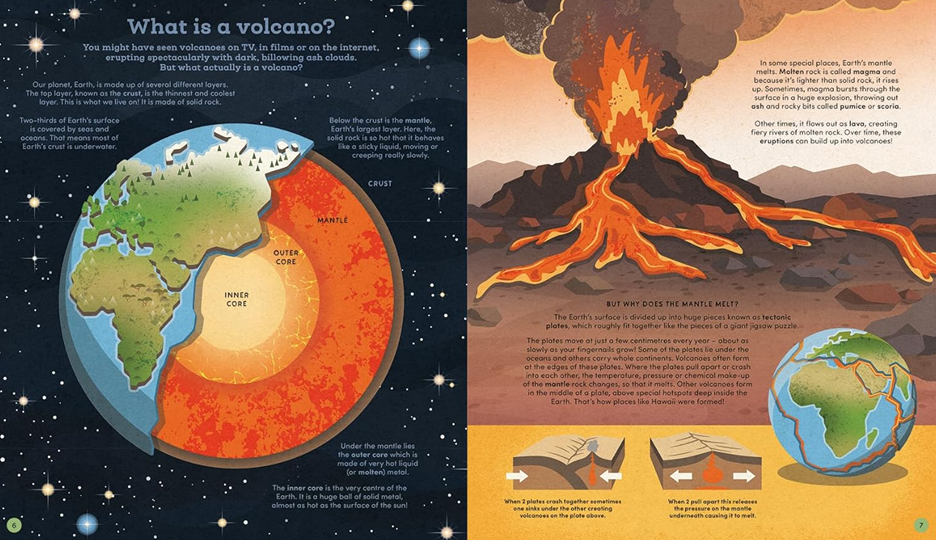
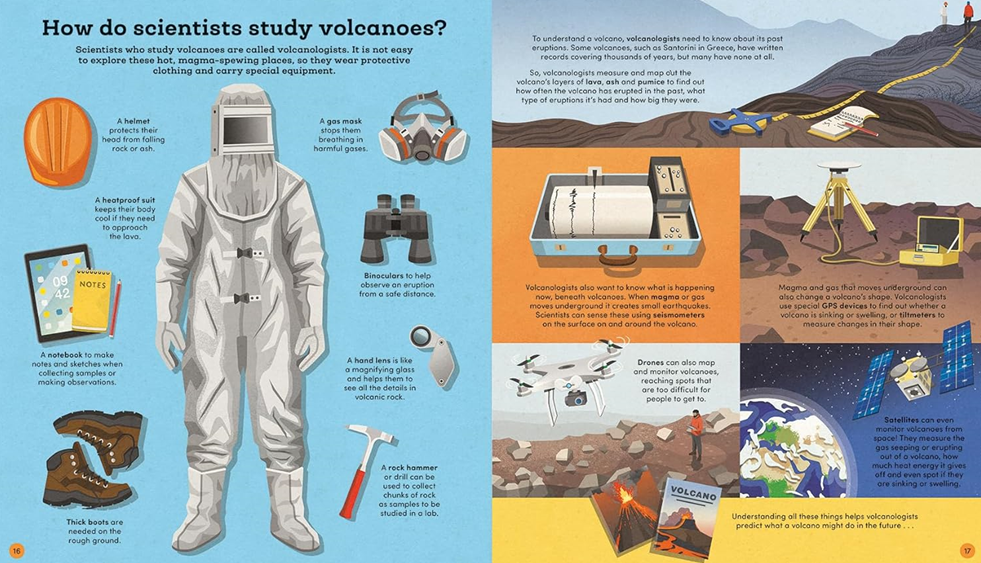
Mainly it was a matter of deciding what not to put into the book as there are so many fascinating things about volcanoes. We wanted to make it far reaching, for example, thinking about the whole world and volcanoes on other planets, but also relatable, for example, talking about the animals that live on volcanoes and what sort of equipment we use to study them.
There are loads of great resources and videos on the web to find out more about volcanoes but we suggest you go places like the US geological survey (USGS) website, where the information is reliable.
4. What are your three top facts about volcanoes?
Tamsin:
1. Most of the world's volcanoes are underwater at the mid-ocean ridges.
2. Not all volcanoes erupt liquid rock. Ol Doinyo Lengai in Tanzania erupts a black liquid that looks like motor oil and is made of molten carbonate.
3. Explosive volcanic eruptions can electrify the particles and gas causing discharges and other electrical phenomena sometimes visible as volcanic lightning, and St Elmo's fire.
David: I love coming across unusual stories about volcanic eruptions, so:
1. When Krakatoa erupted in 1883, it made a noise that was mistaken for cannon-fire, thousands of kilometres away. In one place, soldiers thought their fort was coming under attack; in other places, people thought there were ships in distress at sea.
2. In 2022, after a very large eruption of an underwater volcano near Tonga, in the Pacific Ocean, scientists noticed that the sound waves from the explosion caused a tsunami (a sea wave) that travelled around the world's oceans at speeds as high as 1000 km / hr and lasted for nearly 2 days.
3. Finally, one of the smallest eruption in the world happened in Iceland in 1977, when a borehole that was being drilled to look for steam hit a pool of molten rock about 1 km below the surface. There was a small explosion, and about 1 cubic metre of lava erupted at the surface: about the same volume as a fridge.
5. How did you work together in writing this book?
We work together a lot and so are quite used to it! We split up the topics and each had a first go and then we swapped and edited each other's work.
6. What can young readers expect to find in The Power of Volcanoes? Do you hope it might inspire some future volcanologists?
We hope so! All the science is up-to-date with what volcano scientists think and we worked hard to try to capture sometimes complex things in ways that will make sense to young readers.
7. How do Daniel Long's illustrations support the text; Any favourite spreads?
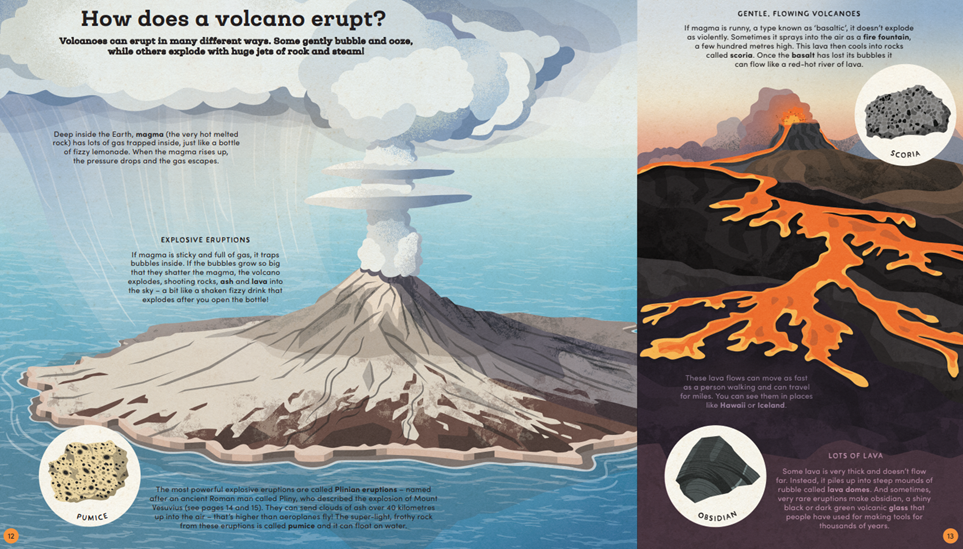
We think that Dan's pictures are beautiful, they really bring the science to life and are just a lot of fun to look at too. In places he has worked old paintings of volcanic eruptions into his work and an amazing array of images from the present-day. We love all the spreads but 'How does a volcano erupt?' with its powerful Plinian eruption column and the red on black of the lava flows is especially breath-taking.
8. How good scientists have become at predicting when a volcano will erupt?
The science of eruption prediction has come on a long way over the past 200 years, but we still have a lot to learn. Using instruments like seismometers (to measure tiny earthquakes) and satellite radar (to detect the swelling of the ground), we can sometimes track magma moving underground, and know that a volcano is primed to erupt. Even so, eruptions can still start quickly and without much warning; and since there are many volcanoes in remote parts of the world, or underwater, which are not monitored, there are a small number of unexpected eruptions around the world every year.
Some volcanoes are naturally more predictable than others. For example, Kilauea, on Hawaii, has erupted vivid 'fire fountains' of magma every ten days since late 2024. Each eruption is very short, and usually begins after the summit of the volcano stops swelling up, and starts to deflate.
9. What is currently the most dangerous volcano on Earth? Have you had any close shaves while doing your work around volcanoes?
That's a really difficult question. Volcanoes that are close to cities like Campi Flegrei or Vesuvius and Naples (Italy), or Mt Rainier and Seattle (USA) are of particular concern to volcanologists and are monitored very closely. Volcanoes with ice caps can cause terrible destruction because the volcanic heat can melt the ice and cause mudslides of volcanic debris known as lahars. This happened in Colombia in 1985, when Nevado del Ruiz erupted, killing over 25,000 people. Some volcanoes have small eruptions all the time and it is hard to predict when a slightly larger and more deadly eruption will happen. This happened at Fuego volcano in Guatemala in 2018, killing over 200 people.
Tamsin: The most danger I have been in on a volcano is being held up at gun point on Masaya volcano in Nicaragua, so not so much to do with the volcano but very frightening.
David: The most danger I think that I have been in is when I was in a helicopter flying over a volcano, and one of the engines failed so the pilot was not sure that they would be able to land. Everyone else was terrified but as I did not have a microphone in my headset I was blissfully unaware until we were safely on the ground!.
10. When you're not studying or writing about volcanoes, what makes you happiest? Are you an adventurer at heart, or do you enjoy armchair time, too?
Tamsin: I like reading books and spending time with family and friends but am also generally very happy when I am outdoors (even when not near a volcano!) hiking or biking up or over mountains, in, on or near the sea or exploring new places and cultures.
David: I love reading and listening to music, both of which can take you to wonderful places in your imagination!

Creative Challenge: Can you suggest activities or experiments that children can do, to help bring the power of volcanoes to life?
There are lots that are fun: They can make a Baking soda volcano, for example; or go to a local museum if possible and look at the different types of rocks; or create a Lava flow viscosity experiment.

School Visits: Our department is sometimes able to offer school visits. Check out https://www.earth.ox.ac.uk/schools

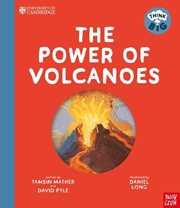 University of Cambridge: Think Big: The Power of Volcanoes