Laughter is Not Allowed in Sam Usher's picture book, No More Silliness!


About Author
Sam Usher - who is NEVER silly - tells ReadingZone why Laughter is Not Allowed in his new picture book, No More Silliness!
Sam Usher is an acclaimed writer and artist who has illustrated books by Michael Morpurgo and Emma Carroll, as well as his own Adventures with Grandad series. He has been shortlisted for the Waterstones Children's Book Prize and longlisted for the Greenaway Medal.
When he's not writing or drawing, you'll find Sam playing the piano, eating chocolate and trespassing.
Interview
September 2026
Warning: Laughter is Not Allowed in Sam Usher's picture book, No More Silliness!
Sam Usher - who is NEVER silly - tells ReadingZone why he decided to write a picture book in which laughter is Not Allowed: Warning: No More Silliness!
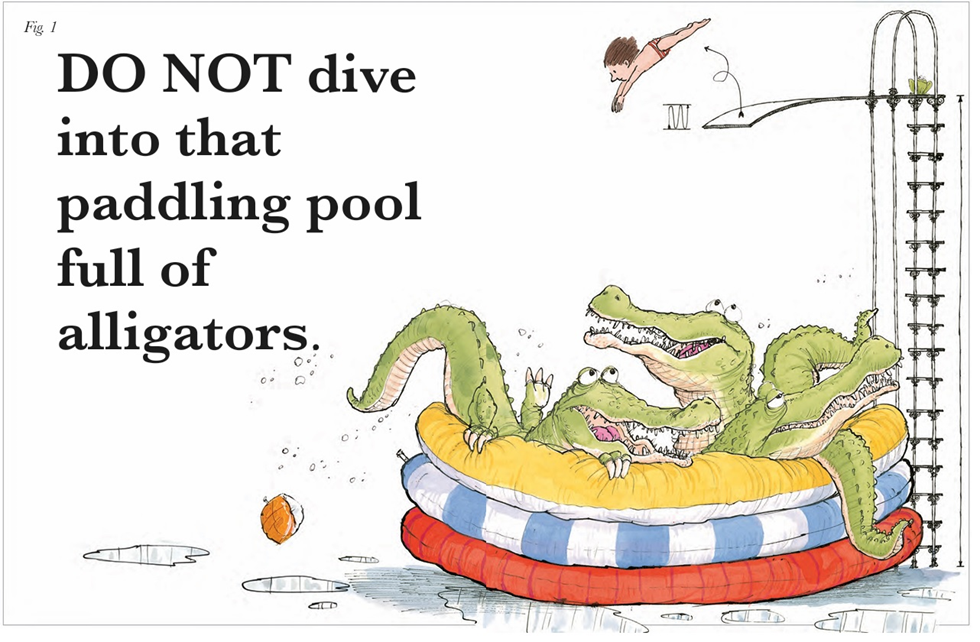
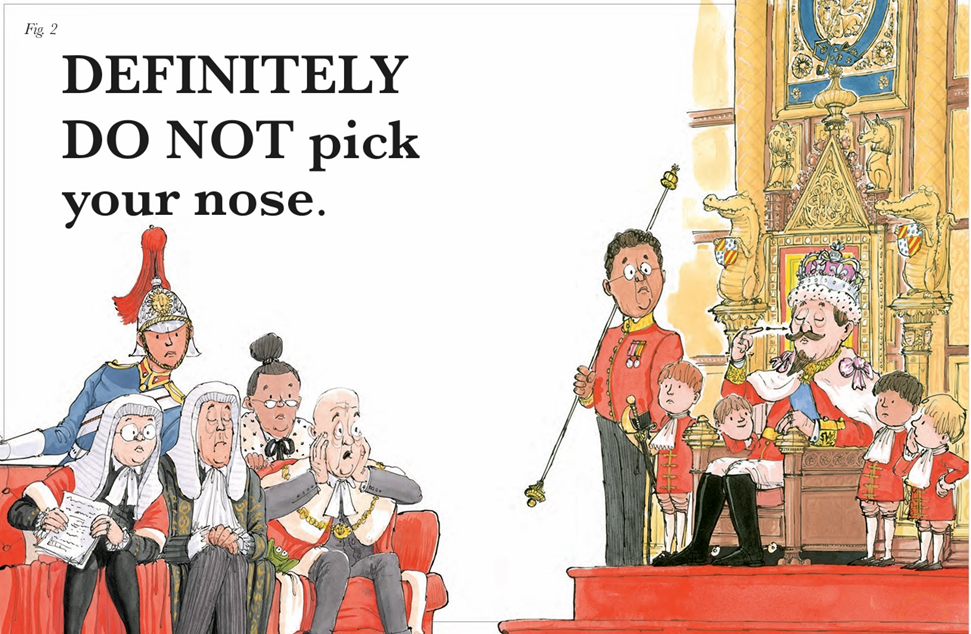
Warning: No More Silliness! If you have ever jumped into a pool full of alligators, picked your nose (yes, I'm talking to you!), or disturbed a pirate while he's reading a book, then you need to know - there will be consequences!
Q&A with Sam Usher: Why silliness is not allowed in his new picture book, No More Silliness!
"Who makes rules, what are they for, what happens if we break them?
Can it sometimes be a good thing?"
1. Can you tell us a little about yourself and the kinds of picture books you enjoy creating? What happens in your new book, No More Silliness
I've been making children's books since I left art school in 2008 - my first book was Can You See Sassoon?, which was followed by SNOW and 11 more books about a boy and his Grandfather.
WARNING: No More Silliness is my first book since that series ended. I love books with adventure, realism, beauty, sublimeness, traditionalism, mischief. A mixture of seriousness and astonishment at the wonder and beauty of the world, then when that gets embarrassing, puncture it with a good joke, eg a trifle falling on someone's head.
This is a very serious book and I don't understand why people keep laughing at it - it's my political manifesto for when I'm Prime Minister, which should be next year some time.
2. What inspired you to create your very serious 'political manifesto'?
The germ of the idea came to me during COVID - all the silly rules around scotch eggs and sitting down or standing up, and meeting people in groups of six but definitely not seve, and being banned from walking in a field 50 miles from civilisation in case you coughed on a badger. I thought: most of us a pretty sensible, do we also need to be told not to jump in a paddling pool full of alligators?
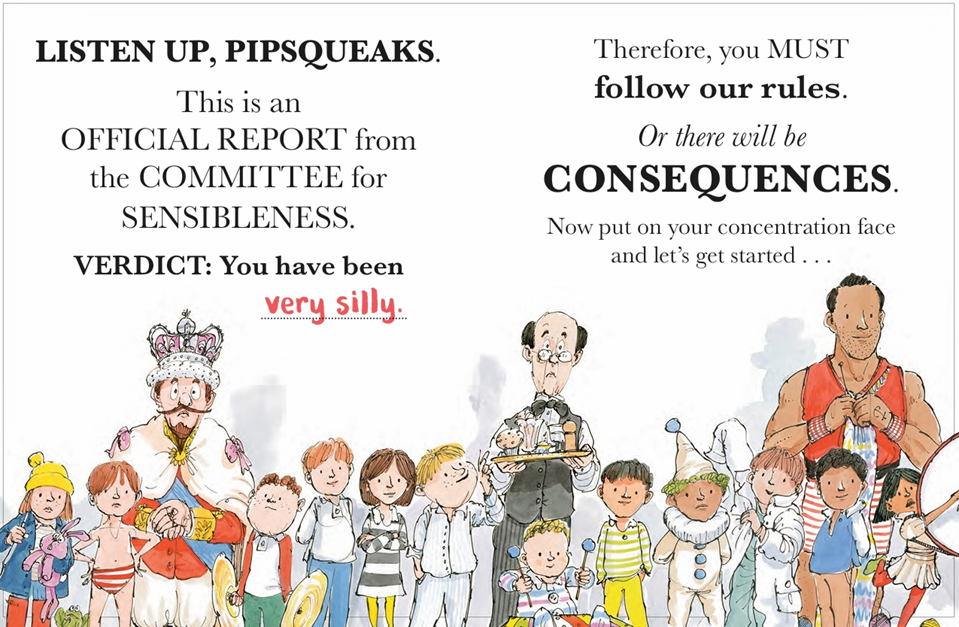
Illustrations from Sam Usher's Warning: No More Silliness!
3. Who delivers the rules in No More Silliness?
Lockdown made me think about who makes rules, what are they for, what happens if we break them? Can it sometimes be a good thing? For about 18 months it was a steadily growing list of rules in my notebook, but we weren't quite sure how to turn it into a book - who was telling the reader these rules? Me? A teacher? A random army general?
The Official Report framing was a way to solve that, and came a bit later in the process - an anonymous bureaucratic organisation with an official crest and latin motto - a clever friend translated it for me 'Do As We Say' became 'Quod Dicimus Hoc Facis'. The authorial voice is just how I talk to children when I do school visits.
4. How did you approach illustrating your 'report'?
Very little decision making, just panic! I had three months to do the drawings before I went away on a book tour to Italy, drew non-stop for two months, it wasn't looking right, started again, drew like a lunatic again, ran out of time, and this is what we came up with.
I just wanted the line to lively, the characters to be expressive, the colours to be bright. Or if there are creative decisions which I have made I did it without thinking - the answer is probably 'because it looks a bit old fashioned' - eg the arrows and diagram bits - I use a pen and nib and indian ink, and colour with watercolours, so the whole approach is faintly Victorian. My job is the hobby of an elderly, infirm aunt taking in the sea air.
5. Just how silly do things get in the story? What's your favourite moment of rule-breaking?
They do not get silly at all! As I said before this is a very serious book. My favourite moment of rule breaking was when the publisher asked me to draw the cover and I accidentally went to Italy for three weeks instead . . .
6. This is a great picture book to share with a group. How do you feel children will respond to seeing these characters - including nose-picking adults! - being so - silly?
I hope they take it very seriously and follow the rules to the letter. If they laugh they should be reported to the police.
7. Are there opportunities for interaction for the children through the story?
I would like the children reading to help find Steven the Frog - he lives in my garden and has snuck into every page of the book, which is quite annoying. Aside from that I hope readers will sit in sombre silence and allow themselves to be inculcated with a healthy notion of order and sensibleness.
8. We love the page of 'consequences' at the end of the book. Do you think it will also get some more serious discussions started about 'consequences' for bad behaviour?
Yes I wanted some of the consequences to be good, some of them to be irrelevant, and some of them to be bad, so children might think why did that rule exist in the first place? Sometimes there's a good reason, sometimes there's a bad reason, sometimes there's a reason which everyone has forgotten about, so perhaps it's best just to follow it anyway.
9. What's been your greatest moment of 'silliness'! Were there consequences. . . .?
I have never been silly.
10. For children who enjoy No More Silliness, do you have other picture books they might also enjoy?
How Tom Beat Captain Najork and His Hired Sportsman by Russel Hoban and Quentin Blake The Phantom Tollbooth by Norton Juster The Molesworth series by Geoffrey Willans and Ronald Searle.

Creative Challenge from Sam Usher: Work in pairs, or small groups and take it in turns drawing. The challenge is to draw an animal ONLY from descriptions of the other people in your pair, or group; then reveal it at the end - does the drawing look like the animal they were describing?
Here's where it's fun - an elephant's nose is: long, bendy, and sucks up water - hang on, that's a straw! Can the describers describe accurately; can the drawers draw accurately?
Sam Usher's School Visits: I've been visiting schools and doing events in the UK and Italy for 15 years - 1000 seater theatres, assemblies, class rooms. Usually primary school. Mostly fun, but I sneak in some drawing skills and creative writing too - a session will be structured around one of my books, with live drawing, draw-alongs, and at the end they can ask me questions about my job, EVEN where do you get your ideas from? and how much money do you have?
 Warning: No More Silliness!: A silly and hilarious picture book all about breaking the rules!