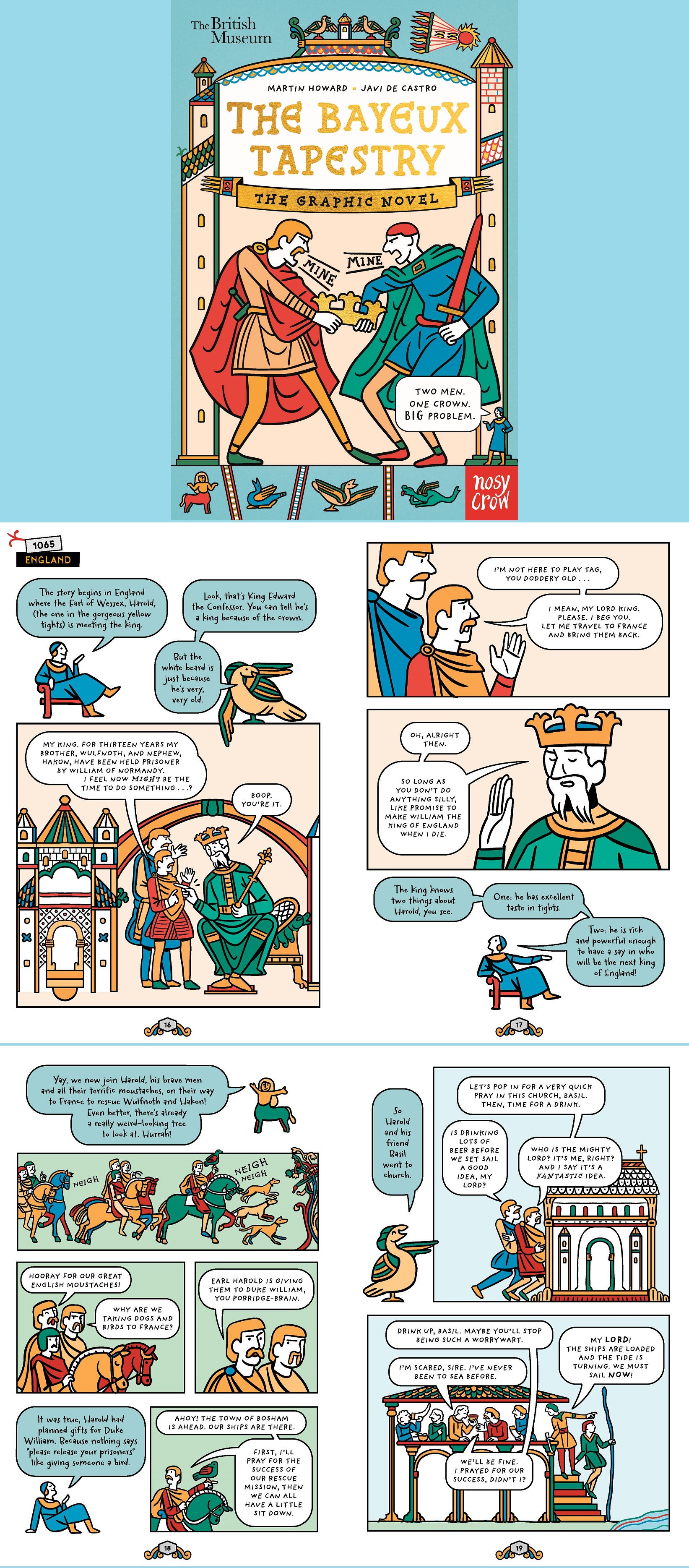
Martin Howard revisits the Bayeux Tapestry - with a hilarious graphic novel retelling!


About Author
Colour-changing moustaches, pointy fingers and stripy trees - discover the REAL Bayeux Tapestry story in Martin Howard's hilarious new book, The Bayeux Tapestry: The Graphic Novel.
Martin Howard writes funny books for children - including the Mallory Vayle and Maggoty Skull series - and also has a deep love of history. He has written children's biographies for Alexander the Great, Christopher Columbus and Neil Armstrong among other historical books. So he was delighted to combine comedy and history to retell the story of the Bayeux Tapestry and, for the first time in publishing history, put the focus where it truly belongs: on moustaches.
Interview
August 2026
Revisiting the Bayeux Tapestry with Martin Howard's The Bayeux Tapestry: The Graphic Novel
With the Bayeux Tapestry starring in a new show at the British Museum, it's a good time to take a fresh look at the history the precious document recounts. And in Martin Howard's The Bayeux Tapestry: The Graphic Novel, there's an added incentive for teachers and parents to get excited; as well as offering a clear explanation of the historical events with additional insights, The Bayeux Tapestry: The Graphic Novel (Nosy Crow) is very, very funny.
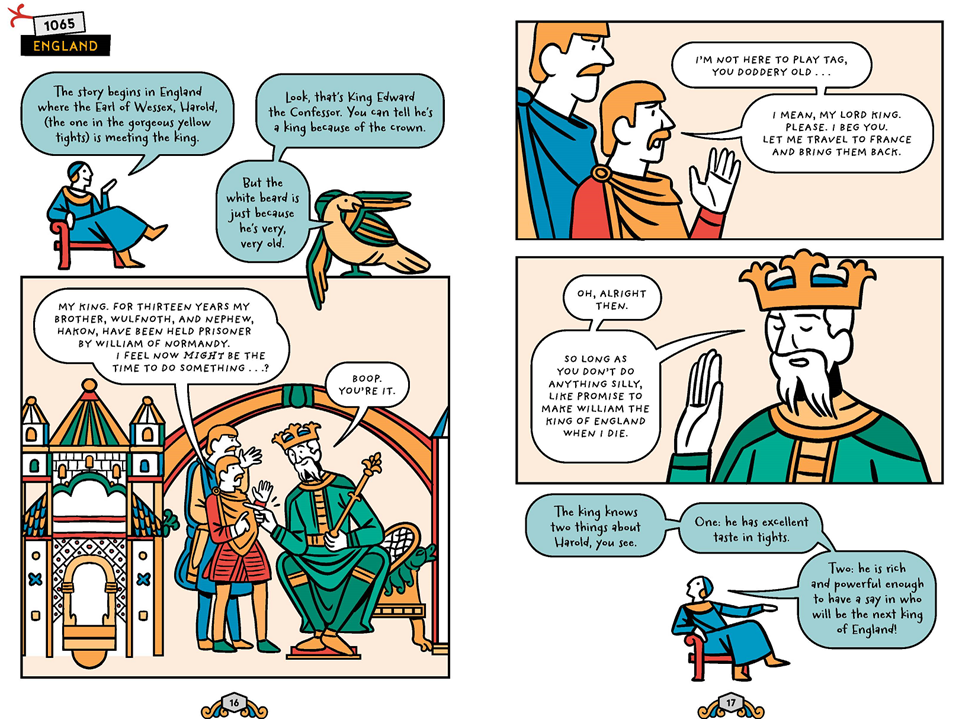
Colour-changing moustaches, pointy fingers and stripy trees - as well as the added commentary from bystanders to the main events - make this a treat for readers aged 7+ to explore, and a valuable resource for learning about the period.
The British Museum: The Bayeux Tapestry: The Graphic Novel Kings squabble, armies clash and arrows fly in this thrilling, hilarious historical retelling of 1066; the Bayeux Tapestry as you've never seen it! Read an extract.
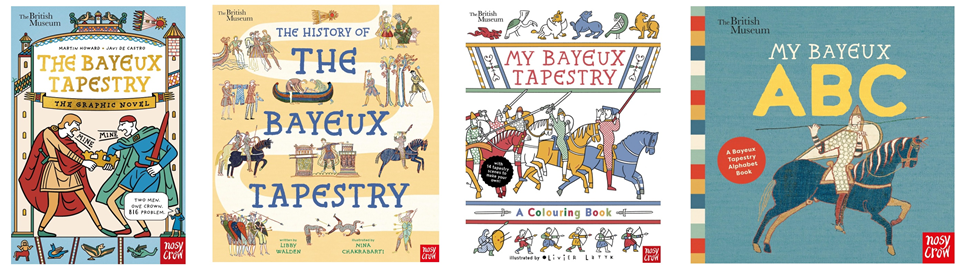
A selection of Bayeux Tapestry titles published this Autumn by Nosy Crow with The British Museum

Creative Challenge from Martin Howard: Create your own cartoon strip of the Bayeux Tapestry!
If readers would like to follow the same creative process that I used then perhaps they could draw or trace a part of the tapestry that catches their attention and then imagine what the people in it might be saying to each other about what is happening in the story. It could be funny or serious . . .
Q&A with Martin Howard: Exploring the Bayeux Tapestry, its history and his new graphic novel
"It tells a very serious story of betrayal and war and conquest during which many people lost their lives,
but there are odd little quirks that made me laugh."
1. Hello Martin! We've chatted before about your (hilarious!) Malory Vayle books. So what got you interested in a very different project - creating a graphic novel version of the Bayeux Tapestry?
Hullo, hullo! Always a pleasure to chat with you fantastic ReadingZone folk. Thank you for having me again. As you say, I'm better known for writing funny books - especially the Mallory Vayle and Maggoty Skull series - but I have always loved researching and writing books about history too. I've written about Alexander the Great and Christopher Columbus and Neil Armstrong and other history books, too.
To answer your question, this book happened by accident really. One day last summer, I happened to be chatting to Kate Wilson, who is the boss at Nosy Crow, while she was on holiday in France. We were talking about Mallory and Maggoty but I got very excited when she told me she was on her way to see the Bayeux Tapestry and we both thought a funny version would be brilliant. One conversation led to another which led to another and so The Bayeux Tapestry: The Graphic Novel was born . . .
2. We learn in the graphic novel that the Bayeux Tapestry isn't a tapestry after all . . . So can you fill us in: What is it, who made it and why is it called the Bayeux Tapestry?
Oh, I LOVE talking about this stuff! So, the Bayeux Tapestry is, in fact, an embroidery. A tapestry is created by weaving threads together to make a piece of fabric with a design. For an embroidery, the design is stitched straight on to an existing piece of fabric.
No one knows for certain who made it but it was probably commissioned by Bishop Odo, who appears in the book, and stitched at Canterbury in England. So it should be called the Canterbury Embroidery really. But at some point it was taken to Bayeux Cathedral in France where it was stored in a chest and forgotten about until 1476, when it reappeared in a list of the cathedral's treasures.
It is one of a kind - a stunning work of art - and the fact that it has survived almost intact for almost a thousand years is a miracle!
3. So, as a history buff as well as a children's author - did you know all about 1066 and the Norman Conquest when you started writing your graphic novel version of the tapestry (embroidery!)?
Yes, I am very much a history boffin! My mum was fascinated by history and passed that love on to me at an early age. I usually have at least one history book on the go and when I went to university it was a coin toss between studying English literature or history. I chose literature because there is a lot of history involved in that too.
So yes, I knew a bit about the Norman Conquest and its impact on British history before I started writing but it was great fun diving deeper into the subject and researching all the odd little details in the tapestry.
4. Did you (and perhaps some experts) fact-check the Bayeux Tapestry for your version? What kinds of things does it get wrong?
Because it made such a very long time ago the history of that period is quite muddy (it's part of the reason the tapestry is so important), but yes it is very likely that the Bayeux Tapestry gets a few things wrong, probably on purpose to present William in a better light.
For example, it tells the story of a battle that William fought against Duke Conan of Brittany before the invasion of England. The tapestry says William beat Conan but other writings from the time say that Conan escaped. We also don't know for certain why Harold went to see William in Normandy in the first place, so we had to make choices and go with the explanation of events that seems most likely.
All the facts in the book were checked by experts at the British Museum, and I'm very proud to say they didn't correct much of the story as I wrote it.
5. Despite occasional errors, the original tapestry is a serious historical document - but are there things modern readers might find funny?
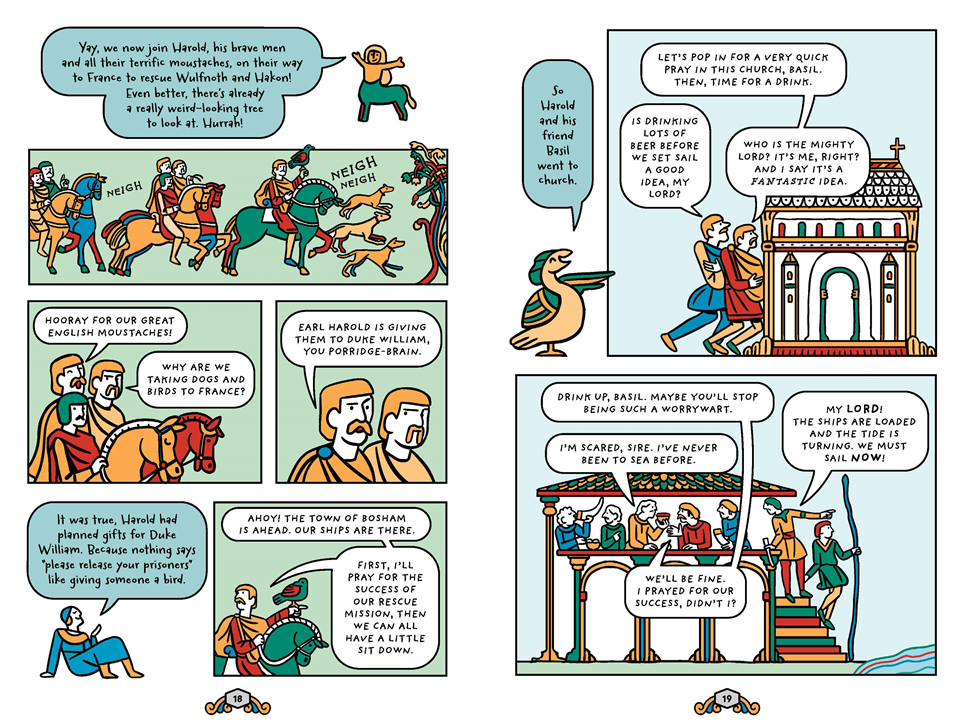
It tells a very serious story of betrayal and war and conquest during which many people lost their lives, but there are odd little quirks that made me laugh. For instance, I love the way that Harold's moustache often changes colour and sometimes disappears completely. I found a lot of humour too in trying to imagine who the people in the tapestry were and what they might have said to each other.
6. Given that it's a story told in pictures, was most of the work already done for you in creating it as a graphic novel?
Exactly! The Bayeux Tapestry was the graphic novel of its time. All I had to do was put some words in the mouths of its characters!
7. How do you keep young (and old!) readers engaged in your graphic novel version of these historical events?
I remember from my own history lessons at school that we sometimes think about history as a very serious and weighty series of events caused by a few powerful people. It's easy to forget that all of those events involve other people too. Ordinary people - brave or cowardly, kind or treacherous, funny and silly - whose lives are changed by events beyond their control.
The Bayeux Tapestry graphic novel is, of course, a funny book and it's very, very unlikely that any of the characters ever spoke the words I have given them but I hope it helps to make the story fresh and alive to present the people in the story as people and not just bystanders of history with nothing to say to us or each other.
8. Will readers also learn the factual side of the Norman Conquest, especially if they can't make it to the British Museum exhibition? Will you be going?
Readers will definitely learn about the Norman Conquest! Yes, it's a silly and funny book but the story itself is as accurate as we could make it. It's just that in our version the warhorses the Normans sailed with across the Channel give reviews of the ferry crossing and onboard food and facilities!
The British Museum has asked me to do a couple of events at the end of October so, yes, I will be taking the opportunity to see the tapestry in all its glory.
9. What kinds of things do the Bayeux Tapestry images teach us about life in general back then, perhaps reflected in Javi de Castro's illustrations for the graphic novel?
There are so many details that tell us about life at the time of the Norman Conquest: from clothing and food to how people thought about religion and politics. In such a vast tapestry it is very noticeable that female figures only appear four times!
For me, the main thing the tapestry teaches us is how different life was back in 1066, but - at the same time - how little has changed. Not to be all serious but we still live in a world where one man can plunge nations into a war that ordinary people don't want and cause upheaval that might change events for decades or even centuries to come.
Javi de Castro's amazing artwork is very true to the original tapestry. He has done a fantastic job of keeping the spirit and details while adding colour and life. His images really help remind readers that the tapestry was intended to tell an exciting and colourful story.
10. Do you have any more graphic novels or historical retellings planned? What are you writing at the moment?
Funnily enough, I have been thinking about this a lot recently. I love writing history books and I think it's important to tell those stories in a way that will grab the imaginations of young readers today. There is so much that history can teach us about who we are and where we came from. But that is a project for future Martin. At the moment, I am having way too much fun writing the fourth Mallory Vayle and Maggoty Skull book.
Creative Challenge from Martin Howard: Create your own cartoon strip of the Bayeux Tapestry!
If readers would like to follow the same creative process that I used then perhaps they could draw or trace a part of the tapestry that catches their attention and then imagine what the people in it might be saying to each other about what is happening in the story. It could be funny or serious . . .
Organise a School Visit by Martin Howard: Because I live in France I usually do one trip over to the UK for school events every year. This year it will be at the end of October/beginning of November. I can't bring a lot of props so they tend to be a talk (which I hope is entertaining), and a reading and then a lot of questions and answers because that is my favourite part. For Bayeux Tapestry events, we will probably do a creative workshop thing that looks very similar to the above. Anyone interested in booking an event can speak to Sîan Taylor at publisher Nosy Crow.

More Bayeux Tapestry titles from Nosy Crow: British Museum: My Bayeux Tapestry: A Colouring Book; British Museum: My Bayeux ABC: A Bayeux Tapestry Alphabet Book; British Museum: The History of the Bayeux Tapestry

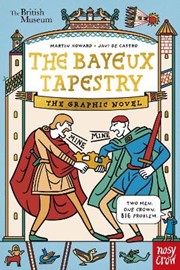 British Museum: The Bayeux Tapestry: The Graphic Novel