AM Dassu introduces her short story collection, Wild Journey


About Author
AM Dassu joins ReadingZone to talk about the journeys children from around the world make in her new collection of stories, Wild Journey.
She has written 14 children's books, including Boy, Everywhere, Kicked Out and Fight Back, which have collectively been listed for over 55 awards, including the Carnegie Medal and Waterstones Children's Book Prize.
She is a director at Inclusive Minds and a patron of The Other Side of Hope - an international literary magazine edited by immigrants and refugees.
You can find her on Instagram: @a.m.dassu
Interview
November 2025
Exploring inner and outer journeys in AM Dassu's short story collection, Wild Journey (Zephyr)
Known for her inclusive novels featuring characters facing extraordinary challenges, AM Dassu's latest novel, Wild Journey, brings together a range of stories featuring children from across the globe who each face a very different challenge, linked together by the starling's migration.
ReadingZone spoke with AM Dassu to find out what inspired Wild Journey, why she chose starlings to feature through each of the stories, and the themes of family and coming home that she explores.
Wild Journey would make a great class read, and we also have a writing challenge from AM Dassu, below, for children to write their own imagined journey.
Review: "Perfect for sharing with a class, the stories would work well for a story time, offering plenty to discuss and reflect upon."
Q&A with AM Dassu: Exploring inner and outer journeys in Wild Journey (Zephyr)
"I write stories about ordinary people who do extraordinary things in exceptional circumstances, and I try to make them hopeful, full of empathy and empowering for my readers."
1. Thank you so much for joining us on ReadingZone to talk about Wild Journey. Can you start by telling us a little about yourself, and how you became an author? What kinds of themes do you enjoy exploring in your stories?
Thank you for having me here! I have always loved writing but had forgotten how much after I left college. I wrote poems and short stories in my free time but didn't really think about getting them published. I thought it would be too hard for someone who hadn't studied at Cambridge or Oxford.
Then 11 years ago, while writing some copy for a friend's website, I rediscovered my love of writing for an audience and set up a blog which was nominated for the UK Blog Awards in the same year. That gave me the confidence to submit a piece to The Huffington Post, for which I became a featured writer. My very first piece was published on the front page, alongside Barack Obama and Lenny Henry.
In 2015, I was a parent helper for swimming lessons at my son's school, and every week one boy in the class would put on his socks before his pants and trousers in the muddy wet changing rooms - I would always tell him to put his socks on last. One day, I was inspired to write a picture book about this boy, entitled 'Soggy Socks'. I read it to my children that night, and they absolutely loved it, and so, I wrote a second, then a third story, by which point I realised this was the dream job I'd been looking for.
I started looking into getting published, and the rest is history! I now write stories about ordinary people who do extraordinary things in exceptional circumstances, and I try to make them hopeful, full of empathy and empowering for my readers.
2. Can you tell us about Wild Journey, your new book that includes stories about different journeys? What inspired you to write distinct stories, themed around journeys?
When my editor asked me to choose a theme for a collection of short stories, we decided journeys would be best, because I write about journeys people take. But I wanted it to be different from anything I'd written before.
I plotted five stories set across the world, in five different settings, with five wildly different characters, to explore how we sometimes take outer journeys that unexpectedly lead to an inner journey. Most of all I wanted to explore what 'home' means to different beings, and how brave and resilient we are as humans!
I decided starlings would be the perfect connecting link in each story because they migrate across the world, taking epic journeys to new places. I wanted, of course, to write diverse characters in which my readers feel seen, and so in these stories you will find British children from all sorts of backgrounds; Black, mixed Egyptian, Syrian, some with ginger hair, blonde some brown. They all have different family set ups: characters who live with both parents, have half siblings, whose parents are divorced or who are from carer and refugee families.
3. Why do you give each of the stories a single-word title; Star, Feather, Wolf, Flight, and ending with a story entitled 'Home'?
I wanted to leave my readers intrigued, wondering what each story was about. You'd never think Star was about a starling, until you read it, or what Wolf is actually about. I love creating ambiguity and encouraging conversation to take place over the simplest things.
Home, for me, is family and connection, and I try to show that in my stories in various way. In the first story, Jamal learns to care for a starling and then has to let it go back home to its flock, and in the last story, Yusuf finds a new home in England. I thought it was the perfect way to bookend the collection.
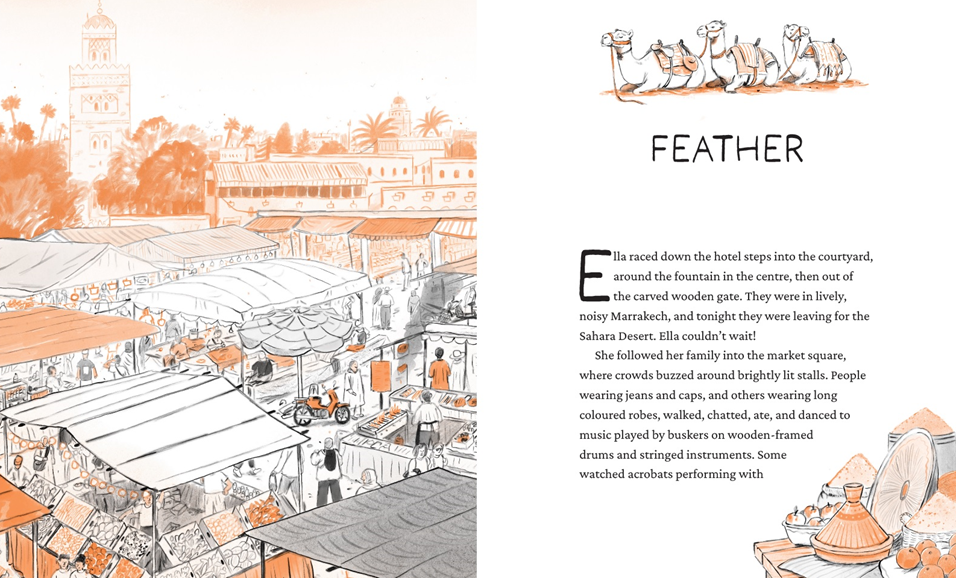
4. You've mentioned that the stories are set in many different countries - Egypt, Morocco, Spain, France and the UK. Why did you want to give these snapshots of children living similar but also very different lives around the world?
We live in a world that is the most connected it has ever been by social media, but sadly at the same time, we are seeing immense division, hatred and fear of people who are different. In these stories, and in fact all of my stories, I want to show how very similar we are despite our differences; how we all have the same hopes and fears.
When writing, my hope is always for my reader to see themselves in a character, to encourage empathy, bring us together and hopefully help build a more inclusive, welcoming society.
5. Can you talk about the kinds of journeys the children in Wild Journey experience, both physical and metaphoric? What kinds of discussions do you hope their stories might encourage among readers?
In Star, homesick Yusuf is bored and lonely while his mum cares for her father in Egypt. When he stumbles upon an injured starling, he is overjoyed he has company at last, but he realises he has to let the bird go, which is very hard to do. This story explores having a sick person in your family, having to do what your parents want, boredom and wanting something you can't have - all feelings that any child might experience but may not understand.
In Feather, Ella is on a desert safari in the Sahara Desert with her family. She uses up all of the water whilst playing with her brother. When her mother collapses in the desert due to heat exhaustion, she panics, runs off to find water and gets lost. She is saved by a Berber and is grateful that there are people that live in the desert, too. She goes from being very independent, to accepting help when she needs it.
In Wolf, Aaron is in the Asturias Forest in Spain with his dad who is a conservation scientist. He wants to help, but isn't allowed, and so feels useless and not confident. When a wolf approaches him, he is led to a den to help the wolf's pup. He fights his extreme fear of being eaten, and ends up feeling empowered, confident and like someone who can also do useful things like his father.
In Flight, Isabelle is at her grand-père's farm in France where he tells her a story about her uncle, who once planned to run and fly away with a starling murmuration (inspired by Icarus and Daedalus' story). Isabelle, like her uncle, also dislikes her half-sibling because she has taken her mum's attention, but learns that if you give someone you don't like a chance, you might just like spending time with them after all.
In the last story, Home, we come back to England, where Yusuf, a refugee, is starting school and is petrified because he doesn't know English and won't be able to make friends. He soon learns that there are many ways to communicate. Gazing at a murmuration above the playground, he accepts that he can make England home for now, just like the starlings do.
6. Many of the stories also show our link with nature, why did you want this to be part of these stories?
Inspired by the journey that starlings take and how they travel vast distances across countries and seas, I wanted to explore the different settings that starlings also encounter. I wanted to show how an environment that is very different from what we are used to can also be home, temporarily for us, more permanently for others. I hope the stories inspire readers to find out more about each location and perhaps play their part in preserving it.
7. As you've mentioned, starlings are threaded through each of these stories. Do they hold a particular fascination for you? Did you learn any new starling facts while researching for these stories?
Absolutely, I have always been mesmerised by the sight of a murmuration, where thousands of birds gather and swoop, dance, swoosh and dive for protection. While writing, I learned so much about these birds. They are so interesting - not only can they live solitary lives; they also congregate in huge numbers. They are all over the world and adapt to their environments and most fascinatingly, they can mimic humans and car alarms. They are gregarious and have been known to mimic other birds in the wild and confuse that species!
I thought they were the perfect bird for Wild Journey because of their migration patterns, the varied locations where they stop or settle, which would act as perfect backdrops for my stories.
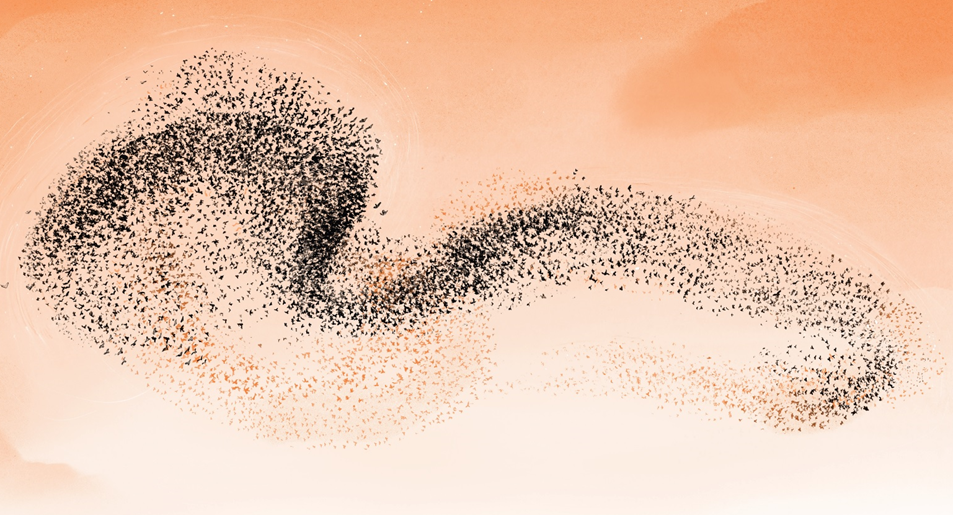
8. The illustrations by Joe Lillington are gorgeous; what do you feel they bring to the collection?
I love them! Joe's illustrations bring the stories to life and give readers a chance to pause and use a different part of their brain. I love how his art and my words work in harmony. When drafting the book, I asked for beautiful spreads between each story, where there wouldn't be any words, so readers could take a break or a rest, especially for those who are reluctant readers or simply to add to the experience of reading. I am so grateful for Joe's art and the beautiful production of this book.
9. Are you planning to write further short story collections? When and where do you prefer to write, and what are you writing currently?
I don't have any plans to write another collection yet, but if there is a demand for it, I certainly will. I am currently writing a light middle grade fantasy, which is so exciting and I hope it will be another book that is easy to digest and accessible for all children to read for fun and pleasure.
I prefer to write in peace and quiet, and so I usually write at my desk in the front room, but if a scene comes to me while I am doing chores or driving, I will stop and write it down quickly on my phone and email it to myself to incorporate it into my story when I'm next back at my desk.
10. What has been your favourite 'wild journey' in your own life and what kinds of journeys do you enjoy the most?
About 22 years ago, I went on a safari in the savanna in Kenya where we saw wild animals roaming freely. It was truly breathtaking! Then a few years ago, I went on holiday to Türkiye with extended family and instead of spending time in the pool or by the sea, which is what I would have normally done to relax, we hired a car and explored waterfalls, canyons, and gorges. This experience was so thrilling and refreshing that I am now always keen to explore the wild, wherever I go!

Creative Challenge from AM Dassu: Write a story about going on a journey
Think of a place that you really want to visit, that is completely different from anywhere you have been before. Google it, look at photos and maybe videos, and then think of a character who would have to do something that they really don't like in that setting. A good story will always put the main character in peril; having to do something that they don't really want to. For example, you could have your character enter a cave covered by spiderwebs in order to find their friend - even though they're petrified of spiders and dark, enclosed places. Make your character go on an outer journey and an inner journey by fighting their fears and coming out the other side. Let me know how it goes!
AM Dassu's School Events
I love meeting young people, it's the best part of the job! I've just designed the Wild Journey workshop, which is so much fun! In this interactive workshop, after introducing the book, I tell students what they should do if they find themselves in the same situation as my characters. But first I ask what you shouldn't do - if you get lost in a desert, or find an injured bird, or stumble across a wolf den etc. It's definitely my favourite workshop. I'm astounded and so impressed by the answers I get!
You can contact me and find out more about my school visits here: amdassu.com
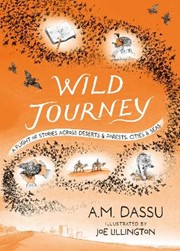 Wild Journey
 Kicked Out: A Boy, Everywhere story
 Fight Back
 Boy, Everywhere