Caspar Salmon takes readers on an alphabet adventure!


About Author
Now You Know Your ABC is a surprising, funny picture book by Caspar Salmon, who tells ReadingZone to tell us more about it.
Caspar Salmon writes and broadcasts about this and that for a living - mostly cinema - and enjoys seeing friends, swimming, and reading. He grew up in France but now lives in north London with his two children.
Matt Hunt, from Redditch, studied fine art at Birmingham School of Art and then developed a love for children's illustration. He's influenced by old movies, classic illustration, cartoons and books.
Interview
April 2026
Learning the alphabet just got way more fun with Caspar Salmon's new picture book, Now You Know Your ABC . . . Or Do You?, illustrated by Matt Hunt? With a fairytale wolf on the prowl and the reader on the menu, it's time to gallop quickly through the alphabet - and make your escape! (fingers crossed!)
ReadingZone caught up with Caspar to explore humour, the alphabet, and why D is for Danger in his new picture book, Now You Know Your ABC, the hilarious follow-up to his (also brilliant) How to Count to One, both published by Nosy Crow.
More about Now You Know Your ABC: A is for apple. B is for ball. C is for castle. But wait! D is NOT for dog. There's a wolf in this book and it's lurking right behind you. YOU are the hero of this story!
Review: "Now You Know Your ABC turns something familiar - learning the ABC - into a wild, imaginative chase that keeps children completely engaged." - Louise, ReadingZone
Caspar Salmon introduces his alphabet adventure
"What should be a simple task of learning the alphabet with some easy everyday objects becomes a rather
fraught and fantastical adventure featuring peril, magic, and haughty French people
1. How did you start creating picture books for children and what kinds of stories do you enjoy creating? Who or what inspires you?
I hadn't written anything for children until I had children of my own, and started reading them stories - so I would say that my primary inspiration is my kids, and the fun relationship that we have. Making them laugh is such a pleasure, as is seeing them become funny people themselves, working out how to use timing, surprise, irony and different registers of language so as to get a laugh.
I really believe that humour is a gift that you bring to other people, a moment of pleasure in the everyday. And so, no surprise, the stories I enjoy creating are often quite unusual, and aiming to produce a giggle or guffaw.
2. What happens in your new picture book, Now You Know Your ABC? Does it have any links to your debut picture book, How to Count to One?
The link with How To Count To One is that in both books I'm taking a key part of early years learning, and messing around with it a bit. In the new book, what should be a simple task of learning the alphabet with some easy everyday objects becomes a rather fraught and fantastical adventure, featuring peril, magic, and haughty French people.
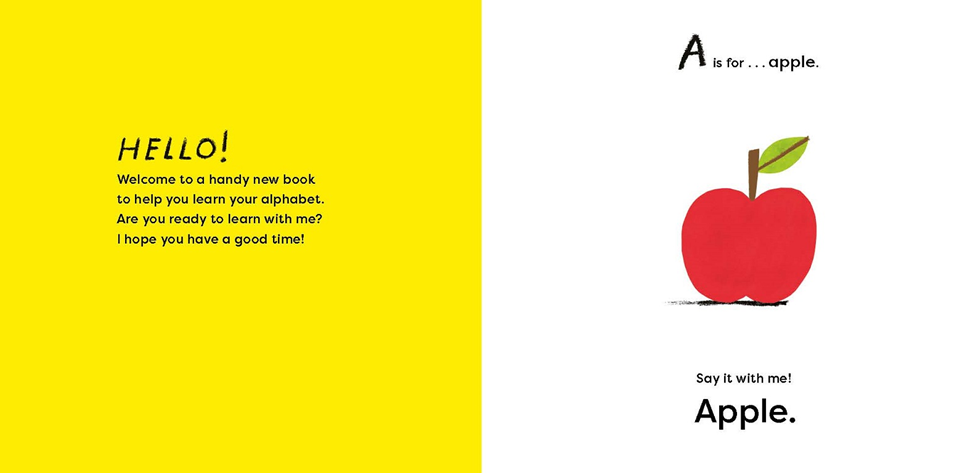
Illustrations from Now You Know Your ABC
3. What inspired the idea behind Now You Know Your ABC, and especially the wily wolf's appearance?
I wanted to write a follow-up to How To Count To One, and it seemed logical to turn my attention to the alphabet. I thought these would be good subjects as every child learns these things at an early age and is soon familiar with these codes. That's how my sense of humour works, playing around with the everyday, making boring or routine things jump out in some way.
The wolf comes from fairytales! When I first thought of introducing a story into the ABC, my mind naturally turned to traditional fairytales and bedtime stories - Little Red Riding Hood, The Three Little Pigs - in which the figure of a wolf stands for the threat of the unknown, and a primal animal-ness that human civilisation can't always run from.
These are growing-up stories, I suppose. Learning the alphabet takes you out of your baby-hood and into civilisation; going outdoors and facing the various threats of the world makes you an adult.
4. The story follows the alphabet and there are surprises on every page turn - did this make it a tricky one to write?
No, the text of the book came quite easily, but I must credit my brilliant illustrator, Matt Hunt, for finding different ways into the text that really amplify the humour and which bring in jokes of their own. The way he has threaded the wolf throughout the book is so clever and funny, and was not really there in my original conception of the text.
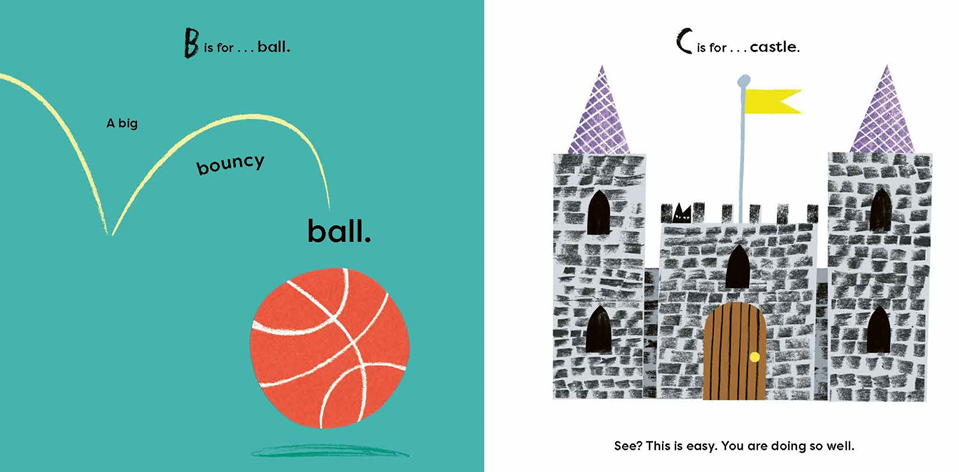
5. It is very funny - have you enjoyed creating the authorial voice for both this story and How to Count to One?
Yes, very much! I must say, though, that the authorial voice of these books is not a million miles from my own voice. I am a bit of a scamp in real life, what can I say.
6. Do you think Now You Know Your ABC will help children who don't yet know their ABC?
I don't actually know if it will, that remains to be seen. I can imagine - for instance - an older sibling who already knows the ABC enjoying the book, and a younger sibling simultaneously taking in various letters almost unconsciously during storytime.
The truth is that I didn't write the book specifically as an educational resource, and I don't think it should or will be used exactly as that; but I reckon it could be a fun and interesting additional tool to reinforce the ABC.
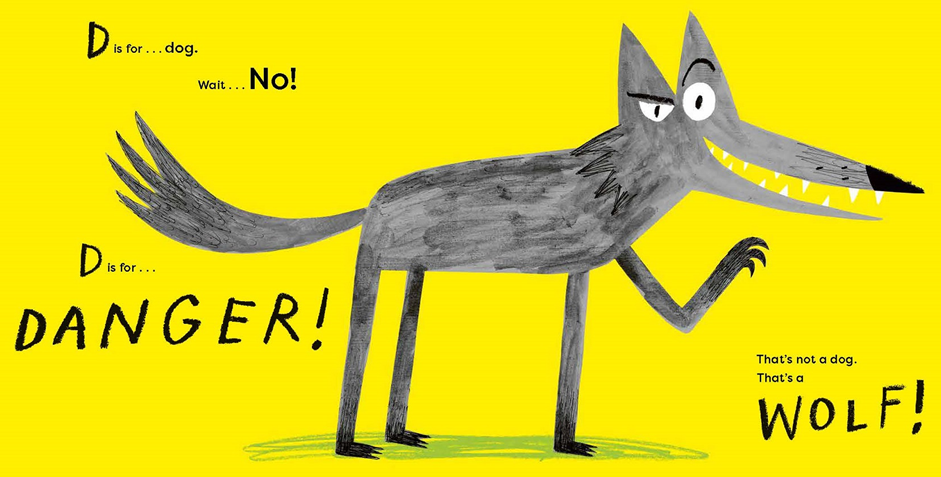
7. Matt Hunt has illustrated Now You Know Your ABC and How to Count to One - why does his style work so well with these stories?
So many reasons, but the main things are that he has a very playful eye, and he is very resourceful in the different layers of interpretation he can bring to a book. My tone is very jokey, and a bit ironic, and Matt's pictures are in that vein I think; but as I said before, he also finds ways of weaving themes and ideas throughout a text that bring a pleasure of their own.
One more thing that I think works very well, is that Matt's bright and cheerful illustrations are good at, let's say, softening my edges; my natural instinct as a writer (and as a person) is to be a bit challenging and perhaps even abrasive - that can be fun for kids, because they like it when someone doesn't respect conventions, but they do also need brightness and gaiety alongside that. A spoonful of sugar helps the medicine go down!
8. So you've enjoyed seeing how he has interpreted this text - any favourite spreads?
Yes, it's been a blast. The illustration for 'K is for KEY!' always makes me laugh, it's so dramatic and silly; and of course I love the French people.
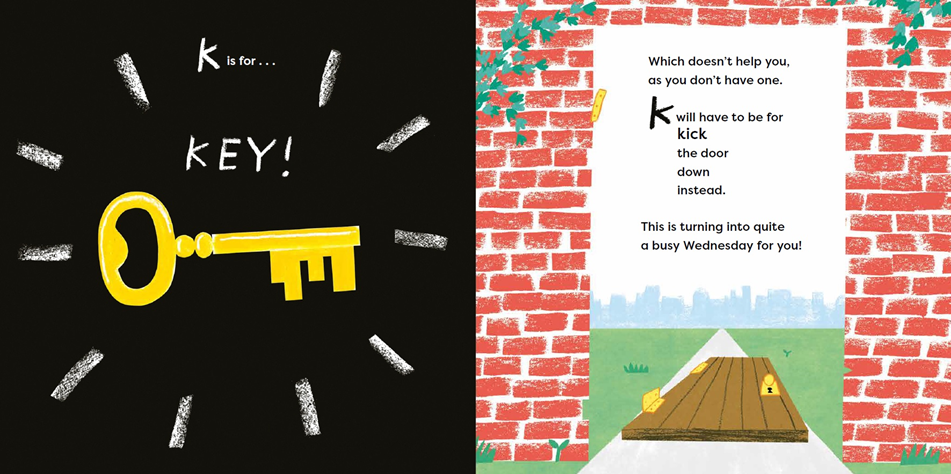
9. Any suggestions for how adults sharing the story with young children might be able to take it further with activities or discussions linked to the book?
I don't know about activities so much - I guess you could find other words beginning with these letters within the story, or think up some others which might fit into it in some way?
Discussions . . . well, I think the book's structure is very unusual, so an adult sharing the story with children could perhaps ask them about the twist from a standard educational book into an adventure story; and then the return to 'normal' alphabet at the end, which I hope makes people laugh. Careful not to ruin the fun though!
10. Do you have any more picture books planned? What are you writing currently?
I've had another idea for a picture book which I'm turning over in my mind - it's not really like this one, but if I can get it right it will also play with form and storytelling in unusual ways, by trying to tell several stories at once. I'm trying to write an adult book as well, but finding that a lot harder, and I won't have Matt to help me out on this one (unless we somehow invented a completely new kind of novel?).

Creative Challenge: How about getting young writers started with writing their own story using letters from the alphabet?
D could stand for anything! Start with an A, a B and a C of your own choosing (the more boring the better) and then get things pumping with an unusual letter D that kickstarts a story. Or: write the story from the wolf's perspective! The poor thing must be terribly hungry, I feel quite sorry for it.

School Visits: I do offer school events. A reading, discussion and signing make for a fun event I think. Schools can contact me directly at my email address ([email protected]).

Caspar Salmon introduces his earlier picture book, How to Count to One (Nosy Crow Books)
Children who are familiar with a traditional counting book is like will shriek with laughter at Casper Salmon and Matt Hunt's fresh approach to learning to count - while still learning about numbers and our world. We asked author Casper Salmon and illustrator Matt Hunt to tell us more about How to Count to One!
 Now You Know Your ABC: . . . or do you?
 How to Count to ONE: (And don't even THINK about bigger numbers!)