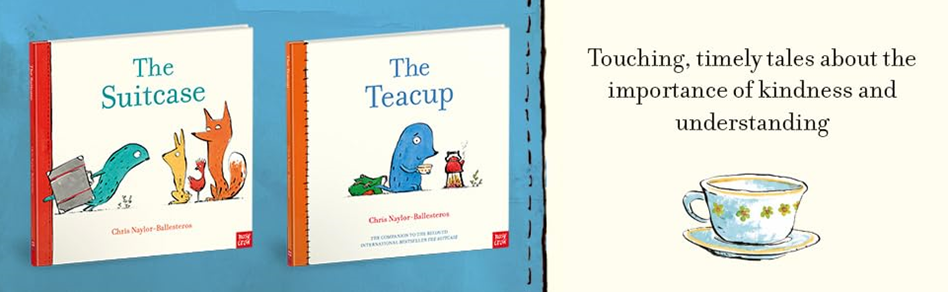
Chris Naylor-Ballesteros introduces The Teacup, his heartfelt companion to The Suitcase


About Author
Chris Naylor-Ballesteros's picture book The Suitcase, about kindness to strangers, caught hearts and minds around the world. Now he returns to the same group of friends, and a new stranger, in his picture book, The Teacup.
Chris is originally from Bradford and he studied illustration and graphic design at Bradford College of Art. When his children were small he realised he loved the picture books he read to them, so he started to create his own from his home studio near Limoges, France.
When he's not in his studio, he likes listening to and making music, wandering around the countryside, a bit of running and riding a bike.
You can find him on Instagram @chris.naylor.ballesteros
Interview
July 2026
Chris Naylor explores belonging, migration and hope in The Teacup, companion to The Suitcase
Chris Naylor-Ballesteros's picture book The Suitcase caught hearts and minds around the world, and he returns to the same group of friends, and a stranger, in his new picture book, The Teacup, published by Nosy Crow.
ReadingZone caught up with Chris to find out why he wanted to return to themes of The Suitcase for this follow-up story, and the messages of hope, friendship and found family he creates in The Teacup.
More about The Teacup Review: "The Teacup is an engaging and emotionally powerful text that explores themes of belonging, empathy, friendship, migration and prejudice in a way that is accessible to young children."

Creative Challenge from Chris Naylor-Ballesteros: The activity I've been doing in schools for The Teacup has worked well and you get some very interesting ideas from children. The children just have to draw a big teacup shape on a piece of A4 then put on it whatever they want to personalise it - it could be a pattern or drawing of objects or people - anything they want that makes it unmistakably theirs, but not just their name!
Q&A with Chris Naylor-Ballesteros, exploring the themes in his new picture book, The Teacup
"Hopefully these stories will encourage discussions about trusting people we don't know or understand, and appreciating
that they have a past life, experiences, memories and sadnesses or joys, just like us."
1. How did you start in creating picture books and what are your favourite moments as an author and illustrator?
I started by making a book for my children when they were little. I was a late starter but I realised that I loved picture books when I started reading them for my kids. That first book was never published but a year or two later I made another and it found a publisher.
The best moments are the big things like getting your first contract and first real copies. There have been some lovely moments in school visits or book fairs too, just little things where you realise that our books have a life after we finish making them and in fact their real life only starts when they're being read and enjoyed.
2. Can you tell us about your new picture book, The Teacup, and how it connects with your earlier book, The Suitcase?
At the end of The Suitcase I knew that the stranger, despite having a new home and new friends, was still missing something quite fundamental in his life. If you applied the clichéd ending "and they all lived happily ever after" to this story, it wouldn't really be true. In the old photo in his suitcase there is a vague shadow at the bottom of a figure who's taking the picture. I wanted to write about that character and a potential reunion.
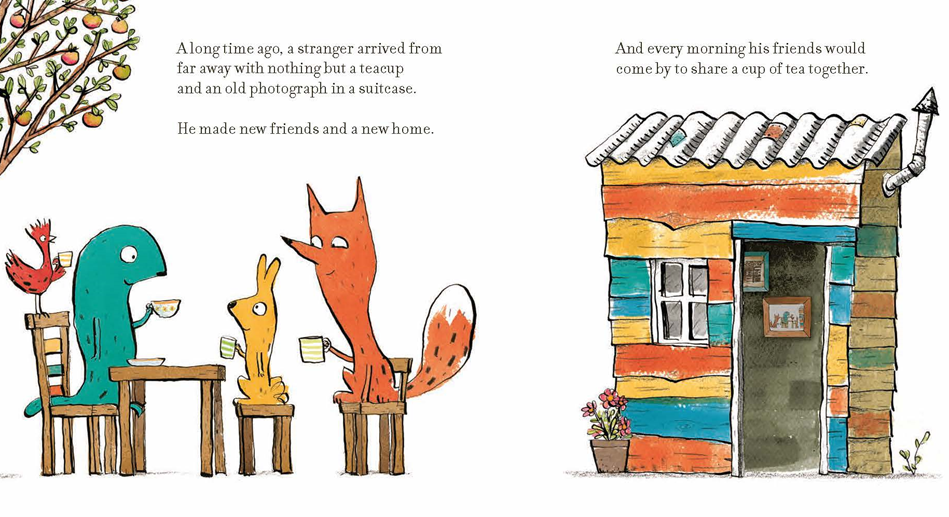
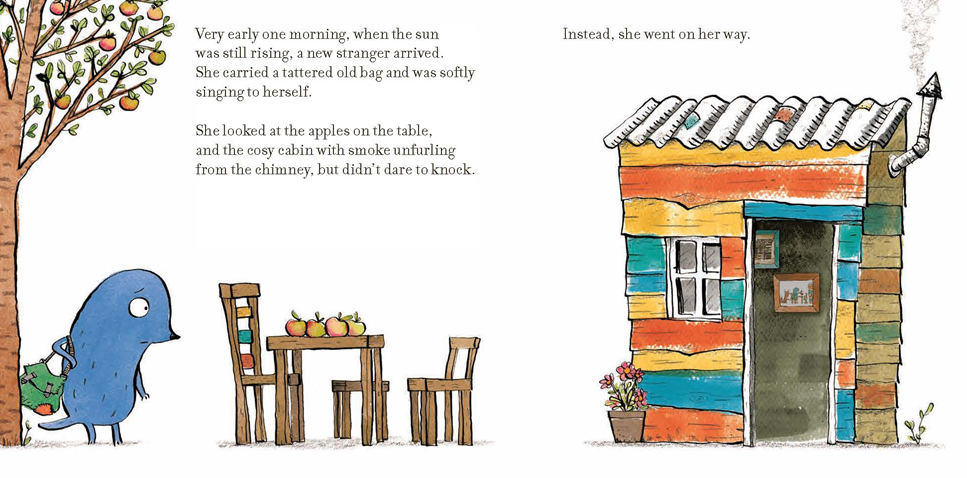
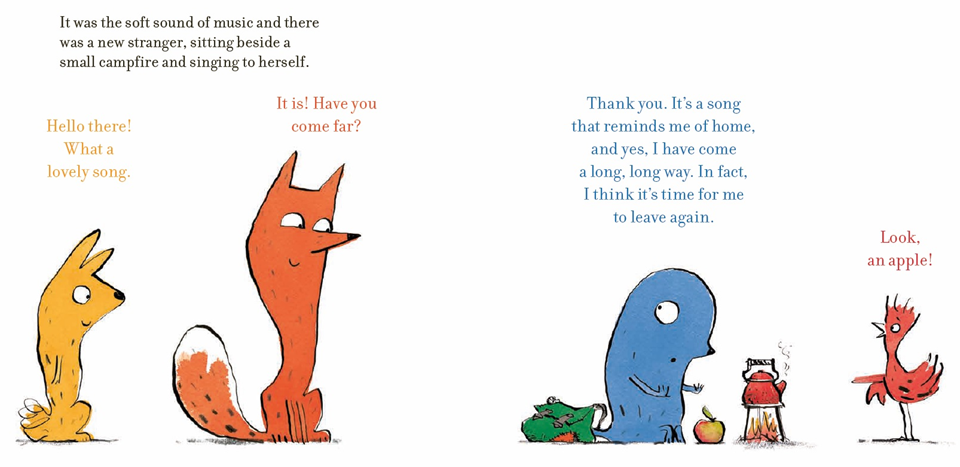
Images from The Teacup, by Chris Naylor-Ballesteros
3. Why did you want to create a follow-up to The Suitcase, and why did you choose to make the teacup the focus in this new story?
I'd had the idea that two identical objects could symbolise the link between two people. We invest ourselves emotionally in quite arbitrary objects when people leave us or are lost to us. As the original stranger had a teacup, then it had to be that! It could be that they intentionally kept one teacup each when parting, hoping that they (both themselves and the cups) would find each other again.
4. What kinds of themes do you explore in The Teacup? How well do you feel we are doing in how welcoming we are to strangers, refugees, migrants to our shores since you wrote The Suitcase?
Again, it's about a misunderstanding, but this time fuelled by what the group of friends perceive as evidence of a wrongdoing. They jump to a conclusion and feel vindicated, but then realise they got it wrong, and try to help make things right.
I think things have worsened since The Suitcase came out. Migrants and refugees are still demonised. Shamelessly xenophobic rhetoric has moved into mainstream political language. There doesn't seem much political will to turn the tide at the moment.
5. You have kept the same group of friends in this story as in The Suitcase. Why do you also make their response to the new stranger similar to how they react in The Suitcase?
Well that was a tricky balance! They needed to have learned something from the first book but still be capable of making a mistake. So the trick was to give them a seemingly plausible reason to have suspicions, that didn't stem solely from another stranger being in their midst. A lot of editorial discussion and thought went into this, it wasn't easy.
6. What kinds of discussions do you hope The Suitcase and The Teacup will encourage?
Hopefully these stories will encourage discussions about trusting people we don't know or understand, and appreciating that they have a past life, experiences, memories and sadnesses or joys, just like us. And that they are not defined by the difficulties they face or the hard situation they find themselves in, it could easily be us in their place.
7. What kinds of activities have you seen created for The Suitcase, and do you have some ideas for follow up activities for The Teacup?
When I visited schools for The Suitcase, I asked children to draw two or three objects they'd put in an empty case if they had to leave home. The results were really great. Children want to take the Xbox, a fridge or a live dinosaur, but overwhelmingly there are drawings of families and pets, their best friend or their favourite cuddly toy. In any case I didn't have the heart to tell the children they couldn't take family members, so they'd need a very big case - and a fridge, in the end!
The Teacup school visits have involved children drawing on a blank cup, so that if we found the cup, we'd know it belonged only to them and no one else. This works well except when a bright spark says "can't I just write my name on my cup?" Er… yes, I suppose you could just do that.
8. Can you talk us through the spare colour palette for this book and The Suitcase? How do you create your images?
I always preferred fairly minimal picture books that had a lot of empty space and used it to direct the eye around the pages. I'm not someone who paints panoramic landscapes and oodles of details, even though I do like looking at those kinds of books, too. The Suitcase, Teacup (and Frank & Bert for that matter) all use blank space as part of the story-telling and the colours also are there to help the readers though the story rather than show off how 'colourful' they are. I use watercolour, Indian ink and a bit of pencil here and there.
9. Which of your other books might readers of The Teacup enjoy? What are you working on currently and do you plan to revisit The Suitcase and The Teacup for a new story in the future?
For readers who enjoy The Teacup, there's a book I made with Nosy Crow called 'Out Of nowhere'. It's not as well-known as some of my other books but people who like it, really like it. It's a quiet little story about friends that are separated, and what we do to try to find them again, even if they've changed.
Currently I'm working on the next instalment of Frank & Bert, and in the vein of The Suitcase and The Teacup, I've had for quite a while an idea about a small boat, and how the occupant is repeatedly ignored or abandoned by those that could help, even though they make performative efforts to do so. For a while it seemed that the End Of Civilisation would be due to 'small boats' when in fact it'll probably be climate change, that no one seems to want to seriously confront, so let's all worry about small boats.
10. What kinds of things do you enjoy doing when you're not in your studio?
I love playing music. I play drums and was quite serious in my youth but now play for fun with nice, good players who don't take it too seriously. I walk my dog and trim overgrowing brambles in the garden. I don't enjoy the last one, but seem to do a lot of it.
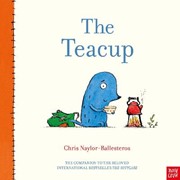 The Teacup
 Frank and Bert: The One Where Bert Plays Football
 Frank and Bert: The One Where Bert Learns to Ride a Bike
 Frank and Bert
 Out of Nowhere
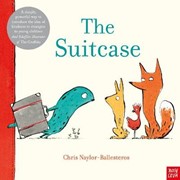 The Suitcase
 I'm Going To Eat This Ant