Counting to 20 with Jonathan Emmett's engaging cats and dogs!


About Author
Jonathan Emmett and Rob Hodgson introduce One Dog, Two Dogs, their new novelty counting book that helps children count to 20.
Jonathan Emmett was an architect before becoming a children's author and novelty book designer. He's written over 70 books, including Alphabet Street and Bringing Down the Moon. He likes building things, playing games and solving puzzles. jonathanemmett.com
Rob Hodgson lives in Bristol where he spends his days making a mess and turning it into quality illustration projects and books. His work often explores play, texture, character design and interactivity.
Interview
September 2026
Counting dogs with Jonathan Emmett & Rob Hodgson (Nosy Crow)
Meet a host of distinctive and dashing dogs in One Dog, Two Dogs by Jonathan Emmett and Rob Hodgson. Lift the flaps and watch these happy pooches run, race and wag their tales all the way from one to 20! This is a companion book to their earlier counting book, One Cat, Two Cats, both published by Nosy Crow.
ReadingZone caught up with Jonathan Emmett to find out how One Dog, Two Dogs can help young children learn to count all the way to 20 - and which would he choose, dogs or cats?
Q&A with Jonathan Emmett: Helping children count with 20 distinctive dogs!
"Children can be encouraged to find their favourite animal on each spread or find each and every
numbered animal in the correct order."
1. You've already created One Cat, Two Cats - why did you decide that dogs needed their own counting book too?
The idea came from my publisher Nosy Crow. One Cat, Two Cats was picked up by so many foreign language co-publishers that a year before that book was published, my editor Victoria England asked me if I could write and paper-engineer One Dog, Two Dogs as a companion book.
2. So is it Dogs or Cats in your home?
My wife is allergic to cats and dogs, so we don't have either, but if we were able to have one, I would much rather have a dog. They seem far more sociable than cats and having a dog would motivate me to get out of the house every day to take it for a walk. So dogs win over cats for me.
3. These books are unusual in counting to 20, not just to 10. Why did you feel young children needed a bit of support for this?
I wrote One Cat, Two Cats after Victoria told me that customers were asking booksellers for counting books that went up to 20. I can see why parents might think there was a need for this as the names of the numbers between 11 and 19 are illogical and inconsistent. Once you get to 20 the names have a logic to them; with numbers like 'twenty-one' or 'forty-five' the first half of the name tells you how many tens there are and the second half how many units.
If the numbers between 11 and 19 followed the same logic, the first two numbers would be named something like "onety-one" and "onety-two" instead of "eleven" and "twelve". Although the names for the numbers from 13 to 19 are split into tens and units, they are the wrong way around, with the units coming first and the suffix "teen" being used to denote a single ten.
Having helped a child to count up to ten, I think it makes sense to continue to help them through this anomalously named range of numbers and leave them at 20, where the names become logical and consistent.
4. How do you encourage young readers to keep counting to 20 through these pages?
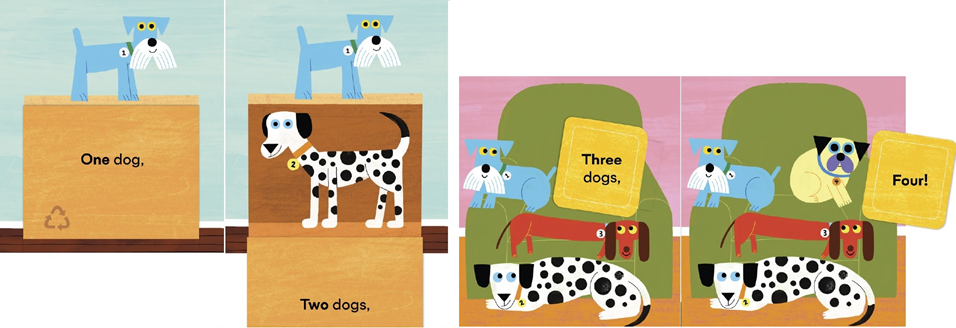
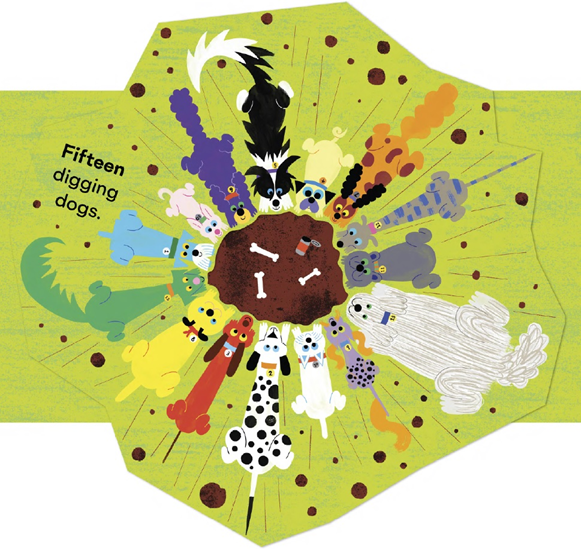
The distinctly different looking dogs and cats Rob has drawn, each wearing a numbered collar, is a key part of the books' appeal as they bring a 'Can you spot?' element to each of the spreads. Children can be encouraged to find their favourite animal on each spread or find each and every numbered animal in the correct order.
5. Is it challenging to create a rhyming story, like these, that are simple but also entertaining for young readers? It sounds familiar - have you used a more popular rhyme as your base?
Writing any text that both scans and rhymes well AND fulfils another function, such as telling a story or conveying rigidly defined concepts like counting or the alphabet, is always challenging. However, it's a challenge I enjoy and it's very satisfying when you succeed.
Both One Cat, Two Cats and One Dog, Two Dogs use a rhyming structure based on that of the traditional counting rhyme One Potato, Two Potato. While the potato rhyme stops at seven, I've added additional verses to make the books' rhymes go up to twenty. It's the similarity to One Potato, Two Potato that makes these texts sound familiar.
6. There are lots of flaps and pop-ups to lift through the story - are these challenging to create? How important are they in keeping young children hooked - and counting!
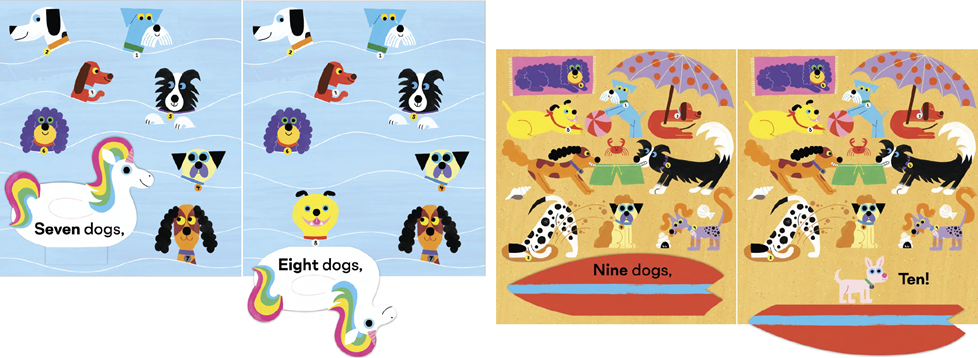
Coming up with ideas for flaps is relatively easy compared with designing pop-up elements, but I enjoy doing both. And, to give credit where credit is due, although most of the flaps in the book were in my prototype, a couple of them have come from Rob or the team at Nosy Crow.
On the page for nine and ten in my prototype, the flap was the lid of a hamper of towels that the dogs were drying themselves with. Setting this page on a beach and making the flap a surfboard is far more visually appealing - but it wasn't my idea!
Children love uncovering hidden characters or objects and in these books, opening a flap always introduces a new cat or dog to the group, which makes the reveal extra special.
7. Have you had any responses to your earlier book, One Cat Two Cats, in helping young children develop their counting skills?
No one has told me that One Cat Two Cats has helped their child develop counting skills specifically, but people have told me that it's their child's favourite book, including this reviewer: https://www.throughthebookshelf.com/reviews/one-dog-two-dogs
8. For children who enjoy counting along to these stories, do you have any other picture books they might also enjoy?
Cookie Count, which features a growing number of mice nibbling on a variety of biscuits, by paper engineering genius Robert Sabuda, is a great pop-up counting book. When We Went to the Park by Shirley Hughes has a simple but clever text that has counting woven into it. And for children who want to count beyond twenty, I recommend Out for the Count, written by Kathryn Cave and beautifully illustrated by Chris Riddell, which goes all the way up to a hundred.
Jonathan Emmett's School Visits: I no longer take direct bookings from schools for in-person visits, but I still offer virtual visits and you can find details of the virtual visit sessions I offer and a booking form on this page of my website
Watch Jonathan Emmett introduce his counting book, One Cat, Two Cats
Jonathan Emmett shares the opening pages of One Cat, Two Cats, a counting book with a classic feel that keeps children entertained, turning the pages - and learning to count from one to 20.
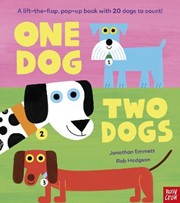 One Dog, Two Dogs: A lift-the-flap, pop-up book with 20 dogs to count!
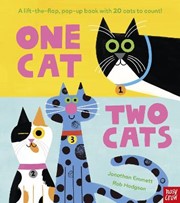 One Cat, Two Cats: A lift-the-flap, pop-up book with 20 cats to count!