SE Durrant


About Author
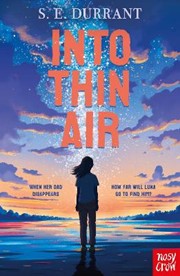
Into Thin Air is a story about family and the environment with a mystery at its heart. ReadingZone caught up with author SE Durrant to find out more!
SE Durrant has wanted to be a writer since she was a child. She spent her childhood in Scotland before moving to Leicestershire when she was 12. She studied Fine Art and then travelled widely before settling in south London.
She has taken on many jobs including selling paintings in Venice and teaching art to children. For many years she worked on research bids at the University of London. She now lives in Brighton with her family.
Interview
August 2026
ReadingZone caught up with author SE Durrant to find out about her new novel, Into Thin Air
In this story about a disappearing father, the environment and space travel, award-winning author SE Durrant deftly explores sibling relationships, coping with anxiety, and families on the brink.
In our indepth Q&A with the author, she discusses the importance of stories about resilience, how first person narratives can help develop empathy, and what her research revealed about living on the International Space Station!
Into Thin Air: When Luna sees her father leaving the house late one night, she expects him to return the next day - but he doesn't. As his absence continues, and no one seems to worry, Luna, her sister and their friend Casper set about uncovering clues to find out where he is, and how to bring him home. Read a chapter from Into Thin Air
Q&A with SE Durrant: Writing challenging stories that give readers hope
"I think the theme running through all of my books is resilience. I write about characters who look at what's
going on around them and feel they have some agency."
1. Can you tell us a little about yourself, what got you into writing? What kinds of books do you write?
I grew up in Scotland with three siblings in a house full of books. We had weekly trips to the local library and one of my favourite things to do was curl up with something to read. I used to write stories for my younger sisters and I remember being amazed that writing allowed me to make anything happen - if I wanted a mouse to drive a car the mouse would drive a car, if I wanted characters to fly I could make them grow wings.
My writing is very different now. I write contemporary fiction focusing on children who live in the real world and are finding their way through challenges. I've never read science fiction. I think I'm rooted very much in the contemporary world. And if I start a book and don't like it, I put it down and try another.
2. What is your new novel, Into Thin Air, about? Do the themes connect with any of your earlier novels?
Into Thin Air is about two sisters whose dad disappears. My narrator, 11-year-old Luna, is a space science and maths enthusiast. She tracks the International Space Station and in doing so finds an escape from the worries of her day-to-day life. Together Luna, her sister Jade and her friend Casey set about finding Dad.
I think the theme running through all of my books is resilience. I write about characters who look at what's going on around them and feel they have some agency.
3. Do you feel that stories like these - difficult situations in the real world where children find a way through - can be transformational for young readers?
Yes, I think it's helpful for children to read stories in which children in difficult circumstances find a way forward and don't lose hope. I want my characters to be relatable and my books to be realistic but hopeful. No-one wins the lottery or is guaranteed to live happily ever after, but by the end of my books my characters have found a way through, understand themselves a little better and feel more connected to their world.
I also think a very important aspect of these sorts of stories is they encourage empathy by allowing children to step into someone else's shoes. A character's circumstances may be unfamiliar but their feelings will be recognisable. Hopefully stories like these encourage children to understand that other lives may be very different but we all have similar hopes and dreams.
4. What was the starting point for Into Thin Air and why did you put a mystery - a father who has disappeared - at its heart?
I enjoy writing about sibling relationships and I began Into Thin Air with the idea of two sisters solving a mystery that is threatening to derail their family.
I put the mystery of Dad disappearing at the heart of the book so Luna and Jade have a very clear goal - find Dad. Family life is very important to Luna and Jade so when Dad disappears and Mum is clearly struggling, they will do whatever they can to make things better.
5. The novel focuses on that relationship between the sisters, Luna and Jade. How did each of their characters develop and how do you explore their relationship through the story?
I think I knew who Luna was very early on. She is perhaps a version of me as a child - a bit of a worrier who wants to put things right but struggles to know how to go about it. Jade was more of a mystery. She is the quirky, loveable younger sister who doesn't notice she's put her jumper on inside out. Luna has complicated feelings about Jade, sometimes feeling superior to her and other times rather envious.
As I was writing the book it became clear that Jade is actually Luna's lynchpin. Luna may think they're very different, but by the end of the book she realises Jade is quite similar to herself. Like Luna, Jade has rituals to help her manage stressful situations. Jade is also the person who keeps Luna grounded when life feels too difficult.
6. The novel is told as a first person narrative, so we see everything through older sister Luna's eyes and how she struggles to interpret the world around her. How did you approach writing her as the narrator and what challenges did this bring?
Luna is in a constant battle to make sense of the world and manage her feelings. She's not someone who can easily switch off so she puts in all sorts of supports and distractions for herself - counting prime numbers, tracking the space station, imagining herself elsewhere. I think perhaps most people do these sorts of things to a certain extent. I certainly I do.
The challenges were to make her sympathetic because she is less empathetic and fun than Jade. But her intentions are good, she tries to learn from her mistakes and by the end of the book she has understood herself a little better. I hope readers warm to her.
7. Luna, as her name suggests, is very interested in space and she regularly checks in to the progress of the International Space Station. Why did you decide to include an astronaut's comments at the start of each chapter?
My knowledge of space science is quite limited but I have always been fascinated by being able to look at things from another perspective. Tracking the space station offered Luna a way to distance herself from her tricky life and imagine being somewhere very different. Into Thin Air is also about environmental concerns so having the view from the space station allowed me to describe Earth as a whole - our one precious planet and the only place we call home.
I begin each chapter with a paragraph about life on the International Space Station because this is a reflection of how Luna thinks. She often thinks about life in space and she hopes to be an astronaut herself when she grows up. I liked the idea of Luna looking out into the night sky and her favourite astronaut, Mimi, looking out at the planet she grew up on.
I did a lot of research on the International Space Station, mostly though looking at the NASA site. One thing that surprised me was that the space station was assembled in space; it weighs 450 tonnes so no rocket would be powerful enough to lift it. I was also surprised that it is about the size of a football pitch. It was also interesting to think about the fact that the station takes 90 minutes to orbit Earth so the astronauts see sixteen sunrises and sunsets every twenty-four hours. To give their days shape the astronauts use a 24-hour clock linked to Greenwich Mean Time, pulling down blinds when it's time to sleep.
8. As you've mentioned, there is a strong environmental message within the story about water pollution. Have you based this on a real event? What would you like readers to take from the sisters' adventures?
I was inspired to write Into Thin Air after listening to the BBC podcast, Buried, which investigates chemical waste being dumped in the countryside and polluting the surrounding area. This story is now on BBC as a documentary.
I would like readers to take from the book the understanding that our world is very precious and should be protected but also that, although very few people can change things on a big scale, small actions can make a difference.
9. Where are your favourite places to write and how does where you're writing affect what or how you write? Are you writing a new novel currently?
I write most efficiently when I am out of the house and away from distractions so will often sit in a café or library when creating a new book. When it comes to editing a manuscript, I work at home because it's a very clear task which I don't get distracted from. I'm currently planning my next middle grade book and am also writing a book for adults.
10. Luna's escape is to imagine leaving Earth and flying into space. What is your favourite place to escape to, and to relax when you're not writing?
I like to walk and am very lucky to live in Brighton with lots of beach and country walks close by. I also enjoy escaping into a good book.

Creative Challenge from SE Durrant
The Golden Record time capsule Voyagers 1 and 2 are space probes which are travelling through interstellar space, gathering information and sending it back to Earth.
Both Voyagers carry a copy of the golden record which describes life on Earth, in case the space probe is ever discovered by extra-terrestrial life. The golden record contains images and sounds representing the diversity of life and culture on Earth. These can be seen and listened to on the NASA website. The Voyagers were launched in 1977 so the golden record is nearly 50 years old.
Write a letter to put on a space shuttle explaining what life on Earth is like today. Think about some of the following:
The clothes you wear, the food you eat
Your favourite sounds and smells
Your favourite sight
The people in your life
A subject you enjoy
How it feels to do your favourite activity

School events with SE Durrant: I really enjoy meeting readers and running workshops. My school events are best suited to Years 4 to 7. I offer assemblies for up 300 pupils and writing workshops for around 30 pupils at a time. My workshops involve planning stories, writing prose or poems or, if preferred, creating drawings. The most important thing to me is that the workshops are stress free for the children and every child creates a piece of work. There will soon be a link on my website but meanwhile please do message me via my Instagram @s.e.durrant or my publicist Emily Simms at Nosy Crow.
 Into Thin Air
 Talking to the Moon
 Running On Empty
 Little Bits of Sky