Reflective Realities survey shows progress in representation in children's books
Posted on Friday, November 20, 2026
Category: News
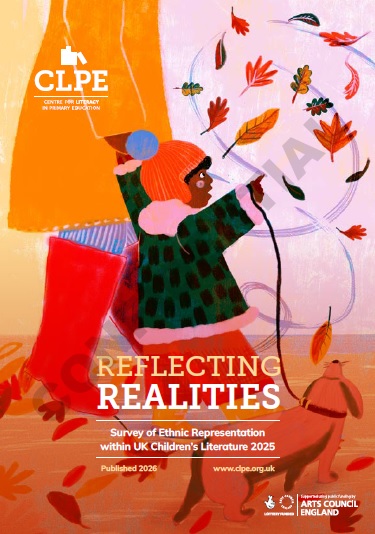
Nearly half of all children's books published in the UK now feature racially minoritised characters, according to the latest CLPE Reflecting Realities' Survey of Ethnic Representation within UK Children's Literature, which publishes today.
The survey found that 44% of children's books, including picture books, fiction and non-fiction titles published in the UK in 2025, featured racially minoritised characters, compared with just 4% when the first survey was published nearly a decade ago, in 2017.
However, despite the substantial increase in overall representation, the survey also found that the percentage of books featuring racially minoritised main characters remains the same as last year, at 24%. While this is a significant improvement on the 1% reported in the first survey, CLPE said the finding raises important questions about the extent to which racially minoritised characters are being positioned at the centre of the story worlds they inhabit.
Looking ahead to its tenth year in 2027, Reflecting Realities will provide a decade-long picture of how representation has evolved across UK children's publishing and what is required to sustain progress over the long term.
This year the survey analysed 1,909 eligible children's books for ages 3-11 years, of which 833 featured racially minoritised characters. The data is supported by NielsenIQ BookData.
Representation across text type
The 2025 findings reveal notable changes across the three text types monitored by the survey - including fiction, non-fiction and picture books.
Representation in fiction rose from 18% in 2024 to 38% in 2025, the highest figure recorded for the category and a significant development for a text type that has historically lagged behind picture books and non-fiction.
Non-fiction recorded the strongest growth, increasing from 27% in 2024 to 67% in 2025 and establishing a new record high. The report highlights the ways in which non-fiction publishing has become increasingly responsive to inclusive approaches across biography, history, STEM, geography, culture and social justice publishing.
Picture books is the only category to have seen a drop - after years of significant expansion - from 38% in 2024 to 37% in 2025, for the first time falling behind representation in fiction.
Industry brings 'meaningful change'
Farrah Serroukh, executive director of research and development at CLPE, said, "We are reporting the highest levels of representation recorded in the history of this research series, showing what is possible when the industry commits itself to meaningful change.
"At the same time, these findings remind us that representation is about more than presence alone. The quality of representation, the positioning of characters and the sustainability of inclusive publishing practices remain just as important as headline figures. As we approach ten years of Reflecting Realities, we hope the industry takes a moment to recognise how far it has come while continuing to invest in the infrastructure, talent and sustained commitment needed to ensure that inclusive literature remains a central and enduring part of children's publishing."
Next year, 2027, CLPE will be able to draw on a full decade of evidence charting representation across UK children's publishing. The resulting data will provide an unprecedented opportunity to examine long-term trends both pre- and post-2020, understand where progress has been sustained, identify emerging patterns across publishing categories and assess the conditions needed to support inclusive publishing in the years ahead.
CLPE is now part of the National Literacy Trust and its chief executive Jonathan Douglas said the Reflecting Realities report provides "vital insights" into the representation of racially minoritised characters in children's publishing. "As the National Year of Reading draws to a close, we must all build on its momentum by continuing to offer an even richer and more diverse range of stories to read and listen to, so every child and young person has the opportunity to see themselves as readers and in the books they read."
The annual survey is supported by the Arts Council and Julia Kingsford, director, literature & South West, Arts Council England, said the it provides an "essential barometer" of representation in children's publishing. "The record levels of representation identified in this year's survey are encouraging and reflect years of dedication from authors, illustrators, publishers, and literacy advocates working to make children's literature more inclusive."
She added that the report reminds us that "representation is not only about visibility but also about whose stories are centred and whose voices are heard".
To view CLPE's Reflecting Realities Survey of Ethnic Representation within UK Children's Literature click here