Nicola Penfold introduces her ecological adventure, And Now We Run


About Author
Two children face danger and a battle survival in And Now We Run, an adventure about climate change, families and friendship. ReadingZone caught up with author Nicola Penfold to find out more!
Nicola grew up in Doncaster, studied English at Cambridge and then completed a Computing Science masters at Imperial College London before turning her hand to writing. Her debut, Where the World Turns Wild, won critical attention and her novels since have focused on humanity and our relationship with nature.
Nicola lives with her husband, four children and two cats in North London.
Find Nicola on X @nicolapenfold, Instagram @nicolapenfoldauthor, and Facebook Nicola Penfold Author
Interview
August 2026
Fighting to survive natural disaster in And Now We Run!
'We're running now, along the spine of the world, and behind us, just below, half the land is sliding away to nowhere.'
ReadingZone caught up with author Nicola Penfold to explore her gripping environmental adventure, And Now We Run!
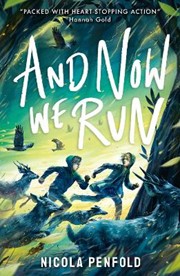
When a reservoir bursts during a school trip and their classmates are evacuated, Jelly and Lincoln are left behind. Together, they must put their fears aside if they are to find a way to safety. Read a Chapter from And Now We Run.
Review: "And Now We Run by Nicola Penfold is an action-packed page turner, driven by compelling, believable characters in their life-or-death race against time." - Sam, ReadingZone
Q&A with Nicola Penfold: Writing about climate change, floods and resilience
"I write stories set in the natural world, because, out of everything,
this is what inspires me most."
1. Can you tell us a little about yourself, how you started in writing for children and what draws you to writing about climate change?
I write stories set in the natural world, because, out of everything, this is what inspires me most. The landscape is always crucial to my story. And then climate change affects landscapes so much, and their wildlife, and all of our lives in the landscape . . . I would find it really difficult to ignore. And climate change, the turbulence this brings to the world, it's a powerful ingredient for a story.
2. You're known for climate change novels set in post-apocalyptic worlds, why did you want to bring this novel into the present day, and what happens in the story?
Yes this time I set out to write a shorter story, and one set now, without so much back story to fill in.
And Now We Run is set on a school residential in West Yorkshire. The two main characters, Jelly and Lincoln, are in Year 7. They find themselves alone when the rest of their group is evacuated from the camp, and the reservoirs in the valley start to give way.
3. Have you used a location you know for the setting in this story, about a reservoir damn collapsing due to heavy rainfall?
It's a made-up place. I find it easier not to be tied to specific locations when I write, but I used places I've visited before as inspiration. I grew up in Doncaster in South Yorkshire, and as a family we took many daytrips and holidays to surrounding countryside.
The abandoned manor house in the novel is inspired by Brodsworth Hall in Doncaster, which has beautiful greyhounds carved from stone, and pet graves, and wonderful topiary! I imagined what this place might look like if all the brilliant gardeners left!
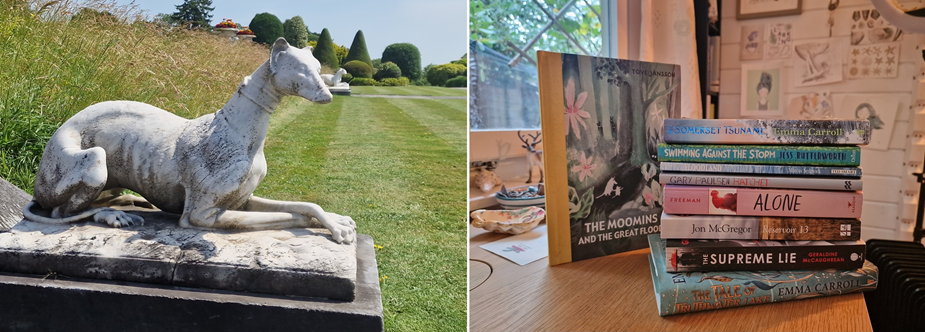
Nicola Penfold shares the inspiration behind And Now We Run - greyhounds at Brodsworth Hall and climate-challenged reading!
4. Can you tell us about the two characters at the heart of the novel, Jelly and Lincoln, and how they developed? Do you like to know your characters before you write them, or do they come to life in the writing?
Jelly's having friendship issues. Her best friend from primary has made new friends, and is leaving Jelly out, and has become really mean! Jelly's so upset and worried it's made her not want to go on the trip . . .
Lincoln's excited to be going away. He's less used to holidays than Jelly, but he knows this landscape and these hills from years ago, when he used to visit this area with his brothers . . .
I didn't want to explain too much about the characters at the outset, so the reader could find things out as they read. I always find out more about my characters as I write as well.
5. Why did you want to tell the story from each of their perspectives and in the first person? Is this how you prefer to write?
I wrote this story first in the more classic third person past tense, but it didn't feel quite right. It never truly came alive. Switching to the first person present brought me up close to my characters. I was in their head.
6. There is a lot of detailed information about how flooding affects the ground and how people in flooded areas might be endangered. How did you research this and did anything surprise you?
I read some news stories, but stayed away from more upsetting real stories. I didn't want to mine real world tragedies for my fiction. So to be honest my research was mostly reading other stories that involved flooding, and also some stories about drowned villages, which I've always found so intriguing.
For example, I read Berlie Doherty's Deep Secret and Emma Carrol's The Tale of Truthwater Lake. I also went back to the Green Knowe books I loved as a child and which feature a flooded landscape.
7. You also explore bullying in the novel, and the impact it can have on young people. Why did you want to include this and what do you hope your readers will take from your characters'experiences?
It sounds a bit clichéd, but this just came to me as I wrote Jelly's character. It felt part of her story. And friendship issues are so common growing up, and maybe especially at this age, changing from primary to secondary. Everyone's becoming the person they want to be, but sometimes this means moving away from old friends, and we don't always get that right. Sometimes kids can be cruel! And adults too of course. Sometimes we just fail to see what someone else is going through.
I suppose I'd love readers to see that these things can be difficult, awful, but we can get through them. They don't have to define us. We're all braver than we know! We all deserve to spend time with people who make us happy
8. The story is framed at the start and end by a bird, a kite, that sees the flood unfold. What gave you the idea to do this, and what do you feel it brings to the novel?
It was my editor's idea to have a third voice in the story, to speak for the landscape itself, and then my agent suggested a bird. So the red kite was born! These birds are amazing. They're so big and beautiful. They were at the brink of extinction in the UK 30 years or so ago, but you see them in so many places now. I love a positive conservation story. We need more of them! Nature thrives when we give it space.
The red kite allows us to see what's going on from above. It's the bird's eye view!
9. Which books would you suggest readers who enjoy this one might also enjoy? What are you writing about currently and do you prefer to write outside in nature, or with no distractions at a desk?
If you enjoyed this book, I recommend Swimming Against the Storm by Jess Butterworth. It's another middle grade adventure featuring water out of control because of climate change. It's set in the swamplands of Louisiana. It's an incredible landscape! Also Thirst by Darren Simpson, which is another water story, with quite a dark thread to it, but a very intriguing one! Also Crater Lake by Jennifer Killick, which is another school residential gone wrong!
10. Where in the world do you most enjoy escaping to - and what is your favourite way to travel, given the impact our journeys have on the climate?
I'm writing yet another story set in a wild landscape, but can't really say more than that. I write in a shed at the bottom of my garden, which has electricity and is where my computer is. I also love writing in coffee shops, in notebooks. Wild places inspire me, but I like to write at a desk or table!
I'm not sure I have an absolute favourite place, there are so many places I love. Some places important to me include the Lake District, the Yorkshire Dales, the North Yorkshire coast, the Peak District . . . Then further south - Dorset, Devon, Cornwall. And I love the green spaces of London where I live.
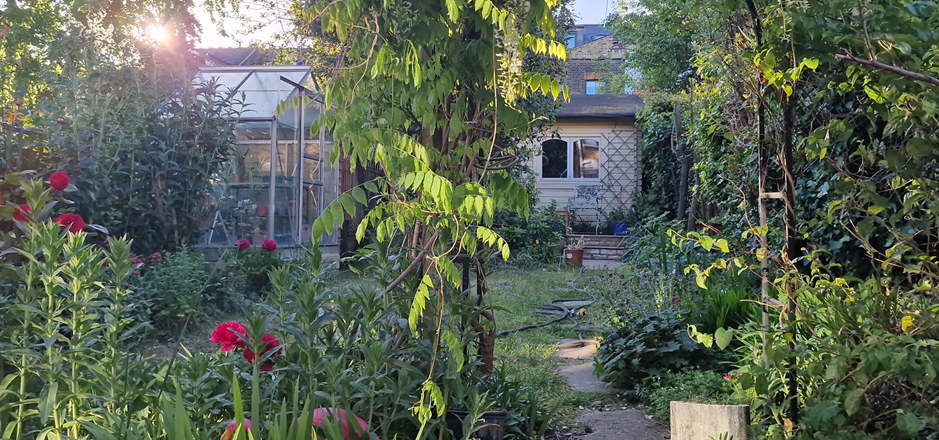
Creative challenge from Nicola Penfold
Imagine your character in a place you know well (or a made up place!). Write a short paragraph to describe what's going on in their head. What are they thinking about? What are they going to do next? How does the place make them feel.
Then something changes very suddenly. Maybe they hear the roar of water coming their way. Maybe the ground shakes due to an earthquake. Maybe a spaceship lands right next to them, or massive hailstones start falling from the sky.
It can be anything at all, but make it something your character has to respond to. What do they do? Do they run?!
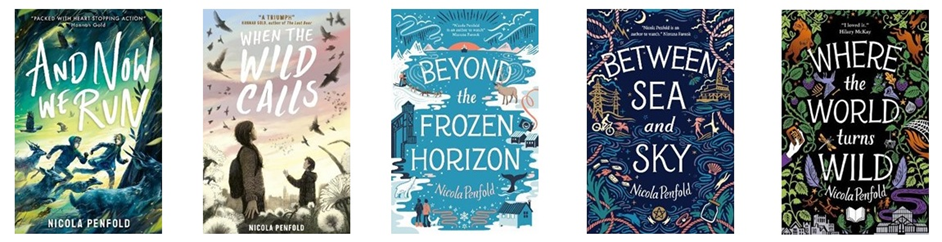
 And Now We Run
 When the Wild Calls
 Beyond the Frozen Horizon
 Between Sea and Sky
 Where The World Turns Wild