Ged Adamson introduces That Bird Can Draw!, a story about creativity, persistence and teamwork.


About Author
Author and illustrator Ged Adamson introduces his picture book That Bird Can Draw!, a story about creativity, persistence and fun.
Ged was born in Liverpool and as a child he was obsessed with drawing, listening to music and making up tunes. In 2016, his story about a short-sighted dog, Douglas You Need Glasses!, became his breakthrough picture book.
Ged has since written and illustrated many books including Shark Dog!, A Fox Found a Box and The Elephant Detectives. He lives in London with his partner and son.
Interview
June 2026
That Bird Can Draw; A story about art, creativity and being true to yourself
In That Bird Can Draw (Nosy Crow), a creative young artist is upstaged by her grandad's new pet, a bird called Vera, who turns out to be an excellent artist. The story encourages children to be true to their own talent and creativity, as well as appreciating the talents of others - and maybe even finding a way to work together with them.
ReadingZone caught up with picture book creator Ged Adamson to find out more about That Bird Can Draw, the discussions it can prompt, and creative activities it can inspire!
Review: "This is a great story to share with children and spark discussions about talents and sharing these, working as a team and as well as perseverance." More about That Bird Can Draw

Creative Challenge from Ged Adamson: Create four pieces of art to make an exhibition:
1. A portrait - it can be of yourself (a self portrait) or someone else. Do this in any way you like.
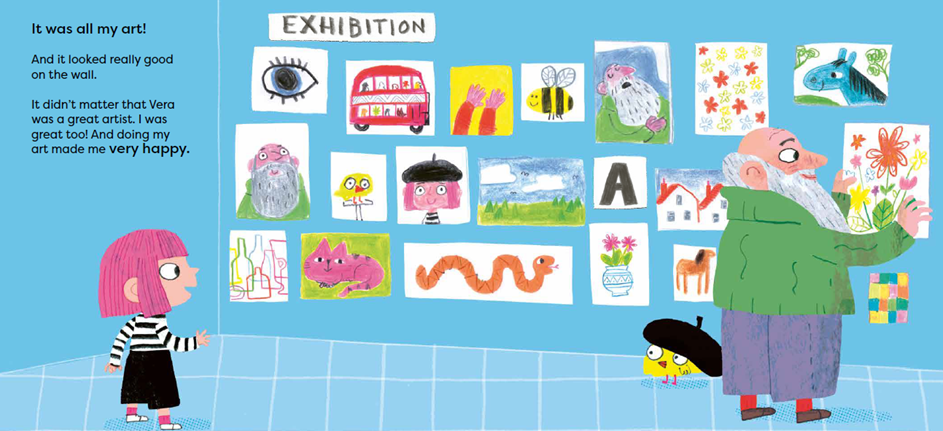
2. A piece of collage art. In That Bird Can Draw!, Vera's second artwork is picture made by cutting up pieces of coloured paper. This can be an abstract or it can be of an object, scene or person!
3. Take an everyday object - it can be anything. A can of food, a favourite toy, a spoon, a shoe - anything. Then make up a title for it. The title doesn't have to have anything to do with the object. The title can be very serious or funny. Write the title on a small square piece of paper and put it next to your object. Put on display in your exhibition!
4. Think of a feeling - joy for example - and draw or paint it using the colours you think fit the feeling best. You can be completely free (another feeling!) with this. You can be as messy and wild as you want. Put all your art pieces together and invite family and friends to your exhibition!

Q&A with Ged Adamson, introducing That Bird Can Draw
"Whilst hopefully being full of humour, the story is about being creative and learning to live alongside
all the other artists, writers, musicians etc comfortably and happily in your own space."
1. How did you start writing picture books, and what kinds of stories do you enjoy creating? What have been the highlights of your picture book career to date?
I was working as a music composer for things like adverts and trailers and short films - all kinds of stuff. But I'd always wanted to be a picture book author and illustrator. I'd done some art related work since arriving in London but it was mostly just the occasional storyboard job - and sometimes getting a cartoon in a magazine. To be honest, I was like a lot of people who say "I'm going to write a chilren's book". I didn't have a clue about the market or what the current scene was, or anything. But I had an idea and put it together into a PDF. It was about a vampire hairdresser. Through that, I was lucky enough to get a brilliant agent - Isabel Atherton at Creative Authors - who is still my agent (and lovely friend) today. I really love doing stories with humour. In fact, it's an important ingredient for me for every book. I think it's just part of being human so it feels like a natural thing to have it running through a text to varying degrees. And something I do again and again is have the narrative in the first person. It feels the most comfortable way to tell the story. And it puts the reader right inside the emotions of the speaking character.
The highlights of my career so far have been getting that initial start with Isy (it was so exciting!) and then not so long after, being offered a deal for Douglas You Need Glasses by Random House in New York. That one really kickstarted my career in children's books. Another great thing was being selected to be in the Society of Illustrators exhibition in NYC with a spread from A Fox Found A Box. Winning the best picture book with Barry Timms at Stockport Children's Book Awards for This Is Not A Unicorn was lovely too. Another big thing for me was joining Nosy Crow's list. That's been a wonderfully rewarding relationship.
2. Can you tell us about your new picture book, That Bird Can Draw, and what happens in this story? Have you drawn on your own experiences of being an artist for That Bird Can Draw?
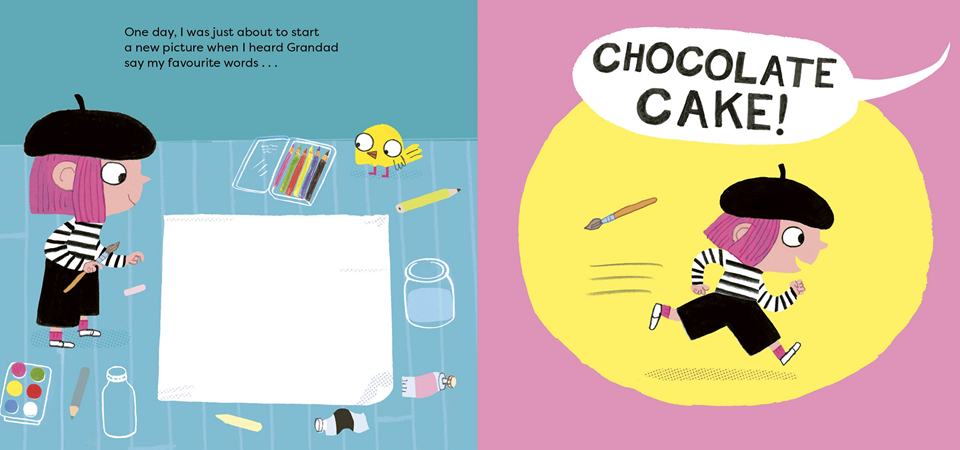
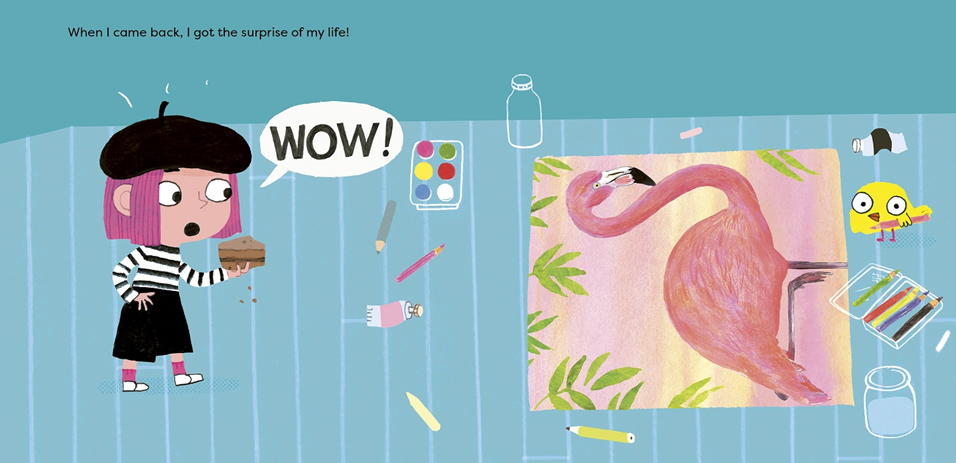
That Bird Can Draw! is about a girl who is the centre of her grandad's world. She loves drawing and painting. Grandad tells her she's a great artist. But grandad has just got a new pet bird called Vera who is revealed to have astonishing artistic talent. Suddenly grandad is full of praise for somebody else. Our narrator doesn't know how to handle this.
Whilst hopefully being full of humour, the story is about being creative and learning to live alongside all the other artists, writers, musicians etc comfortably and happily in your own space. The artist girl in the story feels threatened by the remarkable creative talent of her grandad's new pet bird. She has to work through some complicated emotions to do with confidence and self examination. She's suddenly having to share grandad's admiration with a small, inscrutable creature.
I don't have a directly relatable experience to the narrator but I do remember being at school and finding out there was another boy who was good at drawing and thinking "oh this is a new thing!" We're still friends to this day. So many of my fellow illustrators get incredibly discouraged by constantly seeing great art on social media. The story touches on that. I don't really suffer from this personally because I don't think my illustrations are technically that good! I think I kind of have my own style but I'm no Vera. I'm kind of accepting of my abilities.
I do have the memory of the utter pleasure of having a blank piece of paper and some felt tips in front of me. And then being completely absorbed by drawing and doodling. The image of the girl with the big sheet of paper looking very happy is absolutely from my own childhood experience.
3. What was your initial idea for the story and how did it change as you wrote and illustrated it? Why did you decide to write it from the girl's perspective?
The original idea for the story was pretty much how it ended up in its final published state but there were quite a few changes in the route to the end point of the collaboration between the girl and Vera. As I've said, I think first person narratives are the most effective. I wanted the reader to be part of the girl's developing jealousy, anxiety, sadness and finally acceptance of the bird's talent and her own important place in the creative world. I wanted the feeling of a child telling you something that's happened in their words and how they would articulate this emotional journey they've just gone through.
4. That Bird Can Draw is a lovely story about art and friendship, but what would you like your young readers to take from your picture book, and what kinds of discussions could it raise?
I would like young readers to see themselves in the character of the girl. They don't have to be interested in art and drawing. That Bird Can Draw is about knowing who you are and being confident in the space you occupy in the world. Sometimes things come along and challenge us - other people being 'better' than us at something, or a new child in the family, or someone new in a friendship group who is more outgoing/charming than us. We all face these situations at various points and we need to think about how we would deal with this ourselves.
I'm involved in campaigning about Tech companies' theft of vast swathes of all kinds of creative work. I'd like 'That Bird Can Draw!' to remind kids that art and creativity do not come from AI. In fact, AI is the opposite of that process. When I do events, I get the children in the audience to invent a new story. The way in which we come up with characters, their names and a storyline hopefully shows how fun it is to get your own brain to invent this stuff, rather than hand all that over to automation - which will anyway just rummage through other people's stolen art to generate 'ideas'.
5. The picture book also explores how children share their artwork and grow in confidence in their creativity. What kinds of activities would you suggest to follow-up from a reading of That Bird Can Draw?
A visit to an art gallery would be a nice follow up to reading this one. Especially a gallery that displays all different genres of art. It would be a good way of showing kids that creativity comes in many different forms and that there are many ways of expressing ourselves. There is a part of the story where Vera makes a Mona Lisa style artwork out of lots of small, separate pieces of paper. I think this would be a fun thing to do with a group of children. They could choose an image and each child would complete their part of it. The effect of the finished piece made up of all these different bits would be an exciting thing to see!
6. How did the characters of the girl and Vera, the Bird, start out, and how did you finalise what they would look like?
The look of the character of the girl was very similar to how she ended up in the final art. But I didn't have the pink hair at the start and the stripes on her top weren't there. Vera initially had long feathers hiding her beak. I'm glad I changed that as I think it might have caused too much distraction. Their personalities always remained the same. I think how they are as characters and how they respond - I mean, Vera is very passive for most of the book - was built in to the original story idea.
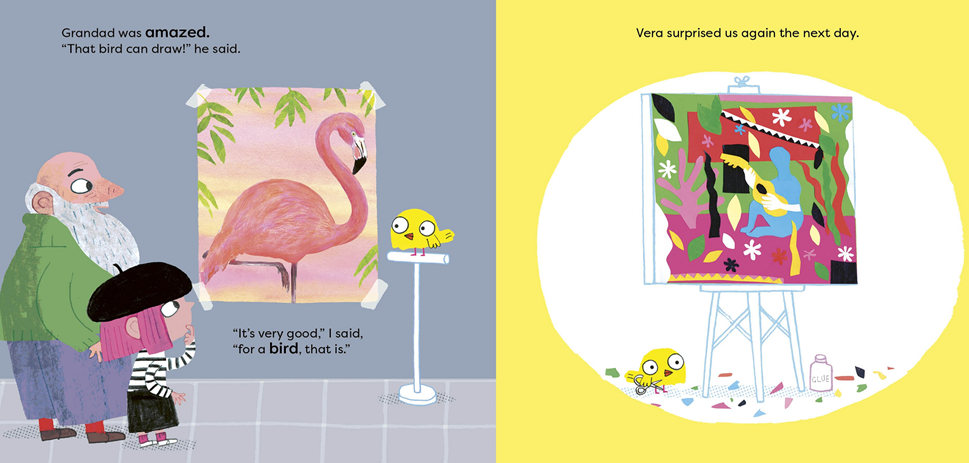
7. How do you create your illustrations? Do you have a favourite spread or moment in this book?
I create my illustrations by drawing with pencil and watercolour (sometimes other things like pastels). Then I scan these drawings into the computer and put them into Photoshop. I can then tidy up things and arrange the composition of each spread. I have piles and piles of paper with all kinds of artwork and separate components - like shadows and blocks of colour. I keep these in a special folder for each book project.
8. For children and families who enjoy That Bird Can Draw, which of your other picture books might they also enjoy?
All of them! No, I think maybe The Elephant Detectives and Be Normal! - both with Nosy Crow. They both have a similar kind of humour to my new one. I did a book called A Fox Found A Box and it went completely under the radar and sold about ten copies, but it's definitely a favourite of mine. I think a good story but not so great art is a book called Ava And The Rainbow (Who Stayed). I wish I could do this one again with new art! I wonder how many other author/illustrators have this feeling about some of their books?
9. Are you planning more picture books with their characters? What are you working on currently?
There are no current plans for a follow up featuring the girl, Vera and Grandad but I'd love to do that! At the moment I'm working on a new picture book that's a mixture of non fiction and a fiction story narrative. I'm really excited about it as I've not done a book like this before. It comes out next year in the spring.
I'm also illustrating picture books by other authors. I'm really enjoying doing the art for a fun series by the very talented Smriti Halls. I absolutely love doing picture books but I'd very much like to do a project that's aimed at older children. I've been talking to people about the possibility of this happening. But it's down to me to come up with an exciting idea!
10. What kinds of things do you enjoy doing in your downtime?
Before I became a children's author, I worked in music. I composed tunes for adverts and other kinds of things for TV and film. So music has always been a passion of mine. There is nothing better for me to clear my head of negative thoughts and anxiety than sitting playing my piano or playing my guitar, making up stuff. I'm not an accomplished player on either but it gives me so much pleasure. I've been working with a talented musician/singer called Lucia Aranguren and having a lot of fun doing that.
I also go mudlarking which, in my case (and everyone who does it around London), involves going to the Thames foreshore and looking for old, interesting things. The Thames is tidal so it moves stuff around every day and dislodges objects onto the shore. I've found all kinds of things. The oldest one is a part of a medieval shoe. I don't go enough though - something I mean to change!

Organising a School Visit by Ged Adamson:
I do offer school visits. I can be reached at [email protected] or my through my website gedadamson.com or if it's a specific book - particularly my latest one - contact the publishers (in this case Nosy Crow) or I can be contacted through my agent Isabel Atherton (find her at creativeauthors.co.uk)

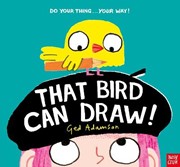 That Bird Can Draw!
 Be Normal!
 The Bear, the Book and the Blanket
 The Elephant Detectives
 This is NOT a Dinosaur!
 This is NOT a Unicorn!